Psychology · Book club
Predictably Irrational book club questions
Here are 12 book club questions for Predictably Irrational by Dan Ariely, ordered to open easily and end somewhere worth arguing about. Copy them, print them, or bring them up one at a time.
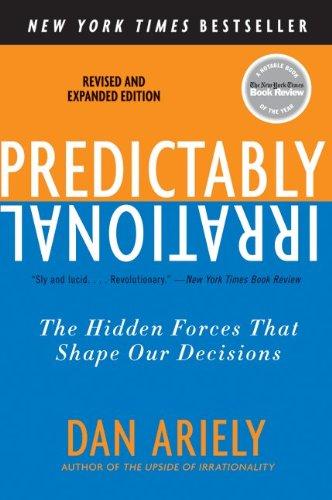
Predictably Irrational is Dan Ariely's examination of how humans make decisions that are consistently, systematically irrational — not random or arbitrary, but irrational in ways that follow patterns.
Dan Ariely · 2008 · 5h 15m
Full summary and key takeaways →The 12 questions
- 1.
Ariely argues irrationality is predictable. In the last month, can you identify a purchase decision where an anchor — a first price you saw — shaped what you eventually paid?
- 2.
The decoy effect is everywhere in pricing. Where have you noticed a tier or option that seemed to exist only to make another choice look like a deal?
- 3.
The zero price effect makes free feel different from cheap. Think of something free you took in the last year that you didn't actually want. Would you have taken it at a penny?
- 4.
Ariely distinguishes social norms from market norms. Has a situation ever shifted between these two registers in your life — and how did it feel when it did?
- 5.
The endowment effect says you overvalue what you own. What's something you're holding onto — a job title, a possession, a position in a debate — partly because it's already yours?
- 6.
Expectations shape experience. Think of something you consumed or experienced while believing it was higher quality than it was. Did the belief change your experience?
- 7.
Ariely's chapter on self-control suggests people benefit from imposed deadlines more than self-set ones. Where in your work or personal life are you operating without a deadline you probably need?
- 8.
The book argues that dishonesty is also predictable — that most people cheat a little when they can rationalize it, rather than a lot. Does that match what you observe in institutions or in yourself?
- 9.
Ariely describes how arousal (in any form — anger, hunger, excitement) shrinks the gap between our stated values and our actual behavior. When have you made a decision in a hot state that your cooler self wouldn't have?
- 10.
Which irrational pattern from the book do you think is most exploited by companies you use regularly? And have you changed behavior as a result of recognizing it?
- 11.
The experiments in this book were mostly run on college students. Do you think the findings apply equally across age groups, cultures, and income levels? What might differ?
- 12.
Ariely ends with the argument that understanding irrationality gives us power to redesign our environment. What's one decision context in your life you could restructure to make the better choice easier?
How to run the discussion
- Pick six to eight, not all of them. An hour of real discussion covers fewer questions than anyone expects, and racing the list is what makes a book club feel like homework.
- Open with what people noticed, not what they concluded. Asking for a verdict first hardens opinions before anyone has heard each other.
- Let the disagreement run. The questions below that split a room are the ones worth the time; the ones everyone answers the same way can be skipped.
- Ask the quiet person a specific question. A direct, narrow question is far easier to answer than an open invitation to contribute.
Themes worth steering toward
If the conversation stalls, these are the threads that usually restart it.
Common questions
What are good book club questions for Predictably Irrational?
Here are 12 book club questions for Predictably Irrational by Dan Ariely, ordered to open easily and end somewhere worth arguing about. The strongest openers ask what each reader noticed rather than what they concluded, and the discussion usually turns on decision-making, behavioral economics, cognitive bias.
How long should a book club discussion of Predictably Irrational last?
Most groups run 60 to 90 minutes of actual discussion. That is roughly six to eight questions, not all of them, so pick the ones that suit your group rather than working down the list in order.
What are the main themes in Predictably Irrational?
Decision-making, Behavioral economics, Cognitive bias, Irrationality, Consumer behavior. Those are the threads most likely to divide a room, which makes them the useful places to steer a discussion that has gone quiet.
Picking the next one? See books like Predictably Irrational or questions for other book club picks.
