Predictable Revenue by Aaron Ross and Marylou Tyler is a 2011 business book about sales, b2b, startups. Mixing prospecting, closing, and account management in a single sales role degrades all three. Specializing roles creates predictability and allows each function to optimize independently.
Summary
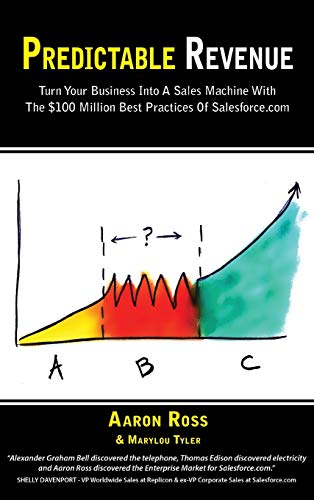
Predictable Revenue is Aaron Ross's account of the outbound sales system he built at Salesforce that generated over $100 million in recurring revenue. Ross worked at Salesforce in the early 2000s and was tasked with finding a way to systematically generate new business without relying on existing customer expansion or expensive enterprise salespeople going door to door. The system he developed — cold emailing a specific kind of decision-maker with a low-pressure, referral-seeking approach — became the template for outbound B2B sales at technology companies worldwide.
The core insight is the separation of roles. Most B2B companies have account executives who are responsible for generating their own leads, managing existing customers, and closing new business simultaneously. Ross argues this is a structural mistake: prospecting is a distinct skill from closing, and mixing them degrades both. The solution is specialized roles — Sales Development Representatives who focus exclusively on generating qualified leads through outbound prospecting, Account Executives who take those leads and focus exclusively on closing, and Customer Success roles focused exclusively on retention and expansion. Each role has different skills, metrics, and management needs.
The second key system is the "Cold Calling 2.0" approach: instead of cold calling busy decision-makers directly, send short, targeted emails asking who the right person to talk to is. This referral-seeking approach has a higher response rate than direct pitching and starts the relationship with a warmer handoff. The email cadence, the ideal customer profile, and the qualification criteria for passing leads from SDRs to AEs are all described in detail.
Predictable Revenue holds up well as a description of a model that genuinely worked, but the cold email tactics it describes have become so widely adopted since 2011 that inboxes are now saturated and the response rates Ross achieved are harder to replicate. The structural insight — specialized sales roles, clear pipeline stages, metric-driven management — remains valuable. The specific execution has dated.
Talk to Predictable Revenue like its author wrote you back.
Get the ideas that fit your life — not generic summaries.
- Chat with the book
- Audiobook-style main ideas
- Adapts to your life and goals
- Helps you take action
Key takeaways
- 1.
Mixing prospecting, closing, and account management in a single sales role degrades all three. Specializing roles creates predictability and allows each function to optimize independently.
- 2.
Sales Development Representatives should focus exclusively on outbound prospecting and qualifying leads to pass to Account Executives. This frees AEs to focus on closing.
- 3.
The Cold Calling 2.0 approach: short emails asking for a referral to the right person, rather than direct pitches to decision-makers, generate more responses and warmer introductions.
- 4.
Ideal customer profiles are the foundation of efficient outbound prospecting. Without a precise definition of who you're targeting, prospecting is random and results are unpredictable.
- 5.
Pipeline stages must be consistently defined and tracked. Without standard criteria for each stage, revenue forecasts are unreliable and coaching is difficult.
- 6.
SDR metrics should focus on leading indicators — number of qualified opportunities passed to AEs — not lagging indicators like revenue. AE metrics should focus on conversion rates and deal size.
- 7.
Inbound marketing and outbound prospecting serve different parts of the pipeline. Inbound fills it with warm leads; outbound fills it with targeted prospects you've selected. Neither replaces the other.
- 8.
Making revenue predictable requires identifying which activities actually generate pipeline, measuring them consistently, and investing in those specifically — not guessing based on effort or intent.
Discussion questions
Use these on your own, with a book club, or as chat starters in Superbook. Book club version, ready to copy or print →
- 1.
Ross argues that mixing prospecting and closing in one role degrades both. Have you seen this play out? What happens when a good closer is forced to spend time prospecting?
- 2.
What makes an ideal customer profile precise enough to be useful for outbound prospecting? What information do you need, and how do you get it?
- 3.
The Cold Calling 2.0 approach relies on short, referral-seeking emails. Has inbox saturation since 2011 made this approach less effective, and what would you change today?
- 4.
What's the right ratio of SDRs to AEs in a B2B sales organization? What factors should determine it?
- 5.
Ross builds the entire system around consistent pipeline stage definitions. What happens in practice when different salespeople define a stage differently?
- 6.
Predictable Revenue describes a model built at Salesforce. How does the model change for a company selling a lower-priced product, a shorter sales cycle, or a smaller total addressable market?
- 7.
What are the organizational signs that a sales team has become a feature factory — shipping activity rather than generating qualified pipeline?
- 8.
How do you balance the SDR model, which prioritizes top-of-funnel efficiency, with the relationship-heavy enterprise selling that still wins some categories of deal?
- 9.
The book focuses heavily on outbound. When is inbound-led growth a better model than outbound-led growth, and how do you decide?
- 10.
Ross says revenue predictability requires measuring leading indicators. What are the leading indicators in a B2B sales process you know well?
- 11.
How has the rise of sales engagement platforms — Outreach, Salesloft, Apollo — changed the implementation of the Predictable Revenue model since the book was written?
Themes
Frequently asked questions
-
Is Predictable Revenue still relevant?
The structural model — specialized roles, consistent pipeline stages, metric-driven management — remains highly relevant. The specific cold email tactics are more dated because the market has adapted since 2011 and response rates have declined. Use the model, update the tactics.
-
What is an SDR?
A Sales Development Representative — a role focused exclusively on generating qualified leads through outbound prospecting and passing them to Account Executives. The SDR model, popularized by this book, has become standard in B2B SaaS organizations.
-
What is Cold Calling 2.0?
A prospecting approach built on short, targeted emails that ask for a referral to the right person rather than pitching directly. Ross found it generated higher response rates than traditional cold calls or direct pitch emails, and started relationships with a warmer internal referral.
-
Does Predictable Revenue apply to small companies?
The specialized roles model requires enough pipeline volume to justify dedicated prospectors. Very early-stage companies or those with short, transactional sales cycles may not benefit from separating SDRs and AEs. As companies grow into a higher-velocity B2B model, the specialization becomes more valuable.
-
What should I read alongside Predictable Revenue?
The Challenger Sale for qualification methodology, Fanatical Prospecting for outbound activity discipline, and The Sales Acceleration Formula for a more data-driven, modern take on building a scalable sales team.