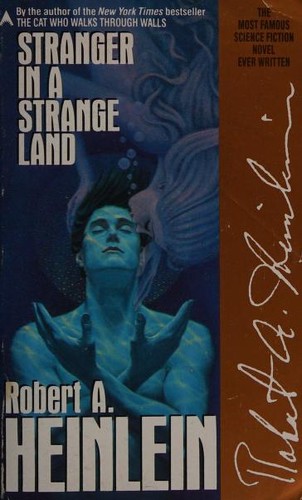
Stranger in a Strange Land by Robert A. Heinlein is a 1961 science fiction book about alienation and culture shock, religion and belief, free love and social norms. Grok — to understand so thoroughly that the observer becomes part of the observed — entered the English language from this novel and remains one of science fiction's most useful coinages.
Summary
Valentine Michael Smith is the first human born on Mars and raised by Martians. When he is brought back to Earth as an adult, he arrives with Martian mental abilities — including telekinesis and total memory — and absolutely no framework for understanding what human beings are doing or why. The novel follows his education by a skeptical nurse named Jill and a worldly old journalist named Jubal Harshaw, and his eventual attempt to found a religion that could teach humans to "grok" — to understand completely, to become one with what one perceives.
The novel is partly social satire, partly countercultural manifesto, partly philosophical exploration of what religion does and whether a better one is possible. Heinlein is using Mike's alien innocence the way Voltaire used Candide — as a lens to make American culture visible by describing it from outside. The sexual politics, the critique of monogamy and possessiveness, and the communal "water-brotherhood" Mike establishes read as a direct anticipation of 1960s counterculture, despite being published in 1961.
This is a long, discursive novel — the original manuscript was even longer, and a restored version released in 1991 is about 60,000 words longer than the original. Large sections are occupied by Jubal Harshaw's extended monologues about religion, politics, and human nature. Heinlein is an essayist in a novelist's clothing, and he is not shy about it. The narrative energy comes in waves rather than as sustained propulsion.
Stranger in a Strange Land is historically important and intellectually stimulating but genuinely uneven. It helped establish a template for countercultural science fiction and introduced "grok" into the English language. Readers who enjoy idea-dense fiction and are willing to accept a lumpy narrative structure will find it rewarding. Readers who want tightly plotted novels, or who bristle at dated gender dynamics — women in the novel are drawn with much less complexity than the men — will find it a more ambivalent experience.
Talk to Stranger in a Strange Land like its author wrote you back.
Get the ideas that fit your life — not generic summaries.
- Chat with the book
- Audiobook-style main ideas
- Adapts to your life and goals
- Helps you take action
Key takeaways
- 1.
Grok — to understand so thoroughly that the observer becomes part of the observed — entered the English language from this novel and remains one of science fiction's most useful coinages.
- 2.
Heinlein uses the Martian-raised human as a device to estrange familiar social institutions: marriage, religion, property, government are all rendered strange by someone encountering them fresh.
- 3.
The novel anticipates the counterculture by arguing that possessiveness, jealousy, and the instinct to control others' sexuality are learned rather than innate.
- 4.
Jubal Harshaw functions as Heinlein's mouthpiece — a cynical libertarian who turns out to have strong views on almost everything and is rarely wrong within the novel's frame.
- 5.
Mike's Church of All Worlds is a sincere exploration of whether a religion built around mutual understanding and without exclusion or condemnation could survive contact with existing human power structures.
- 6.
The novel's answer to that question is dark: genuine radical openness is socially intolerable, and the person who embodies it will be destroyed by those he refuses to judge.
- 7.
Heinlein's libertarianism is fully visible: the novel's ideal is a community of consenting adults who have agreed to be maximally honest with each other and maximally non-coercive to the outside world.
- 8.
The ending, which involves Mike's martyrdom and a kind of spiritual continuation, is the most seriously intended section of the book — whether you find it moving or overwrought depends a lot on your tolerance for Heinlein's earnestness.
Discussion questions
Use these on your own, with a book club, or as chat starters in Superbook. Book club version, ready to copy or print →
- 1.
Grok is one of science fiction's most influential concepts. Do you think it describes something real — a depth of understanding that is qualitatively different from ordinary comprehension?
- 2.
Heinlein gives Jubal Harshaw most of the novel's best arguments. Is Jubal a character, or a device? Does the distinction matter?
- 3.
The women in the novel are largely defined by their relationships to Mike or Jubal. Does that limit what the novel can say about human society, or is it just a product of when it was written?
- 4.
Mike founds a religion. Does Heinlein take religion seriously, mock it, or both — and does the novel land where he intended?
- 5.
The novel was published before the counterculture it seems to anticipate. Does that make it visionary, or did the counterculture simply find in it a convenient articulation of ideas already forming?
- 6.
Mike is destroyed by his own openness to humanity. Is Heinlein arguing that genuine radical acceptance is always fatal, or that the failure was contingent and fixable?
- 7.
Jubal's libertarianism — everyone's business is their own, no one may coerce anyone else — sounds appealing in the abstract. Where does it fail in practice, and does the novel acknowledge those failures?
- 8.
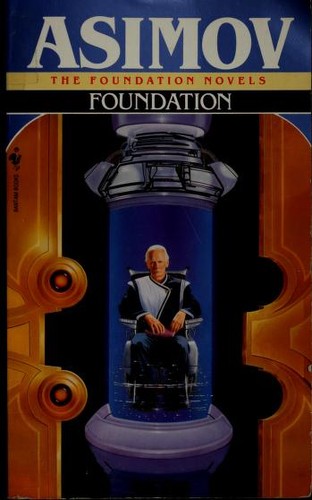
Compared to Foundation's top-down approach to improving humanity — psychohistory, managed decline — Heinlein's approach here is bottom-up and voluntarist. Which is more convincing as a model of change?
- 9.
The 1991 uncut version is 60,000 words longer. If you read the uncut version, did the additions improve it? If you read the original, does it feel padded or tight?
- 10.
Mike is essentially a Christ figure. Is that reading intended by Heinlein, and does it enrich or limit the novel?
- 11.
The novel argues that jealousy is learned and can be unlearned. Do you find that argument convincing?
- 12.
What would Stranger in a Strange Land look like if written today? What would have to change for it to say the same things?
Themes
Frequently asked questions
-
Is Stranger in a Strange Land still worth reading?
Yes, with expectations calibrated. It's an important novel historically and intellectually stimulating, but the gender dynamics are dated and the pacing is loose. Read it as a cultural artifact and a serious attempt to think through religion and community, not as a tightly plotted novel.
-
What does 'grok' mean?
In the novel, a Martian word meaning to understand completely — not just intellectually but in a way that makes the knower and the known one thing. Heinlein intended it to describe a quality of understanding that is richer than ordinary comprehension. It passed into tech culture and everyday use.
-
Which version should I read — the original or the uncut 1991 edition?
Most readers recommend the original (about 160,000 words) as the better-edited book. The 1991 uncut version restores material Heinlein's editors cut, including more explicit content, but many readers find it slower.
-
Is this book appropriate for younger readers?
It contains significant sexual content and provocative ideas about religion and social norms. It is generally regarded as adult fiction. The restored 1991 edition is more explicit than the original.
-
Who shouldn't read this book?
Readers who need tight narrative structure and consistent pacing, or who find extended monologue-as-philosophy tedious. Also readers who cannot bracket dated portrayals of women — the women here are largely defined by their relationships to Mike and Jubal rather than having independent inner lives.