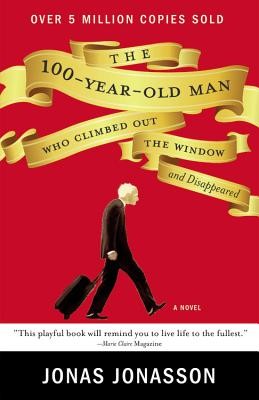
The 100-Year-Old Man Who Climbed Out the Window and Disappeared by Jonas Jonasson is a 2009 contemporary fiction book about longevity and resilience, historical coincidence, accidental adventure. Jonasson's central comic insight is that great historical events often hinge on chance — an explosives expert in the right place at the wrong time, repeatedly, across a century.
Summary
Allan Karlsson turns one hundred years old in a Swedish nursing home, and rather than sit through his birthday party, he climbs out the window in his slippers and walks away. Within hours he has accidentally stolen a suitcase full of cash, befriended a string of oddball companions, and set off a nationwide manhunt. The novel runs two parallel tracks: Allan's present-day picaresque adventure and flashback chapters tracing his impossibly eventful life across the twentieth century — from blowing up his family's outhouse in 1905 to rubbing shoulders with Stalin, Truman, Franco, Kim Il-Sung, and any number of other world leaders who happened to need an explosives expert at the right moment.
The book is essentially a comic meditation on fate and indifference. Allan's governing philosophy is that things are what they are, and worrying about them doesn't help. This serenity gets him through firing squads, gulags, and cold wars with equal equanimity. The historical coincidences pile up to the point of absurdity, which is the point — Jonasson is running a long joke about how the world's great events often hinge on chance encounters with unassuming people who simply stumbled into the frame.
The tone owes something to Forrest Gump and a great deal to Swedish dry humor: deadpan, unflappable, mildly surreal. Jonasson's prose (translated from Swedish) keeps a light touch even when the events are genuinely dark — gulags, war, political murder. The structure alternates between present-day farce and historical romp, which keeps the pace brisk even as the book clocks in at nearly four hundred pages. There is no deep psychological interiority here. Characters are types rather than people, and that's the design: this is fable dressed as novel.
Readers who like their fiction with plot momentum, broad comedy, and a protagonist who is constitutionally incapable of stress will find this delightful. Readers looking for emotional complexity or narrative realism will be frustrated by the same qualities. The book became a massive international bestseller — it spent years on Swedish bestseller lists and sold millions globally — because it offers something genuinely rare: a light, funny, long novel that moves. If you're in the right mood, that's a pleasure in itself.
Talk to The 100-Year-Old Man Who Climbed Out the Window and Disappeared like its author wrote you back.
Get the ideas that fit your life — not generic summaries.
- Chat with the book
- Audiobook-style main ideas
- Adapts to your life and goals
- Helps you take action
Key takeaways
- 1.
Jonasson's central comic insight is that great historical events often hinge on chance — an explosives expert in the right place at the wrong time, repeatedly, across a century.
- 2.
Allan's philosophy of radical acceptance — things are what they are, and worrying doesn't help — functions as both character joke and genuine worldview. The novel treats it with surprising affection.
- 3.
The parallel structure (present-day farce / historical flashback) lets Jonasson keep momentum in both timelines by cutting away whenever one threatens to drag.
- 4.
The book is fundamentally uninterested in psychological realism. Characters exist to move the plot and deliver the joke. That's a choice, not an oversight.
- 5.
Every world leader Allan meets turns out to be petty, vain, or absurd when encountered up close — the novel has a gentle democratizing impulse under all the farce.
- 6.
The ending is deliberately implausible and deeply satisfying. Jonasson earns it by signaling early that verisimilitude is not on offer.
- 7.
The book captures something true about elderly protagonists: the genuine freedom that comes from having very little left to lose and no interest in pretending otherwise.
- 8.
As a Scandinavian export, it belongs to a tradition of deadpan northern humor that treats catastrophe as mildly inconvenient — the opposite of American melodrama.
Discussion questions
Use these on your own, with a book club, or as chat starters in Superbook. Book club version, ready to copy or print →
- 1.
Allan's philosophy is that things are what they are and worrying doesn't help. Do you find this liberating, irresponsible, or both? Does the novel endorse it or just enjoy it?
- 2.
The coincidences pile up to the point of open absurdity — Allan shaping the Manhattan Project, the Cold War, etc. At what point does the joke become a structural flaw for you, if ever?
- 3.
Compare Allan to Forrest Gump. Both are accidental witnesses to history. What's different about what each novel is trying to say with that device?
- 4.
The flashback chapters often involve real historical atrocities (the Spanish Civil War, Soviet gulags) played for light comedy. Did that bother you? Where do you draw the line on historical darkness as farce?
- 5.
The present-day characters — Julius, Benny, the Beauty, the elephant — are broad types. Does the book work better or worse because of that? What would it lose from more psychological depth?
- 6.
Allan shows no interest in legacy, relationships, or meaning-making. Is he a hero, a nihilist, or just a very old man who is tired? What does the novel seem to think?
- 7.
The book was a massive bestseller across Europe and North America. What does that appetite for light, long, comic historical fiction tell us about readers?
- 8.
The women in the novel — including the Beauty — tend to be peripheral or ornamental. Did you notice it while reading, and did it matter to your enjoyment?
- 9.
Jonasson keeps the prose and interior life almost entirely flat. Does that work as a tonal choice, or does it leave the novel feeling hollow by the end?
- 10.
Which world leader's cameo did you find funniest or most pointed? What made it land?
- 11.
By the end, Allan has outlived essentially everyone he knew. The novel treats this lightly. Is that the right choice? What would a more serious version of this story look like?
- 12.
The book ends with Allan disappearing again. Is that a satisfying ending, an evasion, or both?
Themes
Frequently asked questions
-
Is The 100-Year-Old Man a good book club pick?
Yes, for the right group. It generates good conversation about tone, historical comedy, and what we want from fiction when we're in the mood for something light. It's not a book that rewards close reading so much as one that rewards a good mood and a willingness to go along for the ride.
-
How long does it take to read?
It's a long book — around 400 pages — but reads quickly because the prose is breezy and the chapters are short. Most readers finish it in four to six hours of reading time spread across a few days.
-
Is this book funny, or does it just think it is?
For most readers, genuinely funny — the deadpan Swedish tone and the escalating historical absurdities land well. A minority finds the joke exhausting by the midpoint. Your tolerance for one-note comic premises will determine which camp you're in.
-
Do I need to know twentieth-century history to follow the jokes?
A rough awareness of Stalin, Truman, and the Cold War helps, but the novel doesn't require deep knowledge. The historical figures are drawn broadly enough that context clues fill in any gaps.
-
Who shouldn't read this book?
Readers who need emotional depth and character interiority. Allan has essentially no inner life, and the novel offers no apology for that. If flat characters frustrate you, this will be a long four hundred pages.