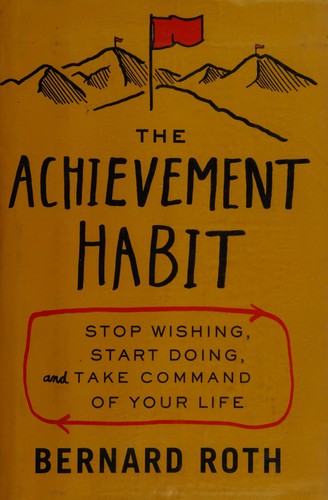
The Achievement Habit by Bernard Roth is a 2015 self-help book about achievement, design thinking, behavior change. Achievement is a habit built through practice, not a talent you either have or don't. The mental patterns that block achievement are identifiable and changeable.
Summary
The Achievement Habit is Bernard Roth's attempt to bring the principles of Stanford's d.school — the design school he co-founded — into the domain of personal effectiveness. Roth is a mechanical engineer and design educator who has spent decades watching students transform their approach to problems, and the book draws on that experience. The central claim is that achievement is a habit, not a talent, and that the habits of thought that block people are learnable and changeable.
The book's core intellectual move is to apply design thinking to the self. In design thinking, you don't begin with a solution; you begin with a thorough understanding of the actual problem. Roth argues that most people are solving the wrong problems — the problems they can articulate, not the underlying ones that are actually driving their behavior. His method for getting at the real problem is to ask "why" repeatedly until you hit something emotionally true rather than something socially acceptable. The gap between your stated reason for not doing something and your actual reason is where the work is.
Roth is particularly focused on two habits of thought that he finds pervasive: the habit of using "can't" when you mean "won't," and the habit of reasons. Saying "I can't do X" when you actually mean "I've decided not to do X given my other priorities" is a form of self-deception that removes agency. Similarly, reasons — explanations for why things went wrong or why you haven't done something — are frequently just stories that protect identity rather than actually useful information. Roth's prescription is blunt: drop the reasons, own the choices.
The book is conversational and draws on classroom exercises from the d.school, some of which are included for readers to try. It's shorter than most books in the genre and more philosophically direct. Roth doesn't soften his message: most people are the main obstacle to their own effectiveness, and the path through is self-examination rather than technique. The Stanford setting and Roth's credibility as a founder lend the book weight it might not otherwise carry, and the d.school exercises make abstract ideas concrete.
Talk to The Achievement Habit like its author wrote you back.
Get the ideas that fit your life — not generic summaries.
- Chat with the book
- Audiobook-style main ideas
- Adapts to your life and goals
- Helps you take action
Key takeaways
- 1.
Achievement is a habit built through practice, not a talent you either have or don't. The mental patterns that block achievement are identifiable and changeable.
- 2.
Most people are solving the wrong problems. Design thinking asks you to investigate the actual problem before generating solutions — the same applies to personal obstacles.
- 3.
Asking 'why' repeatedly until you hit something emotionally true, rather than socially acceptable, is the fastest path to your real problem rather than your stated one.
- 4.
Replace 'I can't' with 'I won't.' The substitution forces a recognition that most limitations are choices, and choices can be revisited while fixed limitations cannot.
- 5.
Reasons are usually stories told to protect identity, not useful information. Dropping reasons and owning outcomes directly is uncomfortable but more honest and more effective.
- 6.
Behavior change requires working on the underlying motivation, not just the behavior. If you understand why you do what you do, changing it becomes a design problem rather than a willpower problem.
- 7.
Reframing problems changes what solutions are possible. A constraint-based reframe often opens up options that a straightforward problem statement closes off.
Discussion questions
Use these on your own, with a book club, or as chat starters in Superbook. Book club version, ready to copy or print →
- 1.
Roth argues that most people are solving the wrong problem. Think of something you've been stuck on for a long time. What's the stated problem — and what might the actual one be?
- 2.
He distinguishes 'can't' from 'won't.' Pick something you regularly say you can't do. Is it actually a won't? What's the honest version of the sentence?
- 3.
Roth is skeptical of reasons — he sees them as largely self-serving stories. When have you offered a reason for something that, on reflection, was more about protecting your image than explaining what happened?
- 4.
The d.school asks students to investigate the actual problem thoroughly before generating solutions. Where in your own life are you jumping to solutions before you've fully diagnosed what's wrong?
- 5.
Achievement is described as a habit. Which of your daily habits actively contribute to your long-term goals, and which ones are neutral or quietly working against them?
- 6.
Roth's classroom exercises push students into discomfort as a design tool. When was the last time you deliberately put yourself in an uncomfortable situation to learn something? What happened?
- 7.
He applies design thinking to personal effectiveness. What other domains from your professional life might improve if you applied a design-thinking lens to them at home?
- 8.
The book argues that self-awareness is the primary tool. What aspect of your own behavior do you understand least, and what would it take to understand it better?
- 9.
Roth says people often don't commit because they're afraid of the cost of full commitment. What is something you're half-committed to right now, and what's the honest reason you're not fully in?
- 10.
The book has a philosophical directness that some readers find bracing and others find preachy. Where did you feel challenged, and where did you push back?
- 11.
If you applied the 'keep asking why' technique to one area of your life where you feel stuck, what do you think you'd eventually uncover at the bottom of the chain?
Themes
Frequently asked questions
-
Is The Achievement Habit worth reading?
Worth reading if you find most productivity books too tactical. Roth's focus on the mental patterns behind achievement rather than the techniques is more interesting than most, and his background as a Stanford design educator gives the ideas a different flavor. The book is short enough that the time investment is low.
-
How long does it take to read The Achievement Habit?
About three to four hours for the roughly 240-page book. Roth writes conversationally and the d.school exercises break up the flow in a useful way.
-
What is design thinking, and how does Roth apply it to personal development?
Design thinking is a problem-solving process that starts with deep investigation of the actual problem rather than jumping to solutions. Roth applies it by asking readers to examine whether they're solving the right problem in their own lives, then use reframing and iteration — standard design tools — on personal obstacles.
-
Who should read The Achievement Habit?
People who have read widely on productivity and effectiveness and want something more philosophically oriented. Also useful for educators and managers who work with people on self-development, since the d.school exercises are designed for facilitating insight in groups.
-
What is the main difference between The Achievement Habit and other productivity books?
Most productivity books give you systems and techniques. Roth focuses on the mental habits that determine whether any technique works. He's more interested in why people block themselves than in what tools they use.