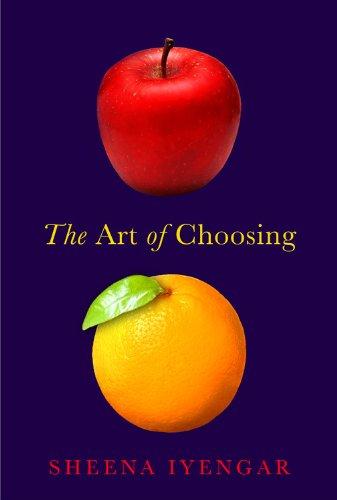
The Art of Choosing by Sheena Iyengar is a 2010 psychology book about choice, decision-making, autonomy. More options do not reliably improve decisions. The jam study showed that larger choice sets attract attention but reduce the probability of purchase and increase post-choice regret.
Summary
Sheena Iyengar's research career is built around one of the most consequential experiments in consumer psychology: the jam study. In a California grocery store, a tasting display offering twenty-four varieties of jam attracted more browsers than a display with six, but shoppers who visited the larger display were far less likely to buy anything. The study launched a decade of debate about whether more choice is better, and Iyengar has spent her career examining when, for whom, and under what conditions that question has a clear answer.
The Art of Choosing is her synthesis of what that research revealed. The book covers the conditions under which more choice genuinely helps — when choosers have clear preferences, sufficient expertise, and a manageable number of options. It covers the conditions under which more choice paralyzes, overwhelms, or leads to poorer decisions. And it situates this empirical work within broader questions about what it means to choose freely, how different cultures understand the relationship between choice and identity, and whether the Western assumption that personal choice is the highest form of autonomy is actually correct.
The cultural chapters are among the most interesting. Iyengar's research shows that Americans tend to perform better on tasks when they make their own choices, while Japanese children in comparable studies perform just as well when choices are made by a trusted authority figure. The Western model — choice is agency, agency is identity, therefore maximum choice maximizes well-being — turns out to be a cultural assumption, not a universal law. Her own life as a blind woman of Sikh background growing up in America gives her an unusual angle on what it means to navigate between radically different cultural frameworks for what constitutes freedom.
The book is clear-eyed about the limits of the jam study paradigm. Not all choices behave like grocery selections, and Iyengar is careful to distinguish where the paradox-of-choice framework applies, where it doesn't, and what the relevant variables are. The practical takeaways for anyone who designs choices for others — as a product designer, policy-maker, or manager — are substantial, but the more durable value is in the reframing: choice is not freedom in any simple sense, and understanding its mechanics makes us better at it.
Talk to The Art of Choosing like its author wrote you back.
Get the ideas that fit your life — not generic summaries.
- Chat with the book
- Audiobook-style main ideas
- Adapts to your life and goals
- Helps you take action
Key takeaways
- 1.
More options do not reliably improve decisions. The jam study showed that larger choice sets attract attention but reduce the probability of purchase and increase post-choice regret.
- 2.
The paradox of choice has limits. It applies most strongly when options are numerous, differences are difficult to evaluate, and choosers lack clear prior preferences.
- 3.
Cultural background shapes how people relate to choice. Western subjects tend to perform better when they choose for themselves; subjects from East Asian cultures often perform equivalently when choices are made by trusted others.
- 4.
Choice is not just instrumental — it is identity-forming in Western culture. This cultural coupling of choice and selfhood makes the reduction of options feel threatening even when it would improve outcomes.
- 5.
Too many options trigger choice deferral, satisfaction-destroying comparison, and higher rates of post-decision regret, even when the eventual choice is objectively good.
- 6.
Choice architects — product designers, policy-makers, employers — have enormous power over actual outcomes by controlling how options are presented, framed, and sequenced.
- 7.
Choosing for others can produce worse outcomes than choosing for yourself partly because accountability and justifiability become primary concerns rather than genuine preference.
- 8.
Expertise dramatically changes the experience of choice. Experts navigate large option sets more effectively because they have prior preferences, evaluation criteria, and the ability to prune quickly.
Discussion questions
Use these on your own, with a book club, or as chat starters in Superbook. Book club version, ready to copy or print →
- 1.
The jam study found that a display of twenty-four jams attracted more visitors but fewer buyers than a display of six. Can you think of analogous situations in your own life where having more options led to worse decisions?
- 2.
Iyengar argues that the Western equation of choice with freedom is cultural, not universal. Does that framing challenge or confirm how you think about your own need for autonomy?
- 3.
Where in your life are you most likely to experience choice paralysis — too many options, difficulty evaluating them, and avoidance as a result?
- 4.
The book shows that people choose differently when they know their choice will be scrutinized. How does knowing others are watching affect the choices you make?
- 5.
Iyengar's research shows cultural differences in the preference for personal versus delegated choice. If you think about people you know from different backgrounds, do you see those differences in practice?
- 6.
What does it mean to be a good choice architect? In your own role — as a manager, parent, designer, or friend — what choices do you structure for others, and are you doing it well?
- 7.
Post-choice regret tends to increase with the number of options considered. How do you decide when you've considered enough?
- 8.
Iyengar is blind and navigates a world designed around visual cues. What does her perspective add to the book's argument that you think a sighted author might have missed?
- 9.
The book distinguishes between satisficers (people who choose the first acceptable option) and maximizers (people who seek the best possible option). Which are you, and in which domains does it cost you?
- 10.
If choosing for yourself in some domains produces no better outcomes than having a trusted person choose for you, which domains in your own life might be candidates for delegating?
- 11.
How does reducing the number of choices you make in low-stakes domains — food, clothing, routine decisions — affect your capacity for the high-stakes choices that matter more?
- 12.
The book ends with a case for developing the skill of choosing rather than just increasing the number of options available. What would that skill look like in practice for you?
Themes
Frequently asked questions
-
What is the paradox of choice?
The finding that beyond some threshold, having more options reduces well-being, increases decision paralysis, and raises post-choice regret — even when the final selection is objectively good. Iyengar's jam study is the most cited demonstration of this effect.
-
Is The Art of Choosing worth reading?
Yes, if you're interested in decision-making, behavioral economics, or the cultural dimensions of how people relate to choice. Iyengar writes with intellectual depth and her personal story gives the book unusual texture. It's more academic in places than competing books in the genre but rewards the effort.
-
How does this book differ from The Paradox of Choice by Barry Schwartz?
Schwartz focuses primarily on the costs of too much choice in modern Western consumer life. Iyengar's scope is wider: she examines when more choice helps, how culture mediates the relationship between choice and well-being, and what choice architecture can do about it. Iyengar is also more careful about the limits of the jam-study paradigm.
-
What is the most practical takeaway for everyday life?
Constrain your own choice sets deliberately in domains where preference is unclear, expertise is low, or the cost of getting it wrong is small. The energy freed by reducing low-stakes choices is better spent on the choices that genuinely require your full attention.
-
Who should read this book?
Product designers, policy-makers, managers, and anyone who structures options for other people. Also useful for anyone who experiences chronic decision fatigue or finds that more options consistently leads to worse outcomes and lower satisfaction.
Similar books
Thinking, Fast and Slow
Daniel Kahneman
Predictably Irrational
Dan Ariely
Algorithms to Live By: The Computer Science of Human Decisions
Brian Christian and Tom Griffiths
Stumbling on Happiness
Daniel Gilbert
