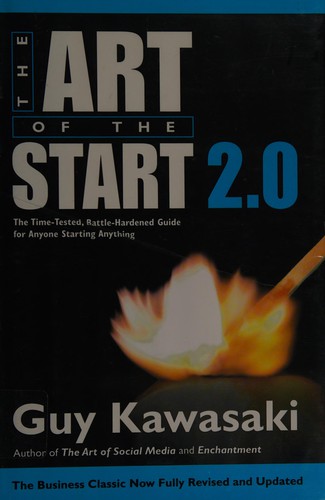
The Art of the Start 2.0 by Guy Kawasaki is a 2015 business book about entrepreneurship, startups, pitching. Start with a meaningful reason to exist beyond profit. Companies that articulate a clear mission attract better employees, inspire customer loyalty, and make harder decisions more easily.
Summary
The Art of the Start 2.0 is Guy Kawasaki's updated guide to launching a company, product, or movement. The original came out in 2004 when Kawasaki was still best known as Apple's original software evangelist. The 2015 revision updates the startup landscape to include social media, crowdfunding, and a post-iPhone product environment. The core advice, though, remains the same: start making something, figure out the pitch, and don't wait until everything is perfect.
Kawasaki's approach is organized around the stages of a startup: defining a meaningful reason to exist beyond money, building a team, crafting a pitch, fundraising, and scaling. His pitch framework is the 10/20/30 rule — ten slides, twenty minutes, thirty-point font — which has circulated independently of the book and has become something of a standard. The underlying principle is that investors are trying to disqualify you as fast as possible, so clarity and brevity work in your favor.
The book is useful and occasionally dated in the same paragraph. Kawasaki is a gifted aphorist and the writing moves quickly. Advice like "don't let the bozos grind you down" and "prototype early, test with real customers, ignore most feedback" holds up. Some of the social media advice, especially on platform-specific tactics, has aged poorly in the decade since publication.
What distinguishes The Art of the Start from most startup books is its directness about what founders actually need to do, not what they should think about. Kawasaki is not interested in the philosophical dimensions of entrepreneurship. He wants you to write the pitch deck, find the first ten customers, and start. That focus makes the book practical and occasionally shallow — it's stronger on execution than on helping founders decide whether their idea is worth executing at all.
Talk to The Art of the Start 2.0 like its author wrote you back.
Get the ideas that fit your life — not generic summaries.
- Chat with the book
- Audiobook-style main ideas
- Adapts to your life and goals
- Helps you take action
Key takeaways
- 1.
Start with a meaningful reason to exist beyond profit. Companies that articulate a clear mission attract better employees, inspire customer loyalty, and make harder decisions more easily.
- 2.
The 10/20/30 rule for pitches: ten slides, twenty minutes, thirty-point font minimum. Most pitch decks are too long, too detailed, and too small to read under pressure.
- 3.
Launch before you're ready. Imperfect products in the market generate feedback that no internal review will surface. Waiting for perfection typically means waiting forever.
- 4.
Hire people who are smarter than you in their specific domain. Founders who hire defensively — people who won't threaten them — build weak organizations.
- 5.
Prototyping and testing with real customers beats planning. Build something minimal, put it in front of people who match your target, and listen to what they actually do more than what they say.
- 6.
Find your first ten customers the hard way: in person, through personal networks, by doing things that don't scale. These customers will tell you whether you have a real business.
- 7.
The single biggest fundraising mistake is talking to investors before you have something to show. Investors fund traction, not ideas. Get to a demo or early data before starting pitches.
- 8.
Execute first, ask permission second. Bureaucracies and large organizations reward caution; startups reward speed. In a startup environment, a well-timed imperfect action beats a perfectly prepared inaction.
Discussion questions
Use these on your own, with a book club, or as chat starters in Superbook. Book club version, ready to copy or print →
- 1.
Kawasaki says companies should start with a meaningful reason to exist beyond money. What's the meaningful reason behind a company you admire? What about one you've worked for?
- 2.
The 10/20/30 rule is now widely known. Have you sat through a pitch or presentation that violated it? What would it have looked like with those constraints applied?
- 3.
Kawasaki argues for launching before you're ready. What's the risk of that approach, and when, if ever, is waiting for polish the right call?
- 4.
Have you ever been in an organization where the founder or leader hired people less capable than themselves to avoid being challenged? What effect did that have?
- 5.
What's the closest thing to a 'first ten customers' moment in your professional experience — a time when you had to find early adopters the hard way?
- 6.
The book is a 2015 update of a 2004 original. Which pieces of advice feel timeless and which feel like artifacts of a particular moment in startup culture?
- 7.
Kawasaki is skeptical of too much market research before building. When does early customer feedback help, and when does it mislead?
- 8.
Most startup advice focuses on what founders should do. What does this book leave out about what founders should avoid?
- 9.
Kawasaki is an experienced evangelist. How much of entrepreneurship is fundamentally a persuasion problem, and how much is it an execution problem?
- 10.
The book is written primarily for founders starting new companies. How much of this advice applies inside a large organization to someone trying to launch a new initiative?
- 11.
Kawasaki says 'don't let the bozos grind you down.' What's the difference between a bozo and a legitimate critic, and how do you tell the difference in the moment?
- 12.
If you were writing this book today, what chapter would you add that isn't here?
Themes
Frequently asked questions
-
Is The Art of the Start 2.0 worth reading?
Yes, especially for first-time founders or people preparing to pitch investors. The advice is direct and the 10/20/30 pitch rule alone justifies the read. Some sections on social media have aged, but the core execution advice is durable.
-
How does The Art of the Start differ from The Lean Startup?
Kawasaki's book is more prescriptive and motivational; Ries's is more methodological. The Lean Startup focuses on validated learning and iteration loops. The Art of the Start covers more ground — pitching, fundraising, hiring, culture — but with less rigor on any single topic.
-
What is the 10/20/30 rule?
Kawasaki's rule for investor pitches: ten slides maximum, twenty minutes to present, and no font smaller than thirty points. The constraints force clarity and prevent the kind of dense, overloaded decks that lose audiences in the first five minutes.
-
Who should read The Art of the Start?
First-time founders, intrapreneurs launching new projects, and anyone preparing to pitch investors or internal stakeholders. Less useful for founders who have already raised a round and are focused on scaling rather than starting.
-
What's the most actionable idea in The Art of the Start?
The pitch deck framework: ten slides covering problem, solution, business model, underlying magic, marketing and sales, competition, team, projections, status, and ask. It's a template, but it's a good one — much better than the decks most first-time founders build on their own.