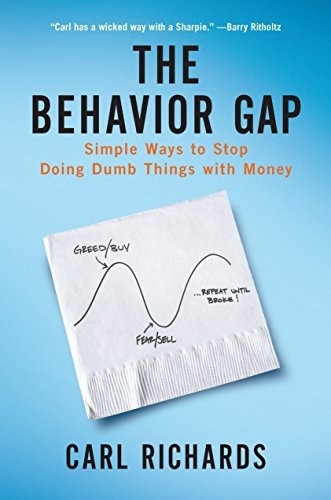
The Behavior Gap by Carl Richards is a 2012 economics book about investor behavior, financial decisions, emotional bias. The behavior gap is the distance between the returns the market earns and the returns investors actually capture — driven by buying high and selling low at emotionally charged moments.
Summary
The Behavior Gap names a specific problem: the gap between what we know we should do with our money and what we actually do. Carl Richards, a certified financial planner and the author of the New York Times "Sketch Guy" column, illustrates this gap with simple diagrams throughout the book. The signature sketch — a Venn diagram where "what we should do" and "what we actually do" barely overlap — captures the book's central concern in a way that most financial writing fails to do in hundreds of pages.
Richards is not interested in technical finance. He assumes readers know the basics: diversify, save more, spend less, avoid timing the market. His argument is that knowledge is not the problem. The problem is behavior under emotional pressure. Investors sell at the bottom because the pain of watching a portfolio decline becomes unbearable. They buy at the top because they see friends making money and FOMO overwhelms their long-term plan. They make major financial decisions — buying a house, choosing a job — to impress people they don't particularly like.
The book is organized around the most common behavioral traps: confusing complex products with sophisticated strategy, mistaking activity for progress, ignoring the difference between what matters and what feels urgent. Richards draws on his own mistakes as much as his clients' — including a period when he and his wife owned a house they couldn't afford and had to short-sell it. The honesty distinguishes the book from advice that comes from people who've never made a consequential financial error.
The limitation is scope. The Behavior Gap is short, accessible, and clear, but it doesn't go deep. Readers wanting a rigorous behavioral finance treatment will need Kahneman or Thaler. What Richards offers is a practical, empathetic reframe: most financial problems are not knowledge problems, and solving them requires looking honestly at the emotional responses driving your decisions.
Talk to The Behavior Gap like its author wrote you back.
Get the ideas that fit your life — not generic summaries.
- Chat with the book
- Audiobook-style main ideas
- Adapts to your life and goals
- Helps you take action
Key takeaways
- 1.
The behavior gap is the distance between the returns the market earns and the returns investors actually capture — driven by buying high and selling low at emotionally charged moments.
- 2.
Most financial problems are not caused by lack of information. They are caused by acting on fear, greed, or the desire to appear sophisticated when you should be doing nothing.
- 3.
Complexity is often sold as sophistication, but a simple, well-understood plan consistently executed beats a complicated strategy executed poorly.
- 4.
We make major financial decisions to impress others — a bigger house, a new car — without noticing that the people we're trying to impress are barely watching.
- 5.
Confusing activity with progress is common in investing. More trades, more research, more advisor meetings do not reliably produce better outcomes.
- 6.
A written financial plan is powerful not because it's smart but because it gives you something to return to when your emotions are telling you to abandon it.
- 7.
The right financial plan is the one you can actually follow, not the theoretically optimal one that you'll abandon when markets get uncomfortable.
Discussion questions
Use these on your own, with a book club, or as chat starters in Superbook. Book club version, ready to copy or print →
- 1.
Richards argues that most financial mistakes are emotional, not analytical. Which emotion — fear, greed, or the desire for social approval — has cost you the most financially?
- 2.
Can you identify a financial decision you made to impress others rather than because it was right for you? What did it cost?
- 3.
What's the most complex financial product you own? Do you genuinely understand it well enough to explain it to someone else?
- 4.
Richards confesses to his own behavior gap with his house purchase. Does personal confession from a financial adviser make the advice more or less useful to you?
- 5.
When did you last check your investment accounts? Was checking necessary, or was it anxiety-driven activity masquerading as diligence?
- 6.
What would your written financial plan look like if you created one this week? What's stopping you from having one?
- 7.
The book argues simplicity is undervalued in finance. What are you doing with your money right now that is more complicated than it needs to be?
- 8.
Richards says the gap often widens most during market extremes. What's your plan for the next significant market drop, and how confident are you that you'll follow it?
- 9.
Is there a financial decision you've been avoiding because making it would require admitting a past mistake? What's the cost of continued avoidance?
- 10.
What does 'good enough' look like for your finances? Is your perfectionism or complexity-seeking making things worse?
- 11.
If you stripped your financial life down to the three most important decisions, what would they be and how well are you executing on each?
Themes
Frequently asked questions
-
What is the behavior gap?
The behavior gap is the difference between the returns the market produces and the lower returns most investors actually earn, caused by buying after prices rise and selling after they fall — behavior driven by emotion rather than analysis.
-
Is The Behavior Gap worth reading?
Yes if you want a quick, honest diagnosis of why smart people make poor financial decisions. It's short and light on technical detail, but the behavioral framing is unusually clear. Read it alongside The Psychology of Money for more depth on the same terrain.
-
How long does it take to read The Behavior Gap?
Around two to three hours. The book is brief and illustrated, designed to be readable in a single sitting. Each chapter is short and built around a central sketch.
-
Who should read The Behavior Gap?
Anyone who knows the basics of personal finance but keeps failing to execute — the person who sells during market drops despite knowing they shouldn't, or who buys expensive things for social reasons while claiming to prioritize saving.
-
What is Carl Richards's most important piece of advice?
Write down your financial plan. The act of writing forces clarity, and having a written plan gives you something to return to when your emotions are pushing you toward a decision you'll regret.