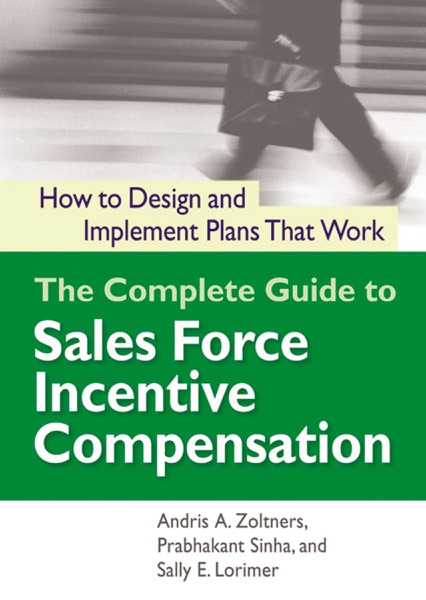
The Complete Guide to Sales Force Incentive Compensation by Andris Zoltners is a 2006 business book about sales management, incentive design, compensation strategy. Most compensation plans accumulate complexity over time without ever being designed from first principles. Periodic zero-based redesign, measured against business strategy, produces better results.
Summary
The Complete Guide to Sales Force Incentive Compensation by Andris Zoltners, Prabhakant Sinha, and Sally Lorimer is the most thorough practitioner reference on the subject. The book addresses every component of a sales compensation system: the structure of the pay plan, target-setting mechanics, territory design, performance metrics, and the processes for reviewing and revising the system over time.
Zoltners and his co-authors approach the topic as management scientists who have spent decades consulting on sales force design. The book's central argument is that most companies design compensation plans reactively — borrowing from competitors, layering new incentives onto old structures, and never building a coherent system from first principles. The result is plans that are too complex to communicate clearly, that reward activities that don't drive business results, and that demoralize high performers while letting average performers coast.
The book is organized around what the authors call the "sales compensation plan testcard" — a set of diagnostic questions covering alignment with business strategy, motivation of desired behaviors, fairness across territories and roles, cost efficiency, and administrative feasibility. Each section works through how to audit an existing plan against these criteria and how to redesign when the audit reveals problems. There are chapters on base versus variable pay ratios, on different incentive mechanics (quota-based bonuses, commission rates, accelerators, team pay), and on the specific challenges of new product launches, territory transitions, and compensation for sales managers rather than individual contributors.
The book is long and technical. It is most useful as a reference for compensation professionals, sales operations leaders, and executives designing or overhauling a sales pay system. Readers looking for a conceptual overview of incentive design in general will find it denser than necessary. But for practitioners who need to get the mechanics right, it covers the field comprehensively in a way that most shorter treatments don't.
Talk to The Complete Guide to Sales Force Incentive Compensation like its author wrote you back.
Get the ideas that fit your life — not generic summaries.
- Chat with the book
- Audiobook-style main ideas
- Adapts to your life and goals
- Helps you take action
Key takeaways
- 1.
Most compensation plans accumulate complexity over time without ever being designed from first principles. Periodic zero-based redesign, measured against business strategy, produces better results.
- 2.
The pay mix — the ratio of fixed base to variable pay — should reflect the degree to which individual sales effort actually drives outcomes. High-influence sales roles warrant higher variable ratios.
- 3.
Quota-setting accuracy matters as much as incentive structure: even a well-designed plan fails if territories are misaligned or quotas are systematically under- or over-set.
- 4.
Incentive plan complexity is a tax on motivation. If a salesperson can't calculate their expected payout in their head, the plan has too many components.
- 5.
Sales compensation should be evaluated against a consistent set of criteria: strategic alignment, motivation of desired behaviors, fairness, cost efficiency, and administrative feasibility.
- 6.
Accelerators above quota reward top performers, but their design must be carefully calibrated — overly steep accelerators create sand-bagging incentives in quota-setting cycles.
- 7.
Compensation for sales managers requires different metrics than for individual contributors. Manager pay should reflect team performance, not just personal sales, to align managers' interests with developing the people below them.
Discussion questions
Use these on your own, with a book club, or as chat starters in Superbook. Book club version, ready to copy or print →
- 1.
The book argues that most companies don't design compensation from first principles. In organizations you've been part of, has the compensation system reflected deliberate design or accumulated history?
- 2.
Zoltners identifies plan complexity as a primary failure mode. What's the most complex incentive structure you've encountered, and did it change behavior in the way it was intended to?
- 3.
The authors argue the pay mix should match the degree of sales influence. For roles where outcomes are driven by many factors beyond individual effort, what should variable pay actually be rewarding?
- 4.
Quota accuracy is treated as a foundational requirement. What organizational dynamics make accurate quota-setting difficult, and what would need to change to fix them?
- 5.
The book covers both individual and team-based incentive components. In your experience, which produces better collaboration and which produces better individual performance?
- 6.
Accelerators above quota are supposed to reward top performers, but they can create sand-bagging in quota negotiations. How do you design around that dynamic?
- 7.
How should sales manager compensation differ from individual contributor compensation, and how often do you see organizations get this wrong?
- 8.
The authors recommend a systematic annual review process for the compensation plan. What organizational barriers prevent companies from doing this even when they know they should?
- 9.
When a company launches a new product with a different margin profile or sales cycle, how should compensation adapt, and what happens when it doesn't?
- 10.
The book is primarily a practitioner reference. What frameworks from it could a non-specialist use to evaluate whether a sales compensation plan is working?
- 11.
The authors argue that fairness across territories matters as much as incentive mechanics. How do you measure and achieve that fairness when territories differ in potential?
Themes
Frequently asked questions
-
What is this book about?
It's a comprehensive practitioner guide to designing, auditing, and improving sales force incentive compensation systems. It covers pay mix, quota-setting, incentive mechanics, territory design, and the processes for keeping compensation plans aligned with business strategy over time.
-
Who should read this book?
Sales operations leaders, compensation professionals, HR directors responsible for sales pay, and executives overseeing sales organizations. It's not a conceptual overview — it's a working reference for people who need to get the mechanics right.
-
Is this book still relevant given how much has changed in B2B sales?
The core principles on pay mix, quota mechanics, and alignment remain sound. Specific examples and some tactical guidance reflect the era of publication, but the diagnostic framework and structural logic hold up for most B2B and enterprise sales contexts.
-
How long is the book and how should I read it?
It's long — over 500 pages — and dense with frameworks and examples. Most practitioners use it as a reference rather than a cover-to-cover read. The chapters on pay mix ratio and quota-setting accuracy are the highest-value starting points for most situations.
-
What's the most common mistake the book helps prevent?
Building plans that are too complex to communicate clearly. The authors argue that if salespeople can't understand their expected payout, the incentive effect is lost — and most compensation plans accumulate complexity without anyone deciding to add it deliberately.