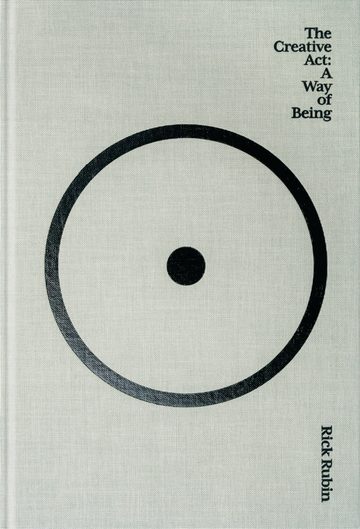
The Creative Act: A Way of Being by Rick Rubin is a 2023 philosophy book about creativity, artistic practice, attention and perception. Creativity begins with perception. The work is to notice more, more accurately — to see what is actually there rather than what you expect or what is convenient.
Summary
The Creative Act is not a how-to book. Rick Rubin, the record producer behind work by Johnny Cash, Jay-Z, the Red Hot Chili Peppers, and dozens of others, doesn't teach a method for making better music or art. He writes instead about a stance toward the world — a way of being present, receptive, and honest — that he believes creative work requires and, in turn, develops.
The book is structured as a series of short chapters, most a few pages, each addressing one aspect of creative life: Source, Listening, Memory, Completion, Feedback, Collaboration, Experimentation. Rubin's argument, stated in various ways across all of them, is that the creative act is less about production than about perception. The work is to notice more, to pay attention to what's actually happening rather than to what you expect to find, and to stay honest enough to act on what you notice rather than on what is safe or approved.
Rubin is not religious in any orthodox sense, but the book has a spiritual register. He talks about creativity as tapping into a larger field — a source beyond the individual ego — and invites readers to release attachment to outcomes, to credit, to the approval of audiences. This language will resonate with some readers and irritate others. The practical effect of the philosophy is real regardless: the chapters on feedback, on completion, and on the relationship between craft and intuition are among the most clear-eyed things written about artistic production.
The format — aphoristic chapters, no narrative arc, no sustained argument — suits some readers and frustrates others. Rubin never tells you what to do in a specific situation. He gives you a way of thinking about your situation and trusts you to draw conclusions. The book works best if you already have a creative practice and want a set of principles to evaluate it against. Read as motivation alone, it fades quickly. Read as a lens for reflecting on actual work, it repays rereading.
Talk to The Creative Act: A Way of Being like its author wrote you back.
Get the ideas that fit your life — not generic summaries.
- Chat with the book
- Audiobook-style main ideas
- Adapts to your life and goals
- Helps you take action
Key takeaways
- 1.
Creativity begins with perception. The work is to notice more, more accurately — to see what is actually there rather than what you expect or what is convenient.
- 2.
Rubin treats completion as a separate skill from creation. Finishing a work is its own discipline, and knowing when something is done is harder than starting.
- 3.
The inner critic is useful in editing but destructive in generation. Rubin argues for separating the two phases, giving each its own time and mental mode.
- 4.
Feedback is most useful when it's specific about what isn't working, not about how to fix it. The fixer is the artist, not the audience.
- 5.
Craft and intuition are not opposites. Technical skill creates the range of choices; intuition selects among them. Both require development.
- 6.
Attachment to outcomes — to sales, critical reception, approval — corrupts creative judgment at the source. The work should be made as well as you can make it, regardless.
- 7.
Experimentation is not a phase of creative work; it's the mode of creative work. The willingness to try things that will probably fail is what produces anything interesting.
- 8.
Collaboration works when both parties bring their full capacity and genuine disagreement is possible. Agreement that comes too easily signals that one person has deferred.
Discussion questions
Use these on your own, with a book club, or as chat starters in Superbook. Book club version, ready to copy or print →
- 1.
Rubin says creativity begins with perception. In your own work, what do you consistently fail to notice or overlook?
- 2.
The book's short chapter format has no sustained argument. Did that structure feel appropriate for the subject matter, or did it leave you wanting more support for the claims?
- 3.
Rubin separates generating from editing. How disciplined are you at keeping those two modes separate in your own practice?
- 4.
He argues that attachment to outcomes corrupts the work. Is that practical advice or spiritual idealism? Have you seen it work either way?
- 5.
The spiritual language in the book — the 'source,' the artist as a vessel — will land differently on different readers. Did it resonate, irritate, or leave you indifferent? Why?
- 6.
Rubin writes that feedback should identify what isn't working without prescribing solutions. Think of the most useful creative feedback you've received. Did it follow that principle?
- 7.
He treats completion as its own difficult skill. Is there something in your work or life that you started but haven't finished? What has kept you from completing it?
- 8.
Rubin has produced work across wildly different genres. Does the framework he describes seem equally applicable to all creative fields, or is it shaped by music in particular?
- 9.
What's the difference between self-trust in creative work and confirmation bias — just following your instincts and calling it integrity?
- 10.
He says the willingness to try things that will probably fail is what produces anything interesting. Do you create enough room in your own practice for failure?
- 11.
Rubin worked with artists at career lows — Johnny Cash in his final years, for example — and helped them make some of their most powerful work. What does that suggest about what a collaborator or editor actually does?
- 12.
Does the book change how you think about the relationship between reputation, public reception, and the actual quality of creative work?
Themes
Frequently asked questions
-
What is The Creative Act about?
Rick Rubin's argument that creativity is less about technique or method than about a way of paying attention — to the world, to the work, and to your own honest response to both. It's organized as short aphoristic chapters covering perception, completion, feedback, collaboration, and related topics.
-
Is The Creative Act worth reading?
Depends on what you're looking for. If you want a framework or actionable steps, it will frustrate you. If you want a thoughtful lens for reflecting on an existing creative practice, it's excellent. It works best read slowly and revisited.
-
Who should read The Creative Act?
Anyone with a serious creative practice — musicians, writers, designers, filmmakers — who wants to think more carefully about process and judgment. Less useful for people who haven't yet started making things.
-
How long is The Creative Act?
Around 384 pages, but the chapters are very short. At average reading pace it takes about five hours, though many readers read it slowly over weeks, returning to individual chapters.
-
What's the most useful idea in The Creative Act?
The separation of generating and editing as distinct mental modes. Rubin argues that the inner critic is useful in revision but corrosive during creation, and that most creative blocks come from running both at once.