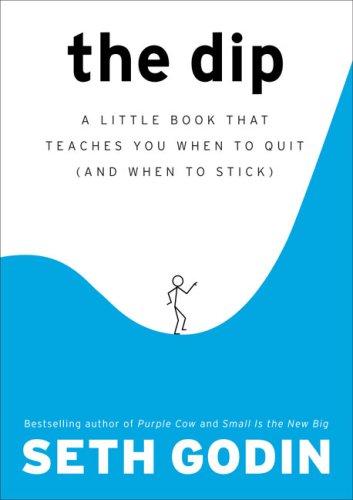
The Dip by Seth Godin is a 2007 self-help book about quitting, persistence, mastery. Strategic quitting is a skill, not a failure. The goal is to quit the right things early enough that you can pour resources into the few things worth seeing through.
Summary
The Dip is Seth Godin's short argument that the ability to quit the right things at the right time is more strategic than persistence for its own sake. The book pushes back against the cultural reflex that quitting is failure. Godin's case is that most people quit too easily on things worth doing and persist too long on things not worth doing — and that confusing the two costs years.
The "dip" is the long, difficult middle of any worthwhile pursuit: the stretch between excited beginner and genuine mastery where most people give up. This middle is where markets thin out and where the eventual few who push through gain durable advantage. Godin argues you should push through dips that lead to genuine scarcity and competitive advantage. But not everything hard is worth pushing through. He distinguishes the dip from two other curves: the "cul-de-sac" (a situation that is neither going up nor down, just flat and going nowhere) and the "cliff" (something that appears to keep going up until it suddenly and catastrophically doesn't). Cul-de-sacs and cliffs deserve to be quit. Dips deserve investment.
The practical implication is to make quitting decisions in advance, before you're in the emotional trough of the dip itself. When you decide what you're willing to quit and what you're committed to, you avoid the worst version of the problem: reactively quitting when things get hard rather than strategically quitting when the path is genuinely wrong. Godin also argues for scarcity as the organizing principle — being the best in the world at a specific, well-defined thing is more valuable than being pretty good at many things.
At seventy-six pages, The Dip is not a comprehensive treatment of any of these ideas. It is a concentrated argument that takes about an hour to read. Readers looking for data or nuance will find it thin. But as a reframe on persistence and quitting, it does the job efficiently — and for readers who have been stuck in a cul-de-sac for months or years, it can be genuinely clarifying.
Talk to The Dip like its author wrote you back.
Get the ideas that fit your life — not generic summaries.
- Chat with the book
- Audiobook-style main ideas
- Adapts to your life and goals
- Helps you take action
Key takeaways
- 1.
Strategic quitting is a skill, not a failure. The goal is to quit the right things early enough that you can pour resources into the few things worth seeing through.
- 2.
The dip is the long, difficult middle between enthusiastic beginner and genuine mastery. It thins out the competition. Lean into it if the destination is worth it.
- 3.
Distinguish the dip from the cul-de-sac. The dip is hard but leads somewhere; the cul-de-sac is a dead end that will never improve no matter how long you persist.
- 4.
Decide in advance what conditions would cause you to quit. Making that decision before you're in the emotional trough of difficulty prevents reactive quitting masquerading as strategy.
- 5.
Being the best in the world at a well-defined, specific thing is more valuable than being mediocre at many things. Define 'the world' narrowly enough that being the best is achievable.
- 6.
Most people quit when things get hard, which is exactly when the competitive advantage of persisting is highest. The scarcity created by the dip is why mastery has value.
- 7.
Quitting something that is not working frees time and attention for something that might. The cost of staying in a cul-de-sac is an opportunity cost, not a virtue.
Discussion questions
Use these on your own, with a book club, or as chat starters in Superbook. Book club version, ready to copy or print →
- 1.
Think about something you've been persisting with for years. Is it a dip, a cul-de-sac, or a cliff? What evidence distinguishes them?
- 2.
Godin says you should decide in advance what would make you quit. Have you ever done this explicitly? What happened when you didn't?
- 3.
What's the smallest, most specific 'world' in which you could genuinely be the best at something? Does that feel liberating or unsatisfying?
- 4.
When have you quit something too early because the dip felt too hard, and later realized you should have pushed through?
- 5.
When have you stayed in something too long — a job, a project, a relationship — when the evidence that it was a cul-de-sac was already clear?
- 6.
What's a cul-de-sac in your professional life right now that you already know isn't going anywhere but haven't yet left?
- 7.
Godin argues that the discomfort of the dip is evidence you're in the right place. How do you distinguish between productive discomfort and a signal to quit?
- 8.
Where are you spreading yourself across too many things, each of which gets you to mediocrity? What would you drop to pursue one thing to mastery?
- 9.
What does 'the best in the world' mean for the specific thing you most want to achieve? Who already occupies that position?
- 10.
If you had to quit one thing in your life in the next thirty days to free up meaningful resources for something else, what would it be?
- 11.
The book is deliberately short. Does the brevity make it more or less convincing? What would a longer, more rigorous treatment need to add?
Themes
Frequently asked questions
-
Is The Dip worth reading?
Yes, if you're stuck on a decision about whether to continue something or quit. The book won't give you data or a systematic framework, but the reframe — that strategic quitting is a skill — is useful and the dip-versus-cul-de-sac distinction alone is worth the hour it takes to read.
-
How long does it take to read The Dip?
About one hour. The book is seventy-six pages. It's often read in a single sitting, which is part of the point — Godin has edited it down to the argument and nothing else.
-
What is the main idea of The Dip?
That the right question is not 'should I quit?' but 'am I in a dip or a cul-de-sac?' Dips are temporary hard stretches worth pushing through. Cul-de-sacs are dead ends that look like dips but go nowhere. Quitting cul-de-sacs early is smart, not weak.
-
Who should read The Dip?
Anyone feeling stuck who can't tell whether they're facing a productive hard stretch or a dead end. Useful for entrepreneurs, career changers, and anyone who has been reflexively persisting with something they know isn't working.
-
Is The Dip based on research?
Not really. It's a short argument and a reframe rather than an evidence-based book. Readers who want data, case studies, or a systematic framework should look elsewhere. Its value is the clarity of the central distinction, not the rigor of the evidence.