The Divine Comedy: Inferno by Dante Alighieri is a 1472 philosophy book about sin and punishment, justice, spiritual journey. The contrapasso principle — punishment that mirrors the nature of the sin — reflects a medieval conviction that sin deforms the soul and justice reveals that deformation.
Summary
The Inferno is the first of three canticles in Dante Alighieri's Divine Comedy, written between approximately 1308 and 1320. It describes Dante's journey through Hell, guided by the Roman poet Virgil, on a path toward spiritual redemption. The poem is structured around thirty-four cantos of interlocking terza rima — a rhyme scheme Dante invented — and presents Hell as nine concentric circles arranged by the moral seriousness of the sins punished within them. Lust, gluttony, and avarice sit at the upper levels; fraud and treachery occupy the depths.
The organizing logic is the contrapasso: every punishment mirrors the nature of the sin that earned it. The lustful are blown about by an eternal wind that echoes their surrender to passion. The flatterers are immersed in excrement. Fraudsters walk in circles of reversed vision. Dante is not interested in arbitrary torment; he is building a moral taxonomy, using physical suffering to make visible what he believes sins actually do to the soul. The architecture of Hell is an argument about justice, and the poem's power comes partly from the fact that Dante populates it with real Florentine contemporaries alongside mythological and biblical figures.
The poem also works as political and personal autobiography. Dante was exiled from Florence in 1302, and the Inferno is threaded with rage at the corrupt clergy, venal politicians, and factional betrayers he blames for Florence's decline. Meeting figures like Francesca da Rimini, Ulysses, and Ugolino in Hell lets Dante render them with genuine sympathy and narrative weight even while placing them under eternal judgment. The tension between compassion and condemnation is the emotional texture that makes the poem humanly compelling rather than merely didactic.
Reading the Inferno well requires some tolerance for medieval theological categories and for Dante's cosmology, which reflects scholastic Christian thought rather than modern moral intuitions. Many of his judgments will seem harsh or arbitrary — the unbaptized pagans in Limbo, the suicides in the wood of self-destroyers. But the poem's architecture is internally consistent and the verse, even in translation, carries a compression and force that rewards patient reading.
Talk to The Divine Comedy: Inferno like its author wrote you back.
Get the ideas that fit your life — not generic summaries.
- Chat with the book
- Audiobook-style main ideas
- Adapts to your life and goals
- Helps you take action
Key takeaways
- 1.
The contrapasso principle — punishment that mirrors the nature of the sin — reflects a medieval conviction that sin deforms the soul and justice reveals that deformation.
- 2.
Hell is organized not by the severity of suffering but by the gravity of moral failure: sins of incontinence are judged less harshly than sins of fraud and betrayal.
- 3.
Dante populates Hell with contemporaries, mixing sympathy with condemnation; the poem is as much a political document as a theological one.
- 4.
Virgil represents human reason as the best guide available but ultimately insufficient: reason can navigate Hell and Purgatory but cannot enter Paradise.
- 5.
The encounter with Ulysses presents the case for intellectual ambition as potentially damnable — the drive to know without limit can be a form of overreach.
- 6.
Dante's emotional responses in Hell — weeping for the damned, fainting, feeling pity — are themselves part of the poem's moral argument about what suffering should produce in the witness.
- 7.
The poem insists on free will: no one in Hell is there against their nature. The damned have become what they chose, and the punishment is simply the full expression of that choice.
- 8.
Even in a medieval Christian framework, the Inferno raises questions about divine justice — particularly regarding the fate of virtuous pagans — that it does not fully resolve.
Discussion questions
Use these on your own, with a book club, or as chat starters in Superbook. Book club version, ready to copy or print →
- 1.
The contrapasso gives each punishment a direct relationship to its corresponding sin. Which punishments in the Inferno do you find most morally coherent, and which seem arbitrary or excessive?
- 2.
Dante arranges Hell so that fraud and treachery are worse than violence. Does that moral hierarchy match your own intuitions? Why or why not?
- 3.
Virgil is the guide through Hell and Purgatory but cannot enter Paradise. What does that say about the limits Dante saw in purely rational virtue?
- 4.
Dante meets Francesca da Rimini with evident sympathy, even weeping for her. Does the poem endorse that sympathy or judge it? What do you make of the ambiguity?
- 5.
Ulysses is damned for the voyage beyond the Pillars of Hercules — for the desire to know without limits. Is that a condemnation of intellectual ambition, or something more specific?
- 6.
The poem is saturated with Dante's personal grievances — his exile, his political enemies, corrupt popes. Does knowing that change how you read the judgments he renders?
- 7.
Dante places the virtuous pagans — Homer, Aristotle, Plato — in Limbo rather than deeper Hell. Does that feel like a generous solution or an evasion?
- 8.
The suicides are placed in a wood of self-destroyers, lower than the murderers. How does that reflect medieval Christian theology about bodily integrity, and what do you think of it?
- 9.
Which figure in the Inferno do you find most humanly compelling? What makes that encounter feel different from the others?
- 10.
The poem was written by someone in exile, facing real enemies. Does reading it as political autobiography change your relationship to its moral authority?
- 11.
How does the Inferno's vision of justice compare to modern secular frameworks? What has changed, and what, if anything, still resonates?
- 12.
Dante frequently expresses pity and compassion for the damned. Is that consistent with a belief in the justice of their punishment, or does the poem contain a genuine tension here?
Themes
Frequently asked questions
-
Do I need to read all three parts of The Divine Comedy?
Not necessarily. The Inferno stands on its own as a complete narrative arc and is by far the most widely read section. Purgatorio and Paradiso are more abstract and theologically demanding. Many readers find the Inferno sufficient as a standalone work, though reading all three reveals the full architecture of Dante's argument.
-
Which translation of the Inferno is best?
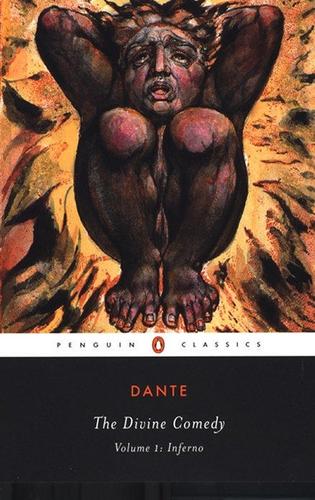
Penguin's edition translated by Robin Kirkpatrick (ISBN 9780142437223) is readable and scholarly. Robert Pinsky's verse translation is praised for its energy. Clive James's recent version is looser but lively. For a bilingual facing-page edition with detailed commentary, Allen Mandelbaum is a standard academic choice.
-
How long does it take to read the Inferno?
About three to four hours for the text alone, but the poem rewards slow reading with commentary. Most readers benefit from pausing at each canto to understand the figures Dante places there, many of whom require historical context that is not self-evident.
-
What is the Inferno actually about?
On the surface, it is a guided tour through Hell. More deeply, it is a meditation on sin, justice, free will, and political corruption, written by a man who believed Florence had been destroyed by the vices he was cataloging. It functions simultaneously as theology, autobiography, political satire, and poetry.
-
Who should read the Inferno?
Anyone interested in the foundations of Western literature, medieval thought, or the relationship between theology and politics. It is also worth reading as a study in how personal grievance can be transformed into structured moral argument. Readers who prefer modern moral frameworks will find it challenging but instructive.