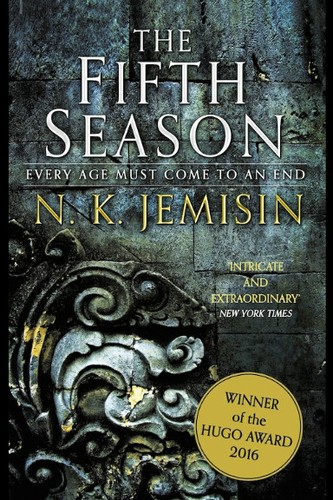
The Fifth Season by N.K. Jemisin is a 2015 fantasy book about oppression and subjugation, survival and endurance, grief and loss. The second-person narration isn't stylistic experimentation for its own sake — it creates the specific sensation of dissociation that comes from surviving unbearable things by not quite inhabiting yourself.
Summary
The Fifth Season takes place on a continent called the Stillness, which is anything but: a geologically unstable supercontinent regularly devastated by "fifth seasons" — catastrophic climate events triggered by seismic activity that can last decades and kill millions. The society that has developed here is built around the management and suppression of orogenes, people born with the ability to psychically control geological forces. Orogenes are both the society's most essential resource and its most persecuted underclass, trained from childhood in a brutal institution called the Fulcrum and owned, essentially, by the empire that depends on them.
The novel follows three women — Essun, a middle-aged orogene who comes home to find her son murdered by her husband; Damaya, a child being taken to the Fulcrum for the first time; and Syenite, a young Fulcrum orogene on her first mission — across what turns out to be a world in its final fifth season. One of the novel's structural surprises, which lands as an emotional gut-punch rather than a plot twist, concerns how these three timelines relate to each other. Jemisin also makes the unusual choice to write one of the timelines in second person — "you" — which produces an intimacy and dissociation simultaneously that is initially jarring and eventually devastating.
Jemisin is explicitly writing about race, structural oppression, and the psychological adaptations required to survive in a society that simultaneously needs you and hates you. The Fulcrum's system of "use-caste" reads unmistakably as a slavery allegory — orogenes are collared with suppressive devices, bought and sold, and trained to refer to themselves in dehumanizing terms. But the world-building is rich enough that the allegory never collapses into simple parallelism; the Stillness has its own logic, its own history, and its own version of how oppression propagates across generations.
The Fifth Season won the Hugo Award for Best Novel in 2016, the first book in Jemisin's Broken Earth trilogy to do so — she went on to win three consecutive Hugos for the three volumes, an achievement unprecedented in the award's history. The prose is dense and deliberate, the worldbuilding is intricate, and the emotional demands are significant. This is not a comfortable book. Readers who want a fantasy that grapples seriously with structural violence and survival will find it extraordinary; readers who prefer their genre fiction lighter will find it exhausting.
Talk to The Fifth Season like its author wrote you back.
Get the ideas that fit your life — not generic summaries.
- Chat with the book
- Audiobook-style main ideas
- Adapts to your life and goals
- Helps you take action
Key takeaways
- 1.
The second-person narration isn't stylistic experimentation for its own sake — it creates the specific sensation of dissociation that comes from surviving unbearable things by not quite inhabiting yourself.
- 2.
The novel argues that the society built to protect people from geological catastrophe is itself the catastrophe — the mechanism of oppression is inseparable from the mechanism of survival.
- 3.
Orogeny is a metaphor for Blackness, disability, and any form of difference that a society exploits while punishing — Jemisin draws that line explicitly in her essays without reducing the novel to illustration.
- 4.
Grief is not a subplot. The novel begins with a mother finding her murdered child and never lets that loss go; survival in the Stillness requires you to keep moving through grief without processing it.
- 5.
The Fulcrum's training doesn't just suppress orogenes — it teaches them to police each other, to internalize their own subjugation, to call themselves 'it.' Jemisin is precise about how oppression gets inside people.
- 6.
The three-timeline structure is a controlled revelation about time, identity, and what a life looks like when you see its phases out of sequence.
- 7.
The stone eaters and Guardians are not fully explained in book one — the novel trusts its readers to sit with mystery, and the strangeness of those figures is part of what keeps the world from reducing to allegory.
- 8.
The world Jemisin builds is geologically coherent — she researched plate tectonics seriously — and that physical reality gives the catastrophes weight that pure fantasy invention wouldn't have.
- 9.
The novel insists that endurance is not passive — surviving a world designed to kill you requires constant strategy, and that strategy is a form of heroism the novel doesn't undervalue.
Discussion questions
Use these on your own, with a book club, or as chat starters in Superbook. Book club version, ready to copy or print →
- 1.
The second-person narration is either the novel's greatest achievement or its biggest obstacle, depending on who you ask. How did it land for you, and do you think the emotional effect justifies the alienation?
- 2.
The Fulcrum trains orogenes to suppress their own power and dehumanize themselves. What parallels do you draw to real-world institutions, and does naming those parallels make the novel stronger or reduce it?
- 3.
Essun's son is murdered in the first pages. How does that loss function differently from a death that happens later in a narrative, after the reader has had time to invest?
- 4.
The Stillness has a class system based on 'use-caste' — what you are good for. How does that system compare to class or caste structures you know, and what does Jemisin add by making it explicitly geological?
- 5.
Alabaster, Syenite's mission partner, is the most powerful orogene alive and also the most politically radical. Is his radicalism presented as correct, dangerous, or both?
- 6.
The three-timeline structure reveals a structural surprise about two-thirds through. Did you see it coming? Does knowing it reframe your reading of what came before?
- 7.
Jemisin has said explicitly that the novel is about race in America, written during the Black Lives Matter movement. Does knowing her intent change how you read the fantasy elements?
- 8.
The stone eaters are unexplained for most of the first book. How does Jemisin manage the tension between mystery and frustration, and did she get the balance right?
- 9.
Survival in the Stillness requires suppressing emotion, hiding identity, and constant vigilance. How does the novel portray the psychological cost of that kind of survival?
- 10.
The novel ends with Essun following a trail toward a possible resolution that will take two more books. Does the first volume work as a standalone, or does it require the trilogy to make sense?
- 11.
The Fifth Season won the Hugo three years in a row for its trilogy. What do you think it says about genre fiction readership that this book — explicitly about oppression, difficult to read — dominated its field?
- 12.
Compare Essun to a hero in a more conventional fantasy novel. What is Jemisin doing differently with the idea of who a hero is and what heroism costs?
Themes
Frequently asked questions
-
Is The Fifth Season hard to read?
In two ways. Emotionally, it begins with a murdered child and doesn't relent — the violence is not gratuitous but it is persistent. Structurally, the second-person narration and three-timeline structure require active orientation. Neither difficulty is gratuitous; both are core to what the novel is doing. But they are real.
-
Do I need to read the whole trilogy?
The first book is structurally complete in the sense that its revelations pay off. The emotional and world-building questions it opens require two more books to resolve. Most readers who finish The Fifth Season continue, and most consider the trilogy one of the strongest in contemporary fantasy.
-
What is the book actually about, without spoilers?
A woman returns home to find her husband has murdered their son and fled with their daughter, in the opening days of a civilization-ending geological catastrophe. As she pursues them, the novel reveals her history, her world, and the full meaning of what has happened through three interwoven timelines.
-
Why did The Fifth Season win so many awards?
It did things fantasy had largely refused to do: use the genre's tools explicitly in service of an argument about structural racism, write a Black woman protagonist whose suffering wasn't redemptive or decorative, and experiment formally with second-person narration in ways that justified themselves emotionally. It changed what readers expected fantasy to be capable of.
-
Who shouldn't read The Fifth Season?
Readers who want escapist fantasy with clear moral categories and a comfortable reading experience. The novel is deliberately uncomfortable, structurally demanding, and politically explicit. Readers who want to be challenged will find it extraordinary; those who want to relax will not.