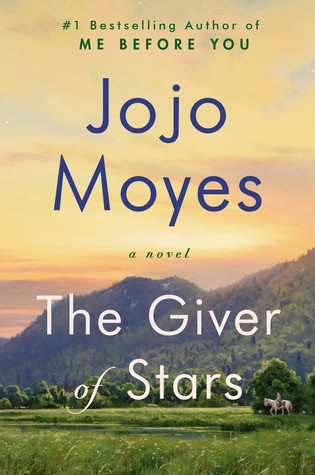
The Giver of Stars by Jojo Moyes is a 2019 historical fiction book about female solidarity, books and literacy as liberation, depression-era appalachia. The WPA Pack Horse Library project was real — between 1935 and 1943, librarians (mostly women) rode horses and mules through eastern Kentucky to deliver books to isolated mountain communities. Moyes honors that history while fictionalizing specific characters.
Summary
In Depression-era Kentucky, a group of women becomes part of Eleanor Roosevelt's Pack Horse Library project — riding mules and horses through mountain terrain to deliver books to isolated communities. The novel follows five women from very different backgrounds: Alice, a recent English bride who fled a suffocating marriage into the mountains; Margery, a fiercely independent local woman who built the library from nothing; Beth, a young woman from a respectable family escaping domestic expectations; Izzy, who lives with a physical disability and needs the library as much as the job; and Sophia, a Black librarian who rides despite the specific dangers facing her in 1930s Kentucky.
The book is fundamentally about what books mean to people who have never had access to them, and what it does to women to discover they can build something together. Moyes is interested in the specific texture of Appalachian mountain life — the poverty, the beauty, the insularity, the gender codes — and in how the library project disrupted those codes by giving women both employment and a reason to be elsewhere. The female friendship at the center of the novel is the real subject.
Moyes writes popular fiction with skill and sentiment; this is warmer and less urban than her contemporary-set novels, and the historical setting gives her room to examine structural constraints on women's lives that might feel schematic in a modern setting. The prose is brisk and vivid, the characters well-differentiated, and the plot — including a murder accusation that brings the community to a crisis point — provides enough external momentum to keep the pages turning through the slower, pastoral sections.
This is Moyes at her most ambitious — a larger cast, a historical setting, and a genuine attempt to honor a mostly forgotten piece of American history. Readers who love her contemporary novels will find it rewarding; those new to her work will find it an accessible entry point into the world of Depression-era historical fiction with a specifically feminist bent. The book draws an inevitable comparison to Barbara Kingsolver's Prodigal Summer and the Appalachian literary tradition, though its loyalties are ultimately with popular fiction rather than literary ambition.
Talk to The Giver of Stars like its author wrote you back.
Get the ideas that fit your life — not generic summaries.
- Chat with the book
- Audiobook-style main ideas
- Adapts to your life and goals
- Helps you take action
Key takeaways
- 1.
The WPA Pack Horse Library project was real — between 1935 and 1943, librarians (mostly women) rode horses and mules through eastern Kentucky to deliver books to isolated mountain communities. Moyes honors that history while fictionalizing specific characters.
- 2.
The novel argues that access to books is a form of social power, and that denying it to women and poor communities is a form of control. The library becomes a vector for something larger than literacy.
- 3.
Sophia's presence in the narrative is handled with more care than is common in popular fiction — Moyes shows the specific and compounding dangers facing a Black woman in rural 1930s Kentucky without letting the white characters' solidarity obscure them.
- 4.
Marriage in the novel is shown primarily as a set of constraints that the library project helped women escape — at least temporarily. Moyes is interested in the economic dependency that made those constraints so total.
- 5.
Margery O'Hare is the novel's most compelling character — a woman who built a library in the mountains through sheer force of will and is destroyed by the same community she served. Her arc is the darkest and most honest in the book.
- 6.
The physical landscape of eastern Kentucky is rendered with genuine affection — the hollows, the trails, the weather — and becomes a character in itself, shaping what the women can and cannot do.
- 7.
The novel suggests that female solidarity is not natural or easy — it has to be built, tested, and chosen repeatedly. The five women in the library don't become friends easily or without friction.
- 8.
The Depression-era setting allows Moyes to examine how economic desperation interacts with gender — women's options narrowed not just by law and custom but by poverty that made dependence rational.
Discussion questions
Use these on your own, with a book club, or as chat starters in Superbook. Book club version, ready to copy or print →
- 1.
The novel is inspired by the real WPA Pack Horse Library project, but Moyes changed many details for dramatic effect. Does knowing it's loosely based on real events change how you read it?
- 2.
Sophia rides as a librarian despite very real dangers. How does Moyes handle her situation relative to the white characters? Does the novel fully reckon with the racial dynamics, or does it rely on the white women's solidarity as cover?
- 3.
Margery is by far the most complex character in the book. What does her fate suggest about what communities do to women who refuse to conform?
- 4.
Alice came to Kentucky from England to escape one set of constraints and found another. How do her outsider observations function in the novel? Is she a reliable lens?
- 5.
The male characters in the novel are mostly either obstacles or allies. Does that feel true to the period, or does it feel like the book flattening them for the sake of the female-solidarity narrative?
- 6.
Books are depicted as transformative for the mountain communities. Do you find that depiction convincing, or does it romanticize literacy?
- 7.
The murder accusation plot brings the community into conflict. How does Quinn handle the question of community loyalty versus justice? Does the resolution feel earned?
- 8.
The five women in the library come from very different class, race, and background positions. Does Moyes make those differences real, or does female solidarity paper over them too quickly?
- 9.
The novel ends on a note of loss and continuation. What do you make of what survives and what doesn't?
- 10.
Compare this to Kristin Hannah's The Four Winds or Cold Mountain. What does each novel do with Appalachian or Depression-era hardship, and what does The Giver of Stars do differently?
- 11.
The landscape of eastern Kentucky is central to the novel. Did Moyes make it feel real to you, or did it feel like backdrop?
- 12.
The library project was defunded in 1943. How does knowing that historical fact inflect your reading of the novel's ending?
Themes
Frequently asked questions
-
Is The Giver of Stars based on a true story?
Loosely. The WPA Pack Horse Library project (1935–1943) was real, and women did ride horses and mules through Kentucky to deliver books. The specific characters and plot are fictional. Moyes's historical note explains what's grounded in fact.
-
Is The Giver of Stars related to Me Before You?
No. It's a standalone novel with different characters, setting, and period. The only connection is the author.
-
How does this compare to Moyes's contemporary fiction?
It's warmer and less emotionally gutting than Me Before You. The historical setting gives the sadness a more panoramic quality — it's about a community and a time rather than a single relationship. Most Moyes fans find it excellent; some miss the modern intimacy of her other work.
-
Is the book appropriate for all readers?
There are scenes of domestic violence, racial violence (historically grounded), and some adult content. It's not graphic, but it's not sanitized either.
-
Who shouldn't read The Giver of Stars?
Readers who dislike sentiment in their fiction will find it too warm. The novel believes in the transformative power of books and female friendship and doesn't hide that belief. If earnestness frustrates you, this isn't the right book.