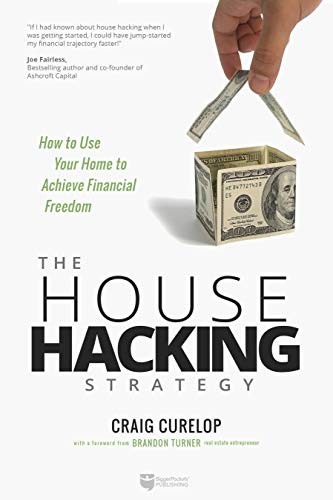
The House Hacking Strategy by Craig Curelop is a 2019 economics book about real estate investing, house hacking, financial independence. House hacking lets you eliminate or drastically reduce your housing costs by having tenants pay your mortgage — often the largest single expense in a household budget.
Summary
House hacking is the practice of buying a multi-unit or single-family property, living in one portion of it, and renting out the rest to offset or eliminate your housing payment. Craig Curelop used this strategy to go from deeply indebted to financially independent in his mid-twenties, and The House Hacking Strategy is his detailed walkthrough of exactly how he did it.
The book covers several variations. A classic house hack means buying a duplex, triplex, or fourplex, occupying one unit, and leasing the others. A single-family hack means renting out spare bedrooms or a finished basement on Airbnb or to long-term tenants. Curelop explains how owner-occupant financing — FHA loans, in particular — lets you enter the market with as little as 3.5 percent down, a threshold far lower than conventional investment property lending requires.
Much of the practical content covers the numbers. Curelop walks through how to analyze a deal: estimating rental income, calculating expenses including vacancy and maintenance, and arriving at cash-on-cash return. He also addresses the less glamorous parts — living next to tenants, managing difficult renters, and accepting short-term discomfort in exchange for long-term wealth. His own experience includes sleeping in a rented living room while his bedrooms generated income.
The strategy's appeal is accessibility. Unlike most real estate investing books, which assume you already have significant capital, house hacking is explicitly designed for people starting from near zero. Curelop is upfront that it requires sacrifice — you live where you invest, often in conditions that are a step down from what you could afford to rent outright. But he frames that sacrifice as temporary and the resulting equity and cashflow as permanent. The book is short and direct, aimed at someone ready to act rather than someone looking for theory.
Talk to The House Hacking Strategy like its author wrote you back.
Get the ideas that fit your life — not generic summaries.
- Chat with the book
- Audiobook-style main ideas
- Adapts to your life and goals
- Helps you take action
Key takeaways
- 1.
House hacking lets you eliminate or drastically reduce your housing costs by having tenants pay your mortgage — often the largest single expense in a household budget.
- 2.
Owner-occupant financing (FHA, conventional 5% down) opens investment properties to buyers who couldn't qualify for a 20-25% investor down payment.
- 3.
Living in the property is temporary. The equity, cash flow, and experience you build are not. Short-term discomfort is the core trade-off the strategy requires.
- 4.
Analyzing a deal comes down to projected rent minus vacancy, expenses, and debt service. If the number is positive or near zero, the house pays for itself.
- 5.
Single-family house hacking through room rentals or ADUs can work even where multifamily zoning is scarce, broadening the geographic range of the strategy.
- 6.
Repeating the strategy — buying, living in, renting out, then moving to the next property — compounds wealth without requiring increasing amounts of capital.
- 7.
Property management is a skill. Setting expectations with tenants early, documenting everything, and maintaining the property prevents most costly disputes.
- 8.
Financial independence through real estate requires time in the market, not timing the market. The first house hack matters more than finding the perfect deal.
Discussion questions
Use these on your own, with a book club, or as chat starters in Superbook. Book club version, ready to copy or print →
- 1.
Curelop frames living discomfort as the price of the strategy. What level of discomfort would you actually tolerate, and for how long?
- 2.
How does house hacking compare to other paths to financial independence you've considered? What does it offer that they don't?
- 3.
The strategy depends on owner-occupant financing. How does your current financial profile — credit score, savings, income — affect your ability to execute it?
- 4.
Curelop used short-term rental platforms aggressively early on. How do local regulations in your market affect that option?
- 5.
What are the actual social costs of living next to or with tenants? How would that affect your relationships or daily life?
- 6.
The book is aimed at people willing to sacrifice comfort now for wealth later. At what point does a good deal stop being worth the personal cost?
- 7.
Curelop recommends repeating the process: buy, live in, move out, repeat. What would need to be true in your life to make that cycle feasible?
- 8.
How do you think about the difference between house hacking as a lifestyle and house hacking as a temporary strategy on the way to something else?
- 9.
What local market conditions make house hacking more or less viable where you live? Are multi-unit properties available and affordable?
- 10.
The book acknowledges landlord-tenant conflict. How would you handle a difficult tenant living steps from your bedroom?
- 11.
Curelop emphasizes running the numbers before buying. What would a minimum acceptable return look like for you, and why?
- 12.
If you couldn't house hack due to life constraints, what elements of the approach could you still apply to your existing housing situation?
Themes
Frequently asked questions
-
What exactly is house hacking?
House hacking means buying a property, living in part of it, and renting out the rest to offset your housing costs. The most common version is buying a small multifamily property and occupying one unit while tenants in the other units pay down the mortgage.
-
Do I need a lot of money to start house hacking?
Not compared to traditional real estate investing. FHA loans allow owner-occupants to purchase with as little as 3.5% down. On a $300,000 property that's about $10,500 plus closing costs — less than a year's rent in many cities.
-
Is The House Hacking Strategy worth reading?
Yes, if you're early in your financial journey and willing to live unconventionally. The book is practical and short. If you're already a seasoned investor or have no interest in living in your investment property, much of it won't apply.
-
Who should read this book?
Young professionals who want to stop paying rent with nothing to show for it and are willing to accept a temporary reduction in living standards. It's also useful for anyone curious about small multifamily investing who doesn't yet understand how owner-occupant financing works.
-
What's the main risk of house hacking?
Vacancy and problem tenants are the most common issues. If a tenant stops paying or the unit sits empty, you're covering the full mortgage yourself. Curelop recommends cash reserves and careful tenant screening to manage this risk.