The Influential Mind: What the Brain Reveals About Our Power to Change Others by Tali Sharot is a 2017 psychology book about influence, persuasion, neuroscience. Most conventional influence tactics — more data, stronger warnings, clearer logic — fail because they don't account for how the brain actually processes persuasion.
Summary
Tali Sharot's second book turns from how our own brains distort perception to how we can change what other people think and do. The premise is that most attempts at influence fail because they rely on methods that are logically intuitive but neurologically counterproductive. Presenting more data, issuing stronger warnings, and framing choices as obligations tend to backfire. The brain responds to being pushed by digging in.
Sharot organizes the book around seven factors the brain uses to evaluate incoming information: emotion, attention, incentives, curiosity, state of mind, other people, and agency. Each chapter presents experimental evidence for how the factor shapes receptivity to influence, followed by practical implications. The most counterintuitive findings involve fear and negative framing. Fear-based messages do trigger attention — the brain is wired to notice threat — but they also trigger avoidance and denial. Telling people what they stand to gain works better than telling them what they'll lose, and this finding runs against how most health, safety, and financial communication is designed.
The chapter on agency is the most applicable. When people feel they chose something themselves rather than being pushed toward it, they hold the belief more strongly and act on it more persistently. This is why open questions sometimes beat directives, and why giving a person partial authorship over an idea is often more effective than giving them a polished argument. The brain's need for autonomy is not a soft management consideration; it's a neurological constraint on persuasion.
The book is a more practical read than The Optimism Bias and covers similar neuroscientific ground with more emphasis on application. The research is solid, though some of the prescriptions require more nuance than the chapter summaries provide. It works best as a reframe of influence away from argument and toward environment — shaping the conditions under which someone forms their own conclusion.
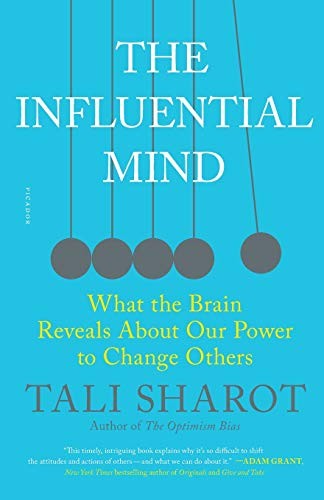
Talk to The Influential Mind: What the Brain Reveals About Our Power to Change Others like its author wrote you back.
Get the ideas that fit your life — not generic summaries.
- Chat with the book
- Audiobook-style main ideas
- Adapts to your life and goals
- Helps you take action
Key takeaways
- 1.
Most conventional influence tactics — more data, stronger warnings, clearer logic — fail because they don't account for how the brain actually processes persuasion.
- 2.
Emotion comes before reason. Information delivered in an emotional context is processed differently and remembered better than the same information presented neutrally.
- 3.
Fear-based messages get attention but trigger avoidance and denial. Gain framing consistently outperforms loss framing in motivating action.
- 4.
The brain is wired to update beliefs more readily when the source is trusted. Credibility is a precondition for influence, not a supplement to good argument.
- 5.
Curiosity is a powerful motivator. Creating an information gap — signaling that something important is unknown — draws attention more effectively than presenting conclusions.
- 6.
Agency is a neurological requirement. When people feel coerced, the brain pushes back. When people feel they chose, they hold the belief more strongly and act more persistently.
- 7.
Social proof works because the brain uses others' behavior as information about what's safe and correct. Showing what the majority does shifts individuals more reliably than exhortation.
- 8.
Prior state matters. The same message lands differently depending on the listener's current emotional and physical state — tired, hungry, anxious, or calm produce different responses.
Discussion questions
Use these on your own, with a book club, or as chat starters in Superbook. Book club version, ready to copy or print →
- 1.
Think of a time you tried to change someone's mind by presenting more evidence. What happened? In hindsight, what else might have worked?
- 2.
Sharot argues fear-based communication backfires. Where do you see this principle violated in public health messaging, parenting, or management?
- 3.
The agency chapter argues that co-creation beats presentation. When in your work or personal life could you give someone partial authorship over an idea you want them to adopt?
- 4.
Sharot finds that people update beliefs more readily when information comes from a trusted source. How do you decide who to trust, and how conscious is that process?
- 5.
The curiosity chapter suggests opening a question works better than delivering an answer. Can you think of a situation where you could deploy this instead of leading with your conclusion?
- 6.
Think of someone in your life who consistently changes your mind. What do they do that makes them effective?
- 7.
The book discusses how the same information lands differently depending on mood and physical state. Has timing ever made the difference in how a conversation went?
- 8.
Sharot's findings on social proof suggest people follow what others do more than they follow argument. Is this unsettling, useful, or both?
- 9.
Where in your life are you trying to influence someone using tactics the book would predict will fail?
- 10.
The book is about influence, but the techniques it describes can be used manipulatively. Where do you draw the line between influence and manipulation?
- 11.
Sharot argues that positive incentives outperform negative ones. Think of a system in your life — a rule, a policy, a structure — built around punishment or fear. What would a redesign around positive incentives look like?
Themes
Frequently asked questions
-
What is The Influential Mind about?
It's a neuroscience-based account of how to change people's minds. Sharot organizes her argument around seven factors — emotion, attention, incentives, curiosity, state of mind, social influence, and agency — and shows how each shapes whether a message is received or rejected.
-
Is The Influential Mind worth reading?
Yes, especially if you work in communication, management, public health, or parenting. The research is solid and the writing is clear. Some prescriptions are compressed into chapter summaries that warrant more nuance, but the core reframe — from argument to environment — is practically useful.
-
How is The Influential Mind different from Influence by Robert Cialdini?
Cialdini's Influence is a classic catalog of persuasion principles drawn from social psychology research. Sharot's book is rooted more specifically in neuroscience and is more focused on the conditions under which influence succeeds or fails. They complement each other rather than overlap.
-
Who should read The Influential Mind?
Anyone who regularly needs to persuade — managers, teachers, public health communicators, salespeople, parents — and anyone curious about why their communication efforts sometimes miss even when they feel logical and clear.
-
What's the most actionable takeaway from The Influential Mind?
The agency principle: people hold beliefs more strongly when they feel they chose rather than were pushed. Practically, this means asking questions that lead someone toward a conclusion rather than presenting the conclusion directly, and giving partial authorship over ideas you want them to adopt.
Similar books
Thinking, Fast and Slow
Daniel Kahneman
Influence: The Psychology of Persuasion
Robert B. Cialdini
Never Split the Difference
Chris Voss

The Optimism Bias: A Tour of the Irrationally Positive Brain
Tali Sharot
