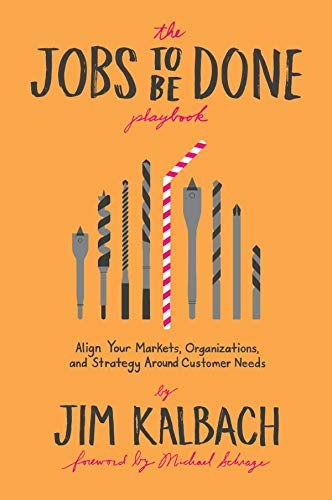
The Jobs To Be Done Playbook by Jim Kalbach is a 2020 business book about customer research, product development, innovation. Customers hire products to get a job done. Understanding the job — the progress they're trying to make — predicts behavior better than demographic or psychographic profiles.
Summary
Jim Kalbach's The Jobs To Be Done Playbook is a practitioner's guide to applying the jobs-to-be-done framework in product development and innovation work. The JTBD idea — that customers "hire" products to perform specific jobs in their lives, and that understanding the job rather than the customer demographic predicts purchase behavior better — originated with Clayton Christensen, but Kalbach's contribution is translating it into workshop exercises, research protocols, and team activities that non-academics can run.
The book is structured as a playbook in the literal sense: each chapter introduces a concept and then provides one or more tools or activities for applying it. Core tools include job mapping (diagramming the sequence of steps a customer goes through in trying to accomplish a job), outcome statements (precise articulations of what success looks like for the customer in measurable terms), and job stories (a variant of user stories that captures context and motivation rather than just role and action). Kalbach draws on multiple JTBD traditions — Christensen's innovation theory, Tony Ulwick's outcome-driven innovation, and the design-focused variant popularized by Intercom — without claiming any one is definitive.
The framework's power is in what it shifts attention toward. Demographic and behavioral data tell you who buys and what they do. JTBD research tries to answer why — what situation prompted the purchase, what were they trying to accomplish, what did they try before, what trade-offs were they willing to make. This kind of context is harder to collect than a survey response but much more useful for making product and positioning decisions.
The Playbook is practical rather than theoretical, which is both its strength and its limitation. Readers looking for a rigorous examination of where JTBD theory holds and where it doesn't will need to supplement it. But for a team that understands the concept and wants to run actual research or workshops, it's the most immediately usable resource available.
Talk to The Jobs To Be Done Playbook like its author wrote you back.
Get the ideas that fit your life — not generic summaries.
- Chat with the book
- Audiobook-style main ideas
- Adapts to your life and goals
- Helps you take action
Key takeaways
- 1.
Customers hire products to get a job done. Understanding the job — the progress they're trying to make — predicts behavior better than demographic or psychographic profiles.
- 2.
The same product can be hired for different jobs by different customers. A milkshake bought in the morning commute is a different product than one bought after a family dinner, even if it's the same item.
- 3.
Job mapping documents the steps a customer goes through to accomplish a job, revealing where existing solutions fall short and where new solutions might find a foothold.
- 4.
Outcome statements capture what customers are trying to achieve in measurable, solution-neutral language. They are the basis for evaluating whether a product actually does the job.
- 5.
Job stories replace persona-driven user stories with context and causality: when I'm in a specific situation, I want to make progress in this direction, so I can achieve this outcome.
- 6.
The JTBD framework has multiple schools with different emphases. Christensen focuses on disruptive innovation, Ulwick on outcome measurement, and the design tradition on motivation and context. Each is useful for different research questions.
- 7.
Switching research — understanding what prompted a customer to stop using one solution and start using another — reveals more about what makes a product valuable than satisfaction surveys do.
- 8.
JTBD is a research lens, not a complete product strategy. It tells you what job to solve, not how to solve it or whether the market is large enough to justify the investment.
Discussion questions
Use these on your own, with a book club, or as chat starters in Superbook. Book club version, ready to copy or print →
- 1.
What job does your core product get hired to do, in the customer's language rather than the product's feature list?
- 2.
Think of a product you use regularly. What job were you trying to get done the first time you 'hired' it, and is that still the primary job you're using it for?
- 3.
Where in your organization do demographic or behavioral frameworks dominate research? What questions aren't being asked as a result?
- 4.
Map one job your customers try to do that your product is involved in. At which step in the job map is the experience worst, and why?
- 5.
Kalbach describes multiple JTBD schools. Which one resonates most with how your team thinks about customers, and what does that tell you?
- 6.
What would your product roadmap look like if it were organized by the jobs customers hire you for rather than by features or technology?
- 7.
Have you or your team done switching research — asked customers what they stopped using before your product? What did you learn or what would you expect to learn?
- 8.
Write an outcome statement for the primary job one of your customers is trying to accomplish. Is it measurable and solution-neutral, or does it sneak in your product's approach?
- 9.
Where does JTBD thinking create friction with the way your organization currently does product development or customer research?
- 10.
The framework shifts focus from who buys to why they buy. Where in your sales or marketing process is that shift most needed?
- 11.
What's a recent product decision your team made that JTBD research might have changed? What information was missing?
- 12.
Kalbach says JTBD is a lens, not a complete strategy. What other frameworks does your team use alongside it, and how do they fit together?
Themes
Frequently asked questions
-
What is The Jobs To Be Done Playbook about?
It's a practical guide to applying the jobs-to-be-done framework through research activities and workshop tools. Kalbach explains the core concepts and provides methods like job mapping, outcome statements, and job stories that teams can use directly in product development and customer research.
-
Do I need to read Clayton Christensen first?
No. The Playbook introduces the framework from the ground up and references multiple JTBD traditions. Reading Competing Against Luck afterward will add theoretical depth, but the Playbook is self-contained for practitioners.
-
Who should read The Jobs To Be Done Playbook?
Product managers, UX researchers, and design team leads who want to run JTBD-based research or workshops. It's most useful for people who already understand the concept at a high level and want concrete methods for applying it.
-
How does JTBD differ from traditional user personas?
Personas describe who buys; JTBD describes why they buy and what they're trying to accomplish. JTBD proponents argue that demographic personas don't predict behavior well because the same person hires different products for different jobs in different contexts.
-
Is The Jobs To Be Done Playbook worth reading?
Yes, if you work in product development and find traditional customer research insufficient for making good decisions. The tools are immediately usable. If you want a more rigorous theoretical treatment, pair it with Competing Against Luck.
Similar books
Competing Against Luck
Clayton M. Christensen

Contagious: Why Things Catch On
Jonah Berger
This Is Marketing: You Can't Be Seen Until You Learn to See
Seth Godin
Blue Ocean Strategy
W. Chan Kim and Renée Mauborgne
