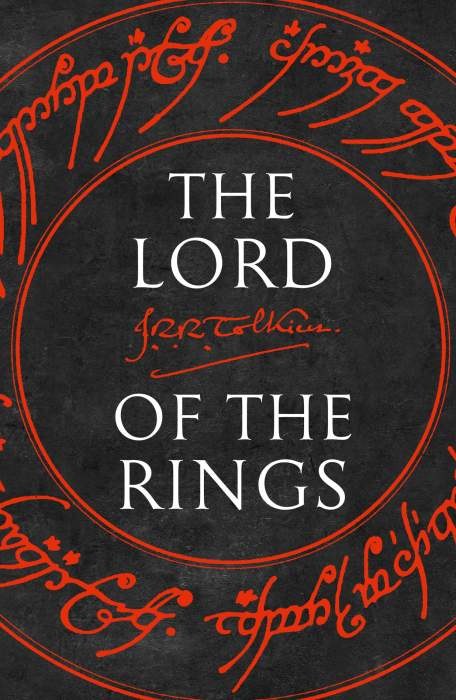
The Lord of the Rings by J.R.R. Tolkien is a 1954 philosophy book about good and evil, friendship and loyalty, power and corruption. Power corrupts even the well-intentioned: Gandalf, Galadriel, and Boromir all recognize that the Ring would remake them, and the wise refuse it precisely because they know how good they could make it seem.
Summary
The Lord of the Rings is a single novel published in three volumes between 1954 and 1955. Tolkien conceived it as a mythology for England — a body of legend rooted in invented languages, deep histories, and a consistent cosmology — and the story of the One Ring is the latest chapter in a history that spans thousands of years. The main narrative follows Frodo Baggins, a hobbit from the Shire, who inherits a ring of immense destructive power and must travel across Middle-earth to destroy it in the volcanic fires where it was made.
The book's moral framework is unusual among fantasy. Tolkien is not optimistic about heroism in the conventional sense. Power corrupts — even the good and the wise. Gandalf refuses the Ring because he knows it would remake him. Frodo, at the moment of the book's climax, fails: he cannot give it up. The Ring is destroyed not through an act of will but through providence and pity — Frodo's earlier mercy toward Gollum becomes, against all expectation, the mechanism of salvation. Tolkien called this kind of reversal "eucatastrophe," a sudden turn for the good that exceeds what could have been earned. It is central to his understanding of what stories are for.
The writing is deliberately archaic, and the pacing is not cinematic. Tolkien invests heavily in geography, genealogy, and history — appendices run to over a hundred pages. The books he loved were Norse sagas, Old English poetry, Finnish mythology. He wanted his work to carry that same weight of age. Critics have divided sharply over whether this succeeds. Some readers find the world's density oppressive; others find it the source of the books' emotional power — the sense that loss, which pervades the story, is loss of something real and long.
The Lord of the Rings is among the most influential works of fiction of the twentieth century, not because it invented fantasy but because it gave the genre its depth model — the sense that an imagined world could have the texture and weight of history. Almost every work of secondary-world fantasy since, in prose, film, and games, has had to position itself in relation to it.
Talk to The Lord of the Rings like its author wrote you back.
Get the ideas that fit your life — not generic summaries.
- Chat with the book
- Audiobook-style main ideas
- Adapts to your life and goals
- Helps you take action
Key takeaways
- 1.
Power corrupts even the well-intentioned: Gandalf, Galadriel, and Boromir all recognize that the Ring would remake them, and the wise refuse it precisely because they know how good they could make it seem.
- 2.
Tolkien's concept of eucatastrophe — a sudden reversal of fortune that exceeds what was earned — is the book's deepest structural principle, enacted when Gollum's destruction of the Ring saves the world.
- 3.
The humble and overlooked are often the most capable of bearing the unbearable: hobbits succeed where greater beings would fail because they have less ambition to be corrupted.
- 4.
Loss is the emotional center of the book. The elves are departing, Lothlorien will fade, the Shire is nearly lost. Even in victory, much that was beautiful cannot be saved.
- 5.
The languages, histories, and appendices are not decoration: they create the illusion of depth that makes the moral stakes feel real. Tolkien understood that myth requires history behind it.
- 6.
Friendship and loyalty, not heroism in the martial sense, drive the story forward. Samwise Gamgee's fidelity to Frodo is the moral engine of the final third.
- 7.
The book is suspicious of industrial power. Saruman's machine-building and the Scouring of the Shire are Tolkien's most direct commentary on modernity and the damage it does to settled, rooted life.
- 8.
Pity and mercy are presented not as sentimental weaknesses but as structural necessities: Bilbo's and Frodo's mercy toward Gollum is what makes the story's resolution possible.
Discussion questions
Use these on your own, with a book club, or as chat starters in Superbook. Book club version, ready to copy or print →
- 1.
Tolkien said power is most dangerous to those who want to use it for good. Do you see this logic operating in people or institutions you know — and do you find it convincing?
- 2.
Frodo fails at the moment of decision — he cannot give up the Ring. Tolkien presents this not as a moral failure but as a tragedy, redeemed by earlier mercy. How do you read that choice?
- 3.
The book is saturated with loss: the passing of the elves, the fading of magic, the price of victory. Does Tolkien's elegiac tone enhance the story for you or work against it?
- 4.
Sam is often described as the true hero of the story. Do you agree? What does the book say about which virtues are most necessary in a genuine crisis?
- 5.
Tolkien was writing partly in response to the two world wars. Where do you see that influence in the text — and does it change how you read the story?
- 6.
The appendices and deep history give the world weight, but they also slow and expand the book enormously. Do you think that density is essential to what the book achieves, or could it work without it?
- 7.
The industrialization represented by Saruman and Mordor is presented as straightforwardly evil. Is Tolkien's anti-industrial stance a strength of the book or a limitation?
- 8.
How does the book's treatment of fate and free will work? Is Frodo fated to fail with the Ring, or does he make a genuine choice?
- 9.
Tolkien invented languages before he wrote stories to go with them. What does it tell us about the relationship between language, culture, and fiction that the books grew this way?
- 10.
The Lord of the Rings defined what secondary-world fantasy is. Is that influence primarily positive for the genre — or has it also constrained what fantasy can imagine?
- 11.
Gollum is the most complex character in the book — he is what Frodo might become, and the mechanism of the story's resolution. What do you make of Tolkien's treatment of him?
- 12.
The Shire is explicitly an idealized version of pre-industrial rural England. What does that nostalgia do to the book's politics — and does it matter?
Themes
Frequently asked questions
-
How long does it take to read The Lord of the Rings?
At average reading pace, around 30 to 35 hours for the full three volumes, not counting the appendices. Many readers take several weeks, reading in sessions. The pacing is deliberately slow in places, and some chapters — the Council of Elrond, the histories — require patience. Most readers find the final third of The Return of the King moves considerably faster.
-
Is The Lord of the Rings worth reading if you've seen the films?
Yes. The films are excellent but substantially different: they accelerate the pacing, collapse the tone, and remove much of what makes the book's world feel deep. The book's treatment of loss, the appendices, and the Scouring of the Shire are all missing from the films. They are different experiences.
-
What order should I read Tolkien's books in?
The Hobbit first, then The Lord of the Rings. The Silmarillion is best read after both, and even then it's a reference text more than a novel. The appendices to The Return of the King are worth reading after the main text if you want the history.
-
Is The Lord of the Rings a Christian allegory?
Tolkien explicitly denied it was an allegory — he disliked allegory and preferred what he called applicability. But his Catholic worldview is deeply embedded in the structure, particularly in the eucatastrophe concept, the treatment of providence, and the ethics of power and humility. It is not allegorical but it is theological.
-
Why is the pacing so slow in places?
Tolkien was writing a mythology, not a plot-driven novel. Slow passages — the Tom Bombadil episode, the stay in Lothlorien, the Council of Elrond — are partly about establishing the reality and depth of the world, and partly about giving the reader time to feel the weight of what is at stake. Whether this works is a matter of temperament.