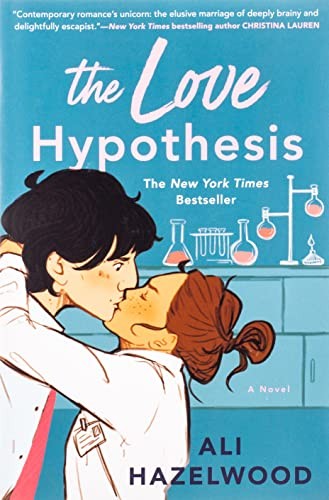
The Love Hypothesis by Ali Hazelwood is a 2021 romance book about fake dating, academia and ambition, stem women and imposter syndrome. Hazelwood's key innovation: grounding the fake-dating romance in doctoral research creates stakes that feel real because the career consequences of academic failure are genuinely severe.
Summary
Olive Smith is a third-year biology PhD student who impulsively kisses a stranger to convince her friend that she's moved on from her ex. The stranger is Adam Carlsen, the most feared and least liked professor in the department — cold, demanding, and improbably attractive. When the kiss is witnessed by exactly the wrong people, the two agree to fake-date to maintain the story, with each having a different motive for playing along. What follows is the standard slow-burn fake-dating arc, delivered with unusual specificity because Hazelwood writes academia from the inside.
The Love Hypothesis became a genuine phenomenon — it began as a fan fiction piece and was adapted into a traditionally published novel that sold millions of copies and launched the "STEMinist romance" subgenre. Hazelwood's specific innovation is embedding the romance in a world readers who went to graduate school recognize: the funding anxiety, the advisor power dynamics, the chronic imposter syndrome, the way academic hierarchies can trap people in terrible situations and call it normal. Olive's insecurity about her research and her future in science is the novel's emotional substrate, and it gives the romance more weight than the premise alone would generate.
Adam Carlsen is the novel's structural challenge. He is distant, demanding, and initially incomprehensible, and Hazelwood has to make him sympathetic without explaining him too quickly. She manages this mostly through comic contrast: Adam's internal warmth shows up in specific behaviors (protecting Olive's research funding, showing up without announcement) before it shows up in words. The slow-burn mechanism is well-calibrated. The explicitly sexual content, when it arrives, is frank and warm.
The novel has real weaknesses: the academic villain is cartoonish, some of the supporting characters are thinly drawn, and Olive's self-deprecation occasionally edges into self-erasure in a way that the novel endorses rather than examines. But as a debut novel in a genre it helped define, it delivers. Readers who like romance, academia, and female STEM protagonists will find it sharply pleasurable.
Talk to The Love Hypothesis like its author wrote you back.
Get the ideas that fit your life — not generic summaries.
- Chat with the book
- Audiobook-style main ideas
- Adapts to your life and goals
- Helps you take action
Key takeaways
- 1.
Hazelwood's key innovation: grounding the fake-dating romance in doctoral research creates stakes that feel real because the career consequences of academic failure are genuinely severe.
- 2.
Olive's imposter syndrome isn't just characterization — it's the emotional engine of the novel. The romance arc is inseparable from her learning to believe her own work has value.
- 3.
The advisor-student power dynamic is handled with more care than many readers expected from a romance novel. Hazelwood doesn't pretend it doesn't exist, and the plot actively addresses it.
- 4.
Adam's apparent coldness is revealed as a protection mechanism developed in response to specific past experiences — the reveal is credible rather than a convenient retcon.
- 5.
The STEM setting allows Hazelwood to write about the specific exhaustion of women in male-dominated fields — the constant underestimation, the need to prove oneself twice — in a format that reaches readers who wouldn't pick up a more explicitly feminist text.
- 6.
The fake-dating conceit works precisely because both characters have real, non-romantic reasons to maintain the fiction — that bilateral investment is what makes the eventual honesty fraught.
- 7.
The novel began as fan fiction and carries traces of that origin in its structure: it knows what genre satisfaction looks like and delivers it with confidence.
- 8.
Hazelwood writes the physical intimacy scenes with specificity and warmth — neither clinical nor purple. They're among the more honest depictions of adult sexual desire in popular romance fiction.
Discussion questions
Use these on your own, with a book club, or as chat starters in Superbook. Book club version, ready to copy or print →
- 1.
Olive's imposter syndrome is persistent and sometimes paralyzing. Does the novel fully resolve it, or does it sidestep the harder work by substituting romantic validation for professional confidence?
- 2.
The advisor-advisee power dynamic between Olive and Adam is real and the novel acknowledges it. Does Hazelwood handle the ethics of their relationship adequately, or does romance logic paper over the structural issues?
- 3.
Adam is initially read by the entire department as cold, demanding, and impossible. The novel reveals he is actually protective and warm. Is that reveal convincing? Did it feel like the novel arguing against snap judgments, or like it backfilling to redeem a bad-tempered character?
- 4.
The academic villain (Dr. Hale) is cartoonishly malevolent. Does that level of villainy undermine the novel's otherwise grounded treatment of academic politics?
- 5.
Olive consistently downplays her own intelligence and contributions. The novel rewards her with a partner who sees her clearly. Is that a satisfying arc, or does it suggest that self-worth requires external validation to be real?
- 6.
The Love Hypothesis originated as fan fiction. Does knowing that context change how you read it — the structure, the character types, the emotional beats?
- 7.
The novel was credited with launching the "STEMinist romance" subgenre. What does the appetite for STEM-set romance fiction tell us about the readers those novels reach?
- 8.
Adam and Olive's fake dating is visible to their colleagues. How does the social performance aspect of fake dating — keeping up a story for an audience — change the emotional stakes compared to a private lie?
- 9.
The novel is almost entirely in Olive's perspective. What would it look like from Adam's? What would we gain or lose?
- 10.
The ending is decisive and satisfying. Does Hazelwood earn it? What work did the novel have to do to make it feel genuinely resolved rather than simply decreed?
- 11.
Olive's female friendships in the novel are warm but not central. Does the romance's centrality crowd out other relationship types in a way that limits the book?
Themes
Frequently asked questions
-
Is The Love Hypothesis fan fiction?
It originated as a fan fiction piece before being substantially revised and traditionally published. The published novel stands alone — no knowledge of the original fandom is needed or helpful.
-
Is The Love Hypothesis explicit?
Yes, there are explicit sexual scenes. The novel is an adult romance and does not fade to black. The explicitly sexual content is warm and relatively tame compared to erotic romance, but readers who prefer closed-door romance should know what to expect.
-
Is the science accurate?
Broadly yes — Hazelwood is a working neuroscientist, and the academic culture, funding dynamics, and research anxieties in the novel are recognizable to anyone who has been in a PhD program. The specific biology is simplified for narrative purposes.
-
Does this book work if you haven't been to graduate school?
Yes. The academic setting adds specificity but the emotional arc — imposter syndrome, the fear of being seen, the slow revelation of mutual feeling — is accessible to anyone. Non-academics report finding the university world vivid and engaging.
-
Who shouldn't read The Love Hypothesis?
Readers who find female self-deprecation frustrating as a character tic — Olive's internal voice involves a lot of downplaying her own intelligence and worth. The novel ultimately challenges that tendency, but it takes a while, and the road there involves a lot of it.