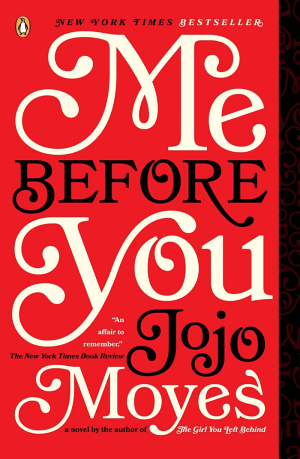
Me Before You by Jojo Moyes is a 2012 romance book about disability and autonomy, love and letting go, class and ambition. The novel's most controversial choice — letting Will proceed with his decision — is also its most defensible one. Moyes refuses to let love override autonomy, which is unusual in popular romance fiction.
Summary
Louisa Clark is twenty-six, cheerfully aimless, and loses her job at the local café on the same day. Desperate for work, she takes a position as companion and caregiver to Will Traynor, a thirty-five-year-old former high-powered banker who was injured in a motorcycle accident two years earlier and is now quadriplegic. Will is brilliant, sarcastic, and comprehensively uninterested in being cheered up. Louisa is persistent, awkward, and genuinely good. The collision of these two people in a converted coach house in rural England is the engine of the novel.
What follows is a love story with a moral argument built into its ending that the novel refuses to soften. Will has told his parents he will agree to a six-month waiting period before proceeding with an assisted death in Switzerland. The six months is the novel's timeframe. Moyes uses it to explore what autonomous personhood means when a body no longer does what a person needs it to do — and to refuse the easy answer that love makes such questions irrelevant. Louisa comes to love Will; Will clearly loves Louisa; the book ends the way it ends, and the response to that ending is the book's real test.
Me Before You works because Moyes writes both characters with enough specificity that their relationship earns its emotional weight. Lou's family is vivid — her parents, her sister Treena, her damp and decent boyfriend Patrick — and the contrast between Lou's working-class Stortford life and Will's wealthy, formerly expansive existence is handled with tact rather than caricature. The prose is efficient, warm, and occasionally very funny.
The novel became a massive bestseller and sparked genuine debate about disability representation and the message it sends about life with quadriplegia. The disability rights community had serious objections; those objections are worth knowing about before reading. The book is not a polemic — it is a love story told from Lou's perspective, not Will's — but its emotional logic does arrive at a position. Readers who found that position devastating rather than dishonest will get something real from this book. Those who found it dishonest will find that the skill of the writing makes it more troubling, not less.
Talk to Me Before You like its author wrote you back.
Get the ideas that fit your life — not generic summaries.
- Chat with the book
- Audiobook-style main ideas
- Adapts to your life and goals
- Helps you take action
Key takeaways
- 1.
The novel's most controversial choice — letting Will proceed with his decision — is also its most defensible one. Moyes refuses to let love override autonomy, which is unusual in popular romance fiction.
- 2.
Lou Clark is one of popular fiction's better heroines: genuinely funny, specifically working-class, perceptive without being implausibly wise. Her voice carries the novel.
- 3.
Will's sarcasm is the book's other great pleasure — he is genuinely witty in a way that earns the reader's respect before he earns sympathy.
- 4.
The class contrast between Lou and Will is handled without condescension in either direction. Moyes understands both worlds without romanticizing either.
- 5.
The disability rights critique of the novel — that it implicitly endorses the idea that life with severe disability is not worth living — is substantive and worth engaging with alongside the reading.
- 6.
The secondary characters (Lou's family, Will's parents, Nathan the nurse) are unusually well-drawn for popular fiction and carry real weight in the story.
- 7.
The book's emotional engine is the expansion of Lou's world — she becomes larger through her relationship with Will in ways that continue after him. That arc is the real answer to what the book is about.
- 8.
Moyes structures the novel with craft: the comedy of the first act, the deepening of the second, the sustained difficulty of the third. The tonal control is what makes the ending survivable.
- 9.
The novel does not resolve the moral question it raises. It refuses to tell you whether Will made the right decision. That refusal is its most honest quality.
Discussion questions
Use these on your own, with a book club, or as chat starters in Superbook. Book club version, ready to copy or print →
- 1.
Will decides to end his life despite having established a meaningful relationship with Lou. Does the novel present this as the right decision, or does it stay neutral? Do you think it's the right decision?
- 2.
The disability rights movement has argued that the novel reinforces the idea that life with quadriplegia isn't worth living. Do you think that critique is fair? How does the novel handle it, or fail to handle it?
- 3.
Lou's trajectory — from aimless to purposeful — is driven entirely by Will's influence. Is that a feminist narrative or an anti-feminist one?
- 4.
Will is occasionally cruel to Lou before he trusts her. The novel treats this cruelty as earned by his situation. Do you agree? How much does his suffering justify his behavior?
- 5.
The novel is told from Lou's perspective, not Will's. How does that choice shape what we know about Will's interiority and the weight we give his decision?
- 6.
Lou's family — especially her mother and sister — are more present in this novel than is usual for romance. How do they shape the emotional landscape?
- 7.
Patrick, Lou's boyfriend, is affable and completely wrong for her. Is he treated fairly by the narrative?
- 8.
The book ends with Will's death and Lou at a cafe in Paris, using the money he left her. Is that ending hopeful, or is it unsatisfying?
- 9.
Moyes has said the book is about seizing life, not about assisted dying. Do you think those two readings of the novel can coexist, or does the ending fix the meaning?
- 10.
How does the class difference between Lou and Will function in the novel — does it complicate their relationship in interesting ways, or is it mostly background?
- 11.
The novel was adapted into a film. If you saw it: what does the film do differently, and does it change the moral weight of the ending?
- 12.
By the end, Lou has become someone new. Is that transformation believable? Is it earned?
Themes
Frequently asked questions
-
Does Will die at the end of Me Before You?
Yes. Will proceeds with his plan for an assisted death in Switzerland. This is widely known and the novel does not treat it as a surprise twist — knowing it in advance doesn't ruin the reading experience, and may actually help you engage with the moral argument as you read.
-
Is Me Before You a tearjerker?
Yes, significantly. Most readers report crying at the ending, and many report crying well before it. The book earns its emotional register — it isn't manipulative so much as relentless.
-
Is Me Before You problematic?
Disability rights advocates have argued that the novel sends a harmful message — that severe disability makes life not worth living, and that a disabled person's decision to die is romantic rather than troubling. That critique deserves serious consideration alongside the reading.
-
Is the sequel worth reading?
After You follows Lou after Will's death and has a more conventional romantic plot. Most readers find it lesser — it doesn't have the moral weight of the original — but it's an easy, warm read for those who want more of Lou.
-
Who shouldn't read Me Before You?
Readers who have personal experience with disability, assisted dying, or grief may find it too close. The novel doesn't handle its subject with the nuance of literary fiction, and some of its implications are easier to accept in a spirit of emotional surrender than critical analysis.