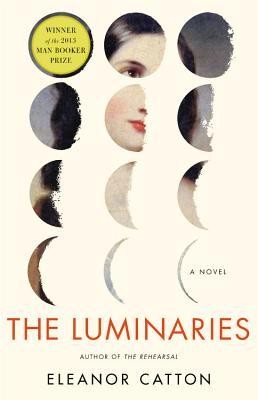
The Luminaries by Eleanor Catton is a 2013 literary fiction book about fortune and fate, truth and deception, gold rush society. The halving structure — chapters that shrink from hundreds of pages to a few as the novel approaches its center — enacts the novel's argument about fate: the closer you get to the event, the less room for free movement.
Summary
The Luminaries is set in Hokitika, a New Zealand gold-rush town, in 1866. Walter Moody arrives in a stormy harbor and blunders into a secret meeting of twelve men, each connected to a cluster of unsolved mysteries: a missing fortune, a man found dead drunk in his cottage, and a woman discovered near death in the road. Over the following eight hundred pages Moody hears each man's account of events, and the reader slowly reconstructs what actually happened.
Catton's formal achievement is staggering and imposes a real cost on the reading experience. The novel is structured according to astrological principles: twelve characters correspond to zodiac signs, seven to planetary bodies, and the chapters halve in length as the book progresses, moving from weeks to hours in its final section. This is not decoration. The structure argues that individual freedom operates within forces and patterns the characters cannot perceive — and that the novel's mystery, like astrology itself, concerns the relationship between visible events and hidden causation. Whether you find this brilliant or excessive will determine your experience of the book.
The prose is a sustained Victorian pastiche — Catton writes with remarkable fidelity to the rhetoric of sensation fiction, the penny press, and the legal document. The period detail is dense and earned. The New Zealand setting is vividly rendered without condescension: the Maori characters are given interiority, and the colonial economy's relationship to race, sex, and class is part of the texture of the narrative rather than its explicit subject.
The Luminaries won the Man Booker Prize in 2013, making Catton the youngest ever winner at twenty-eight. It is a novel that rewards the reader who brings patience and the ability to hold a large cast in mind. It is also genuinely the longest literary novel on most Booker lists, and the structural conceits, however elegant, do produce passages of considerable monotony. The comparison is to Umberto Eco's The Name of the Rose for formal erudition deployed in genre: both novels use a mystery's architecture to do philosophical work.
Talk to The Luminaries like its author wrote you back.
Get the ideas that fit your life — not generic summaries.
- Chat with the book
- Audiobook-style main ideas
- Adapts to your life and goals
- Helps you take action
Key takeaways
- 1.
The halving structure — chapters that shrink from hundreds of pages to a few as the novel approaches its center — enacts the novel's argument about fate: the closer you get to the event, the less room for free movement.
- 2.
The twelve zodiacal men and seven planetary characters are not allegorical in a crude sense. Catton uses astrology as a structural logic, not a symbolic code — the configurations predict tendency, not outcome.
- 3.
Anna Wetherell is the novel's moral center, though she is the character most subjected to others' interpretations of her. How the twelve men read her — prostitute, victim, schemer, survivor — is itself the novel's subject.
- 4.
The gold rush setting is not nostalgic. Hokitika is a town of extraordinary violence and instability, where fortunes evaporate and identities are reassembled constantly. The setting makes the themes concrete.
- 5.
The Victorian pastiche is not parody. Catton inhabits the rhetoric of the period — the legal document, the sensation novel, the newspaper — to show how language constructs social reality.
- 6.
Emery Staines and Anna Wetherell's relationship is the novel's emotional engine, but it is deliberately kept offstage. What the reader gets are other people's accounts of it — which is itself a structural argument about how stories are made.
- 7.
The mystery resolves, but the novel's final effect is not one of explanation. The sense you carry away is of vast, mostly invisible forces moving people around — which is either a cosmic vision or a bleak one, depending on your tolerance for determinism.
- 8.
Catton wrote the novel at twenty-five and published it at twenty-seven. The formal ambition is so conspicuous that it becomes a subject of the book: what it means to impose a system of order on human chaos.
Discussion questions
Use these on your own, with a book club, or as chat starters in Superbook. Book club version, ready to copy or print →
- 1.
The novel's chapters halve in length as it moves forward. Did you notice that structure as you read, and did it affect your experience of the final sections?
- 2.
The twelve men in the Crown Hotel are divided by the novel into zodiacal types. Did you find yourself matching characters to their signs, or did that framework remain background noise?
- 3.
Anna Wetherell is read and interpreted by almost every other character. Does the novel ever give her a perspective that escapes their readings, or is she permanently defined by how others see her?
- 4.
The period pastiche is sustained for nearly five hundred pages. Did it feel authentic and transporting, or did you find it exhausting as a register to sustain?
- 5.
Alistair Lauderback is a politician whose vanity drives several of the novel's complications. Does the novel satirize political ambition, or treat it as just another form of human vulnerability?
- 6.
The gold rush economy is presented as a kind of controlled chaos — everyone is seeking transformation through luck, and luck is distributed randomly. Is that a critique of capitalism, or a neutral description of it?
- 7.
The Maori characters are not central to the novel's mystery but are given real presence. Did Catton handle the colonial context in a way that felt substantive, or backgrounded in a way that felt evasive?
- 8.
The novel won the Booker despite its extraordinary length and formal difficulty. Does prestige affect how you approach a novel — do you work harder at it?
- 9.
Compared to The Name of the Rose, which also uses a genre framework (medieval mystery) to carry philosophical weight, where does The Luminaries succeed and where does it feel like the formal game overcomes the human story?
- 10.
The ending refuses complete resolution — the final section is so compressed that we get events rather than explanations. Was that satisfying or frustrating?
- 11.
Catton has said the novel is about how we read other people, not just about the gold rush. Do you think that thematic argument is legible in the reading experience, or does the formal architecture obscure it?
- 12.
The Luminaries is very long. If you were recommending it, what would you tell a prospective reader about what to expect?
Themes
Frequently asked questions
-
Is The Luminaries worth reading?
For readers who enjoy structurally ambitious literary fiction, yes. It is a remarkable formal achievement and the period detail is superb. For readers who find formal conceits distracting or who want pace and momentum, it is a serious undertaking that may not pay off.
-
How long is The Luminaries, and should I be warned?
Around 830 pages. The first 400 are dense and can be slow — you are building a large cast and a complex web of relationships. The second half moves faster. Most readers find it demands sustained commitment over several weeks.
-
Do I need to know astrology to understand The Luminaries?
No. The astrological structure operates as an organizing principle that scholars and attentive readers can decode, but the novel's story and characters are accessible without it. Knowing astrology adds a layer; not knowing it doesn't subtract one.
-
Is there an adaptation of The Luminaries?
A BBC/TVNZ miniseries adaptation aired in 2020. It covers roughly the first half of the novel and simplifies the structure significantly. It is visually sumptuous but loses most of the formal complexity. Worth watching as a companion.
-
Who shouldn't read The Luminaries?
Readers who require emotional identification with a single protagonist. The novel distributes attention across nineteen characters. Readers who want forward momentum: the first half in particular requires patience to hold the accumulating information.