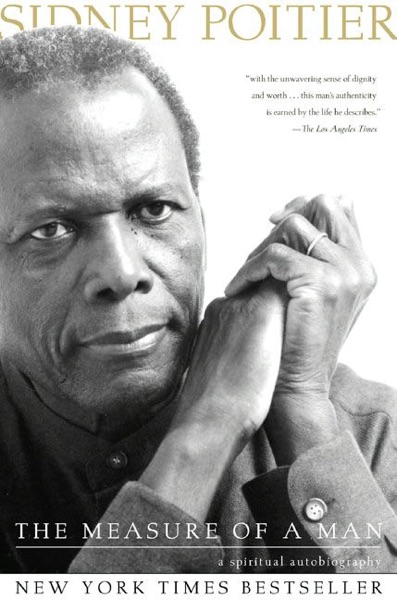
The Measure of a Man: A Spiritual Autobiography by Sidney Poitier is a 2000 memoir book about identity, race and dignity, character. Poitier's framework for a meaningful life comes primarily from his father: a poor Bahamian farmer whose dignity under hardship shaped everything Poitier aspired to.
Summary
The Measure of a Man is Sidney Poitier's reflective autobiography, published when he was in his early seventies and looking back over a life that took him from bare subsistence on Cat Island in the Bahamas to the first Black actor to win the Academy Award for Best Actor. It is less a chronological account of his career than a meditation on the values — integrity, dignity, the refusal to be diminished — that he identifies as the source of whatever he built.
Poitier grew up in the Bahamas in genuine poverty, moved to Miami as a teenager, discovered racism for the first time, and arrived in New York with almost no money and nowhere to sleep. He trained at the American Negro Theatre, stumbled into film work through a series of accidents and auditions, and eventually broke through in a Hollywood that had almost no place for a Black actor who refused to play demeaning roles. The book is candid about the compromises actors face and the specific pressures that faced Black actors in the 1950s and 1960s.
What sets the memoir apart from most celebrity autobiographies is its seriousness of purpose. Poitier is genuinely trying to understand where his values came from — specifically from his father, Reginald Poitier, a Bahamian farmer whose dignity under difficulty Poitier describes as the most formative influence on his life. The chapters on his parents and childhood are the most moving in the book, more emotionally direct than the Hollywood sections.
The subtitle, A Spiritual Autobiography, signals the book's ambition. Poitier is not interested primarily in the mechanics of his career; he is interested in the question of what it means to live well and with integrity. The answers he arrives at are not original — they read like distilled common sense — but they are held with such evident conviction, and grounded in such specific experience, that the book earns the sermons it occasionally delivers.
Talk to The Measure of a Man: A Spiritual Autobiography like its author wrote you back.
Get the ideas that fit your life — not generic summaries.
- Chat with the book
- Audiobook-style main ideas
- Adapts to your life and goals
- Helps you take action
Key takeaways
- 1.
Poitier's framework for a meaningful life comes primarily from his father: a poor Bahamian farmer whose dignity under hardship shaped everything Poitier aspired to.
- 2.
Growing up in the Bahamas, where race operated differently than in the American South, gave Poitier a framework for self-regard that American racism could not fully dismantle.
- 3.
He refused demeaning roles throughout his career, at significant professional cost, because he saw each role as a statement about what Black men were permitted to be.
- 4.
The American Negro Theatre in Harlem was the training ground that gave Poitier craft and community when he had neither money nor connections.
- 5.
Success in Hollywood did not resolve the contradictions of being a Black star in a racist industry; it complicated them.
- 6.
Poitier distinguishes between fame and character, and is explicit that he values the second more highly than the first.
- 7.
The book is as much a philosophical essay as a memoir — Poitier is less interested in recounting events than in understanding their meaning.
- 8.
Parenthood runs through the book as a counterweight to career: Poitier measures himself against his father's example more than against any professional achievement.
Discussion questions
Use these on your own, with a book club, or as chat starters in Superbook. Book club version, ready to copy or print →
- 1.
Poitier credits his father's example above all others. Who in your life has functioned as that kind of moral model, and what specific quality did they embody?
- 2.
He grew up in the Bahamas before encountering American segregation. How does the book suggest that early formation around race and dignity can be protective against later dehumanization?
- 3.
Poitier refused certain roles throughout his career. What kinds of professional compromises do you think are tolerable, and what line would you not cross?
- 4.
The subtitle calls the book a spiritual autobiography. What does Poitier mean by spiritual, and does the book deliver on that framing?
- 5.
Poitier describes the specific pressures of being a 'first' — the first Black actor to win the Best Actor Oscar. What does it cost to carry symbolic weight that was never asked for?
- 6.
How does Poitier's account of the 1950s and 1960s Hollywood contrast with your understanding of that era from other sources?
- 7.
The book is meditative rather than dramatic — Poitier does not dwell on scandal or crisis. Does that restraint make it more or less trustworthy?
- 8.
What does Poitier think success means? Does his definition match the one operating in the broader culture he describes?
- 9.
He writes about his children and his complicated feelings as a father with unusual directness. What does the book say about the relationship between a driven career and a present parent?
- 10.
Poitier was deeply influenced by values he learned before he had power. How do the values formed in poverty and obscurity hold up when wealth and fame arrive?
- 11.
Which passage in the book felt most personally applicable to your own life, and why?
- 12.
The book was published in 2000. Does anything about the world it describes feel resolved, and does anything feel unresolved or more urgent?
Themes
Frequently asked questions
-
What is The Measure of a Man about?
It is Sidney Poitier's reflective memoir about character, values, and what it meant to live with integrity as a Black man in mid-twentieth century America. It is less focused on Hollywood career details than on the question of where moral formation comes from.
-
Is The Measure of a Man worth reading?
Yes, particularly for readers interested in questions of character, race, and dignity. It is not a tell-all Hollywood memoir. It is quieter and more philosophical than most celebrity autobiography, which either appeals to you or doesn't.
-
How long does it take to read?
Around four to five hours. The book is under 300 pages and moves at a reflective pace — unhurried but not slow. It rewards reading in sustained blocks rather than short sessions.
-
Who should read this book?
Anyone interested in the civil rights era in Hollywood, in questions of identity and race, or in the relationship between values instilled in childhood and decisions made under pressure. Also useful for anyone grappling with what it means to maintain integrity in a career that depends on other people's approval.
-
Is it religious?
It references faith and spirituality throughout but does not belong to any specific tradition and does not require any. The spiritual dimension is closer to ethics and meaning-making than to religious doctrine.
Similar books

Becoming
Michelle Obama
Just Mercy: A Story of Justice and Redemption
Bryan Stevenson

Born a Crime: Stories from a South African Childhood
Trevor Noah
Man's Search for Meaning
Viktor E. Frankl
