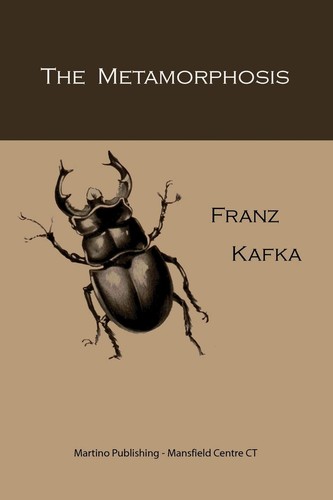
The Metamorphosis by Franz Kafka is a 1915 literary fiction book about alienation, family and obligation, work and identity. The transformation is literal but also functions as a precise image of what depression, chronic illness, or sudden dependency does to a family's social and economic arrangements.
Summary
The Metamorphosis begins with one of the most famous sentences in world literature: Gregor Samsa wakes one morning to find he has been transformed into a giant insect. What follows is not a horror story, not a fantasy, and not quite a parable — it is something harder to categorize, written with the flat bureaucratic precision of a bad dream in which everyone accepts the impossible without surprise. Gregor's primary concern, even after his transformation, is that he is going to be late for work.
The novella tracks what happens to a family when its primary earner suddenly cannot work. Gregor had been supporting his parents and his sister Grete on the salary he earned as a traveling salesman — a job he hated, a debt he could not escape. Now, as an insect, he is a burden. The family reorganizes around his absence: his father takes a job, Grete cares for Gregor, his mother pretends nothing has happened. Slowly the burden becomes unbearable and the care becomes resentment, until Gregor's death is received as a relief. The story ends with the family going for a walk in the spring sunshine, looking forward.
Kafka's genius is to make this completely realistic while maintaining the insect transformation as literal fact. The horror is not the transformation itself but the family's gradual withdrawal of humanity — the mechanism by which a person becomes, in the eyes of the people who claimed to love him, a thing that needs to be disposed of. The bureaucratic, affectless prose style is the vehicle: everything is described with the same neutral tone, the same matter-of-fact acceptance, whether it is a workday commute or a son's slow death from neglect.
The Metamorphosis is short enough to read in two hours and dense enough to discuss for weeks. It is one of those texts that seems to mean something different each time you come back to it — as an allegory of depression, of disability, of immigrant assimilation, of late capitalism's treatment of workers. Kafka disliked being asked what it meant. That is probably the right response.
Talk to The Metamorphosis like its author wrote you back.
Get the ideas that fit your life — not generic summaries.
- Chat with the book
- Audiobook-style main ideas
- Adapts to your life and goals
- Helps you take action
Key takeaways
- 1.
The transformation is literal but also functions as a precise image of what depression, chronic illness, or sudden dependency does to a family's social and economic arrangements.
- 2.
Kafka's flat, bureaucratic prose style is inseparable from the horror. Nothing is described as horrifying. This normalizing tone is the story's central technique.
- 3.
Gregor's first thought after transformation is about missing work. The joke is also the tragedy: identity under capitalism is entirely bound to economic function.
- 4.
Grete starts as Gregor's most devoted caretaker and ends as the person who declares he must go. Her arc is the story's most emotionally precise element.
- 5.
The father's aggression toward Gregor — throwing apples, refusing any accommodation — is never punished or even examined critically by the narrative. This refusal to editorialize is Kafka's most unsettling decision.
- 6.
Gregor's final act — dying to free his family from the burden of his existence — is presented as consideration rather than tragedy. The narrative endorses it with the family's relief.
- 7.
The story refuses to explain the transformation. Asking 'what does the insect mean' is less productive than asking 'what does the story show happening to a family under economic and emotional pressure?'
- 8.
The Metamorphosis is one of the founding texts of literary modernism partly because it refuses both realism and fantasy, creating a third category — a literature of the impossible treated as the mundane — that still has no adequate name.
Discussion questions
Use these on your own, with a book club, or as chat starters in Superbook. Book club version, ready to copy or print →
- 1.
Kafka never explains the transformation. How do you read it — literally, symbolically, or both simultaneously? Does the question of meaning matter?
- 2.
Gregor's first concern after waking as an insect is getting to work. What does Kafka mean by that joke? Is it primarily comic or primarily devastating?
- 3.
Grete begins as Gregor's most sympathetic family member and ends as the one who declares he must be 'gotten rid of.' Is her change understandable? Is it a betrayal?
- 4.
The father — who had seemed helpless before Gregor's transformation — becomes aggressive and domineering after it. What does Kafka suggest about the relationship between dependence and cruelty?
- 5.
The story has been read as an allegory for disability, depression, immigrant assimilation, and capitalist alienation. Which reading feels most alive to you, or are they all present simultaneously?
- 6.
Kafka's prose is completely flat — nothing is described as disturbing. How does that choice change your experience of the story's events?
- 7.
Gregor's death is met with relief by his family, and the story ends with them going for a walk in the sunshine. Is that ending cruel, ironic, or simply accurate about how families work?
- 8.
Did you find the story primarily comic, primarily tragic, or something harder to categorize? How does tone function here?
- 9.
Kafka was a Jewish writer in Prague under the Austro-Hungarian empire, working a job he found deadening. How much biographical context do you bring to the story?
- 10.
The story is about family care and who bears it. Does it read differently depending on whether you've been a caretaker, a dependent, or both?
- 11.
Kafka asked his friend Max Brod to destroy his manuscripts after his death. Brod didn't. If he had, and The Metamorphosis had been lost, what would literature have lost specifically?
- 12.
How does The Metamorphosis compare to other Kafka works you've read — The Trial, In the Penal Colony, The Castle? Is this the best introduction to his work, or is there a better one?
Themes
Frequently asked questions
-
Is The Metamorphosis worth reading?
Yes — it is one of the most efficient pieces of prose fiction ever written. At under 25,000 words it covers more thematic ground than many novels twice its length. It is also genuinely strange and resists being fully explained, which is part of why it keeps being read.
-
What does the insect transformation mean in The Metamorphosis?
Kafka never said, and resisted allegorical readings. The transformation works simultaneously as literal event and as image of economic uselessness, illness, social alienation, and the mechanisms by which families withdraw care from members who can no longer contribute. No single reading exhausts it.
-
How long does it take to read The Metamorphosis?
About ninety minutes to two hours. It is a novella, not a novel. Most readers read it in a single sitting, which is the natural way — the compression of the form is part of how it works.
-
Is The Metamorphosis a good introduction to Kafka?
Yes, it's the standard entry point and for good reason. It demonstrates his flat, affectless prose style, his use of the absurd as realism, and his central preoccupations — bureaucracy, family, guilt, economic subjugation — more efficiently than the longer works.
-
Who shouldn't read The Metamorphosis?
Readers who need emotional warmth or hopeful resolution will find it bleak. The story offers no redemption and no explanation. If you're looking for something that ends well for its protagonist, this is not it. But if you're interested in literature that makes the unbearable precise, it is essential.