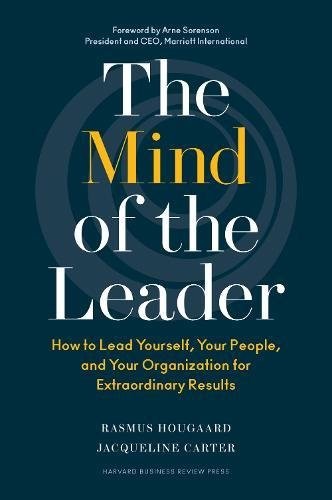
The Mind of the Leader by Rasmus Hougaard and Jacqueline Carter is a 2018 business book about leadership, mindfulness, selflessness. Mindfulness, selflessness, and compassion are the three mental qualities that distinguish effective leaders from merely busy ones.
Summary
The Mind of the Leader makes a straightforward claim: the leadership crisis in most organizations is not a skills problem but a mental habits problem. Rasmus Hougaard and Jacqueline Carter, drawing on research with 35,000 leaders across dozens of companies, argue that what makes or breaks a leader is the quality of attention they bring to people and situations. Their prescription rests on three qualities: mindfulness, selflessness, and compassion.
Mindfulness here is not meditation as stress relief. The authors define it as the capacity to be fully present, aware of one's own mental states, and not hijacked by reactivity. Selflessness means leading without ego — without the status anxiety, self-promotion, and defensiveness that cause leaders to become obstacles to the people they're supposed to serve. Compassion is the willingness to care about others' welfare and act on that care, which the authors carefully distinguish from empathy (feeling others' pain) and from weakness (it co-exists with accountability and candor).
The book moves from the individual leader to teams to organizations. At the individual level, it looks at how mental habits formed under stress produce predictable failures: leaders who think they need to have all the answers, who fear showing vulnerability, or who conflate busyness with impact. At the team level, it examines psychological safety, and at the organizational level it points to companies like LinkedIn, Accenture, and SAP that have built programs around these ideas with measurable results in engagement and retention.
The research backing is real but the book's tone is earnest and sometimes repetitive. The three-pillar framework is memorable and the case studies are useful, but readers expecting a rigorous neuroscientific treatment will find it lighter than the framing suggests. It works best as a leadership self-assessment tool: leaders who read it honestly will likely identify one or two habits that need changing. Leaders who read it defensively will dismiss it as soft, which may itself be the problem the book is diagnosing.
Talk to The Mind of the Leader like its author wrote you back.
Get the ideas that fit your life — not generic summaries.
- Chat with the book
- Audiobook-style main ideas
- Adapts to your life and goals
- Helps you take action
Key takeaways
- 1.
Mindfulness, selflessness, and compassion are the three mental qualities that distinguish effective leaders from merely busy ones.
- 2.
Mindfulness is not relaxation — it is the capacity to be present and non-reactive, which directly improves decision quality under pressure.
- 3.
Ego is the most common saboteur of leadership. Leaders who need to be right, visible, or in control create organizations where others stop thinking.
- 4.
Compassion and accountability are not in tension. Leaders can hold people to high standards while genuinely caring about their wellbeing.
- 5.
Psychological safety — the belief that it is safe to speak up, take risks, and be vulnerable — is built or destroyed by leaders' daily micro-behaviors.
- 6.
Most leaders are too focused on tasks and not focused enough on the humans doing the tasks. Engagement research consistently shows people leave managers, not companies.
- 7.
Selfless leadership does not mean putting yourself last — it means making your own needs and status secondary to the team's mission and growth.
- 8.
The gap between leaders' self-perception and their teams' experience of them is typically large. Most leaders think they are more present and more compassionate than their direct reports perceive them to be.
Discussion questions
Use these on your own, with a book club, or as chat starters in Superbook. Book club version, ready to copy or print →
- 1.
Hougaard and Carter argue ego is the root cause of most leadership failures. Where do you see ego — your own or others' — functioning as a drag on your team?
- 2.
The book distinguishes compassion from empathy. Is that distinction meaningful to you in practice, or does it feel like semantic fine-tuning?
- 3.
Which of the three qualities — mindfulness, selflessness, or compassion — is hardest to sustain under pressure? What breaks it for you?
- 4.
How would your direct reports describe your default mode when you're under stress? What evidence do you have for that assessment?
- 5.
The book argues that psychological safety is built or destroyed in small moments. What recent interaction do you think added or subtracted from safety on your team?
- 6.
Many organizations say they value vulnerability but reward certainty. How does your workplace actually treat leaders who say they don't know?
- 7.
If you became more selfless as a leader — in the authors' sense — what would you have to give up that you currently value?
- 8.
The research shows a significant gap between leaders' self-perception and how their teams experience them. What do you think your version of that gap looks like?
- 9.
Compassion in the book means caring about growth and wellbeing, not sparing people from hard feedback. Where have you confused the two?
- 10.
The authors suggest that busyness is often ego in disguise — a way of signaling importance. How much of your current busyness is genuinely necessary?
- 11.
What would it look like to practice mindfulness not in meditation sessions but in the first five minutes of your next difficult conversation?
- 12.
The book profiles companies that have institutionalized these practices. What would have to be true about your organization for that to happen?
Themes
Frequently asked questions
-
What is The Mind of the Leader about?
It argues that leadership effectiveness depends primarily on three inner qualities: mindfulness (presence and non-reactivity), selflessness (leading without ego), and compassion (genuine care for others' wellbeing). It draws on survey data from 35,000 leaders and case studies from major companies.
-
Is The Mind of the Leader worth reading?
Yes, with some caveats. The core framework is useful and the research is credible. The writing is earnest and occasionally repetitive, and leaders who already practice self-reflection will find some sections obvious. Its real value is as a diagnostic — most readers will identify at least one quality they underdevelop.
-
How does this book differ from other leadership books?
Most leadership books focus on skills, processes, or behaviors. This one focuses on mental habits and inner states, arguing that outer behavior is mostly determined by what is happening inside the leader's head. That is a narrower and more specific claim than most leadership books make.
-
Who should read The Mind of the Leader?
Managers and senior leaders who sense that something in their leadership is not working but can't identify what. Also useful for HR professionals and coaches designing leadership development programs. Less useful for first-time managers who still need foundational skills.
-
What is the most actionable idea in the book?
The authors' suggestion to take a genuine pause — a mindful moment of non-reactivity — before responding in charged conversations. It costs nothing, requires no training, and the authors argue it is where most leadership damage is done or avoided.