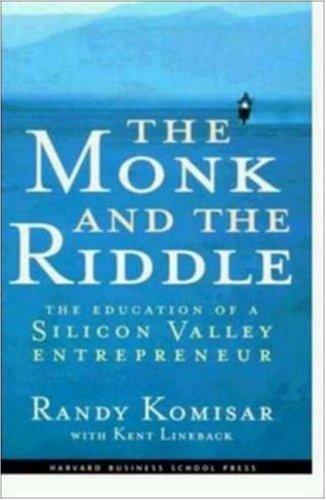
The Monk and the Riddle by Randy Komisar is a 2000 business book about entrepreneurship, purpose and meaning, silicon valley culture. The Deferred Life Plan — working on something joyless now in exchange for freedom later — is a common Silicon Valley trap that rarely pays off the way its practitioners expect.
Summary
Randy Komisar spent years as a virtual CEO and partner at Kleiner Perkins helping founders build companies, and The Monk and the Riddle draws on that experience to make a case about what startup culture gets badly wrong. The argument is simple but cutting: most people in Silicon Valley are playing what Komisar calls the Deferred Life Plan — working on something they don't care about now so they can become wealthy enough to do what they really want later. Komisar argues this plan is almost always a trap.
The book is structured as a business parable. Komisar meets Lenny, a founder pitching a funeral services e-commerce business. The pitch is technically plausible, the economics are defensible, but Komisar's question keeps getting in the way: why are you doing this? Lenny's honest answer is that he wants the money to eventually do something he loves. Komisar uses their conversations, and a subplot about an older mentor named Hawk, to explore the difference between a business built on passion and one built on a financial exit as the end point.
The distinction Komisar draws isn't between ambition and meaning — it's between deferred passion and immediate passion. Successful entrepreneurs, in his account, are doing work they would do even if the financial outcome were uncertain. That doesn't mean they're indifferent to success; it means the work itself is the point, not just the vehicle. He's also honest that passion alone isn't sufficient: the business still needs to solve a real problem, the economics still need to make sense, and the team still needs to execute. But without genuine connection to the work, founders tend to make expedient decisions rather than good ones.
The book is short and its narrative structure keeps it moving. Komisar writes with warmth and some wit, and the parable format lets him say things directly that a more academic book might bury in qualifications. It's most useful for people early in their careers making decisions about what to work on, and for founders who are honest enough to ask themselves whether they'd still be doing this if the payout were smaller. It doesn't resolve the question of what your passion actually is — it just insists you ask it seriously before committing five to ten years of your life.
Talk to The Monk and the Riddle like its author wrote you back.
Get the ideas that fit your life — not generic summaries.
- Chat with the book
- Audiobook-style main ideas
- Adapts to your life and goals
- Helps you take action
Key takeaways
- 1.
The Deferred Life Plan — working on something joyless now in exchange for freedom later — is a common Silicon Valley trap that rarely pays off the way its practitioners expect.
- 2.
Komisar distinguishes passion (the intrinsic drive to do a particular kind of work) from interest (finding a task intellectually engaging). Building a startup requires the former.
- 3.
A business that exists purely as a vehicle to a financial exit tends to produce expedient decisions rather than principled ones, especially when the exit takes longer than planned.
- 4.
Passion is necessary but not sufficient: the business still needs real economics, a solvable problem, and a capable team. Passion without rigor produces enthusiastic failures.
- 5.
The question 'what would you do if you knew you couldn't fail?' is less useful than 'what would you do knowing you might fail anyway?' The second reveals genuine motivation.
- 6.
Silicon Valley's obsession with rapid exit creates pressure to optimize for investors rather than customers, which often undermines the very businesses investors funded.
- 7.
The mentor figure in the book models a career built on engagement over income — not asceticism, but the willingness to prioritize meaning over maximizing the financial outcome.
Discussion questions
Use these on your own, with a book club, or as chat starters in Superbook. Book club version, ready to copy or print →
- 1.
Komisar's Deferred Life Plan is the idea of suffering now to live later. Be honest: to what extent is your current work a version of that plan?
- 2.
He draws a distinction between passion and mere interest. By that standard, what work would you call a genuine passion, not just something you're good at or that pays well?
- 3.
The protagonist Lenny is pitching a business he doesn't care about. Have you ever committed significant effort to a project you weren't personally invested in? What motivated you, and how did it end?
- 4.
Komisar argues that founders without intrinsic connection to their work make worse decisions under pressure. Do you agree? Can you think of counterexamples?
- 5.
The book is sympathetic to entrepreneurs but skeptical of the financial-exit-above-all culture. Where do you think the right balance is between financial ambition and meaningful work?
- 6.
What question would you want a mentor like Komisar to ask you before you committed to your next major career move?
- 7.
The book was published in 2000 at the height of the first internet bubble. How does its critique of Silicon Valley culture hold up now, a quarter-century and several bubbles later?
- 8.
Komisar says the goal is work you'd do even knowing you might fail. What work in your life meets that bar, and what keeps you from pursuing it more directly?
- 9.
The parable format lets Komisar make direct claims about meaning and work without seeming preachy. Does the story device work for you, or does it feel like a shortcut?
- 10.
Hawk, the mentor figure, has made a life outside the conventional startup path. What trade-offs does that life entail, and would you make them?
- 11.
If you had to name one thing you are currently deferring that you tell yourself you'll get to eventually, what would it be? What would it take to start now?
Themes
Frequently asked questions
-
Is The Monk and the Riddle still relevant in 2026?
Yes. The critique of the Deferred Life Plan and the financial-exit culture in tech is, if anything, more pointed now than it was in 2000. The structural pressures Komisar describes — racing toward liquidity at the expense of building something meaningful — have intensified with the rise of mega-funds and shorter venture cycles.
-
How long does it take to read The Monk and the Riddle?
Around three to four hours. It's a short book, under 200 pages, and the parable narrative keeps the pace fast. Many readers finish it in a single sitting.
-
What is the riddle in the title?
The riddle is the fundamental question of how to live: whether you are building a life you actually want, or constructing a plan to defer that life until some future financial threshold. The monk reference is to a figure in a story Komisar tells about being unwilling to commit fully until conditions are perfect — a trap that leads to never committing at all.
-
Who should read this book?
Anyone at an early stage of their career who is choosing what to work on, especially in startups or high-pressure professional environments. Also useful for mid-career people who feel they've been executing someone else's version of success and want a frame for thinking about what they actually want.
-
Is this a practical book or a philosophical one?
Both, though more philosophical than practical. Komisar doesn't give a framework for finding your passion or building a startup. The value is in the questions he asks, not the answers he provides. It works best as a prompt for reflection rather than a step-by-step guide.
Similar books
Zero to One: Notes on Startups, or How to Build the Future
Peter Thiel
The Hard Thing About Hard Things
Ben Horowitz

Shoe Dog: A Memoir by the Creator of Nike
Phil Knight
Start with Why
Simon Sinek
