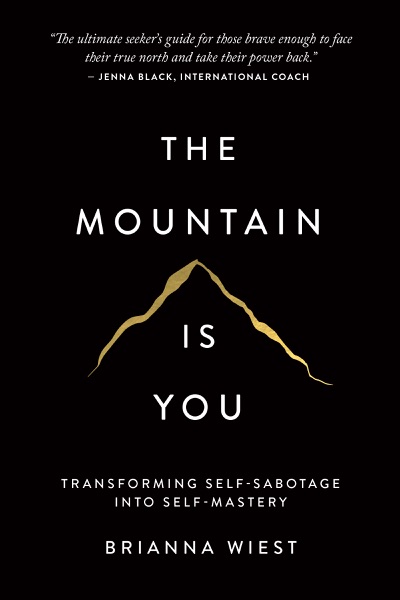
The Mountain Is You by Brianna Wiest is a 2020 self-help book about self-sabotage, emotional healing, self-awareness. Self-sabotage is not irrational. It is a response to competing desires — the part of you that wants one thing and the part that is protecting something else. Understanding what's being protected is the work.
Summary
Brianna Wiest's argument in The Mountain Is You is that most people's obstacles aren't external — they are the person themselves. Self-sabotage is not irrationality; it is a rational response to competing desires and unmet needs. When someone repeatedly undermines their own progress toward something they say they want, Wiest argues, what's usually happening is that a deeper part of them is trying to protect something — safety, a familiar identity, an unconscious belief about what they deserve or what is possible. Until that deeper layer is addressed, the surface behavior won't change for long regardless of motivation or willpower.
The book's first move is to reframe self-sabotage from moral failure to diagnostic information. Rather than treating repeated self-defeating behavior as evidence that something is wrong with a person, Wiest asks what that behavior is trying to accomplish. The pattern is adaptive — it developed in response to real experiences, often in early life — and that means it can be understood and changed when the person understands what need it was meeting.
Much of the book is organized around specific manifestations of self-sabotage: procrastination, people-pleasing, emotional avoidance, the gap between what someone says they want and what they actually pursue. Wiest is clear that addressing these patterns requires more than understanding them intellectually — the emotional experience has to be processed, not just named. She writes about grief, fear of success, the specific trap of keeping a life comfortable enough to tolerate rather than doing the harder work of building something genuinely satisfying.
The book is most useful for readers who feel stuck in patterns they can recognize but can't seem to stop. Its limitation is a tendency toward generality: some passages read as affirmational rather than analytical, and the practical guidance is less specific than the diagnosis. Wiest is better at identifying what the problem is than at giving readers a clear path through it. That said, the reframe — that the mountain is you, that the obstacle is internal — is useful precisely because it is uncomfortable: it places the work where it can actually happen, rather than in the external circumstances that are often easier to blame.
Talk to The Mountain Is You like its author wrote you back.
Get the ideas that fit your life — not generic summaries.
- Chat with the book
- Audiobook-style main ideas
- Adapts to your life and goals
- Helps you take action
Key takeaways
- 1.
Self-sabotage is not irrational. It is a response to competing desires — the part of you that wants one thing and the part that is protecting something else. Understanding what's being protected is the work.
- 2.
Most self-defeating patterns developed for a reason. They were adaptive responses to real experiences. That doesn't make them fixed, but it means they can be understood rather than just condemned.
- 3.
The gap between what you say you want and what you actually do is information. If you've repeatedly failed to pursue something you claim to want, something else is running the show.
- 4.
Emotional avoidance is often the core mechanism of self-sabotage. Pursuing growth requires tolerating discomfort, and most avoidance patterns are designed to prevent exactly that.
- 5.
Comfort is one of the most seductive forms of self-sabotage. A life that is just tolerable enough removes the urgency to change, which is what makes it so effective at keeping people stuck.
- 6.
People-pleasing is a self-sabotage pattern with a specific structure: prioritizing external approval over internal direction consistently produces a life that doesn't fit the person living it.
- 7.
Wiest's central argument is that transformation requires rerouting, not just pushing harder. The same effort applied to a strategy that addresses the underlying pattern produces far better results than willpower alone.
Discussion questions
Use these on your own, with a book club, or as chat starters in Superbook. Book club version, ready to copy or print →
- 1.
Wiest argues that self-sabotage is always trying to protect something. What do you think your own most persistent patterns of self-defeat have been protecting?
- 2.
The book reframes repeated self-undermining from moral failure to diagnostic information. Does that reframe feel freeing, or does it risk becoming an excuse?
- 3.
What's the gap between what you say you want in a particular area of life and what you actually do? What does that gap suggest about competing motivations?
- 4.
Wiest says comfort is one of the most effective forms of self-sabotage because it removes urgency. Where in your own life are you settled into 'comfortable enough' rather than pursuing something genuinely satisfying?
- 5.
The book argues that emotional avoidance is the core mechanism behind most self-defeating behavior. What are you currently avoiding, and what are you protecting yourself from by avoiding it?
- 6.
Wiest distinguishes between understanding a pattern intellectually and actually processing the emotional experience beneath it. Have you found that intellectual understanding is enough to change behavior, or does it require something more?
- 7.
People-pleasing is one of the patterns the book discusses in detail. If you've struggled with it, what specifically drives it for you — fear of rejection, conflict avoidance, something else?
- 8.
The title is a metaphor: the mountain you need to climb is yourself. When did you last encounter your own resistance to something that mattered to you, and what form did that resistance take?
- 9.
The book is oriented toward individual change rather than systemic causes. Does that feel adequate, or does it place too much responsibility on the individual for circumstances that are also shaped by external factors?
- 10.
Wiest argues that the patterns we need to change developed for a reason. Does knowing the reason change your relationship to a pattern you've been trying to change?
- 11.
Which of the book's specific diagnoses — procrastination, people-pleasing, emotional avoidance, comfort-seeking — resonated most with your own experience, and why?
Themes
Frequently asked questions
-
What is The Mountain Is You about?
Self-sabotage — why people undermine their own progress toward things they say they want, and what it takes to address the underlying patterns rather than just fighting the surface behavior. The central argument is that the obstacle is usually internal, not external.
-
Is The Mountain Is You a psychology book or self-help?
Self-help, though it draws on psychological concepts. Wiest isn't a therapist or researcher, and the book doesn't have the evidentiary structure of a psychology text. It's accessible and aimed at personal application rather than clinical understanding.
-
Who should read The Mountain Is You?
People who feel stuck in patterns they can recognize but can't seem to break. Particularly useful for readers who find that motivation and willpower alone haven't been enough — the book's contribution is reframing what the actual problem is.
-
Is there practical guidance, or is it mostly conceptual?
Both, but unevenly. The conceptual reframing — self-sabotage as protection rather than failure — is sharp and useful. The practical guidance is more general, more in the register of mindset than specific technique. Readers who want concrete exercises may want to supplement it.
-
How does this compare to therapy?
It's a complement, not a replacement. The book can help readers identify patterns and understand them in a new way, which is useful groundwork for therapeutic work. But Wiest is clear that actually changing deep patterns requires more than reading about them.