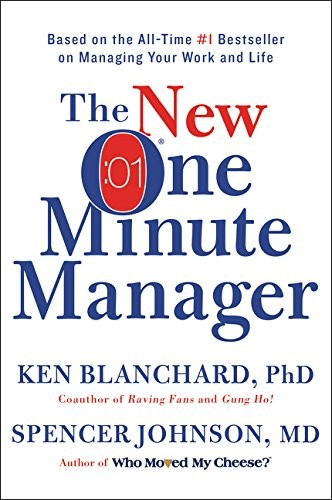
The New One Minute Manager by Kenneth Blanchard and Spencer Johnson is a 2015 business book about management, feedback, goal-setting. Most performance problems are goal-clarity problems. If people don't know what good looks like, feedback is useless.
Summary
The New One Minute Manager is a 2015 update to Kenneth Blanchard and Spencer Johnson's 1982 classic, rewritten to account for flatter organizations, collaborative work environments, and the shift from managers as controllers to managers as enablers. The core framework remains unchanged: three management secrets — One Minute Goals, One Minute Praisings, and One Minute Re-Directs (previously One Minute Reprimands) — delivered in a parable format that makes the ideas easy to remember and immediately actionable.
One Minute Goals means making sure each person knows what they're supposed to do, has agreed to the goal, and can restate it on a single page. The idea is that most performance problems are really goal-clarity problems. One Minute Praisings are brief, immediate, specific acknowledgments of good work — not annual reviews or vague encouragement, but thirty seconds of genuine acknowledgment immediately after someone does something right. One Minute Re-Directs are equally brief, specific, and focused on the behavior not the person: you name what happened, say how it made you feel, pause, then confirm the person's competence and affirm the relationship.
The update reflects several shifts from the original. The new version emphasizes self-leadership and assumes the manager's job is to help people manage themselves, not to direct them. It also acknowledges that praise and re-direction now often need to happen in front of teams or in asynchronous channels, not just in private one-on-one conversations. The shift from "reprimand" to "re-direct" signals a deliberate move away from punishment framing.
The book's format — a parable with a young man learning from a wise old manager — makes it readable in a single sitting. Its weakness is the same as the original's: real management situations are often messier than the parable suggests, and the techniques can feel mechanical when applied without genuine relationship. Used as principles rather than scripts, though, the three secrets are sound and have a forty-year track record of improving management behavior in organizations that take them seriously.
Talk to The New One Minute Manager like its author wrote you back.
Get the ideas that fit your life — not generic summaries.
- Chat with the book
- Audiobook-style main ideas
- Adapts to your life and goals
- Helps you take action
Key takeaways
- 1.
Most performance problems are goal-clarity problems. If people don't know what good looks like, feedback is useless.
- 2.
One Minute Goals: each goal fits on a single page, is agreed to, and the person can restate it in their own words. Review it regularly, not just at annual appraisal time.
- 3.
One Minute Praisings work because they are immediate and specific. Generic praise after the fact doesn't change behavior; specific feedback right after the behavior does.
- 4.
Catch people doing things right. Most managers default to noticing problems. Actively looking for good work and naming it changes both parties' experience of the relationship.
- 5.
One Minute Re-Directs separate the behavior from the person. You address what happened without attacking who the person is, then affirm the relationship and move on.
- 6.
Self-leadership is the end goal of good management — not compliance with your directions, but people who can set their own goals, monitor their own performance, and correct their own course.
- 7.
The three techniques are fast not because management is simple but because effective feedback is specific and timely. Drawn-out performance conversations are often a symptom of delayed feedback.
Discussion questions
Use these on your own, with a book club, or as chat starters in Superbook. Book club version, ready to copy or print →
- 1.
How many of your direct reports could tell you right now, unprompted, what their top three goals are and what good performance on each one looks like?
- 2.
When did you last catch someone on your team doing something right and name it specifically? What stops you from doing that more often?
- 3.
Blanchard and Johnson replace 'reprimand' with 're-direct.' Does that word change matter? Does the framing of corrective feedback change how it lands?
- 4.
The book says most performance problems are goal problems. Think of a performance issue you're dealing with now. Is the goal actually clear to both parties?
- 5.
One Minute Goals fit on a single page. If you had to write down your three most important current goals in one sentence each, could you do it in two minutes?
- 6.
The parable format makes the techniques feel simple. What makes them hard to do consistently in real management situations?
- 7.
The updated version emphasizes self-leadership. In your current role, are you developing people's ability to manage themselves, or managing them in ways that create dependence?
- 8.
Think of a manager who gave you feedback that actually changed your behavior. What made it land differently from feedback that didn't stick?
- 9.
The Re-Direct sequence ends by affirming the relationship. Does that feel natural or contrived to you? What determines the difference?
- 10.
How often do you receive feedback from your own manager using anything like these techniques? What's the effect of that frequency and quality on your own performance?
- 11.
If your team rated you on how clearly you communicate goals, how specifically you acknowledge good work, and how constructively you address problems — what scores would you get?
Themes
Frequently asked questions
-
Is The New One Minute Manager worth reading?
Yes, if you manage people. It's short enough to read in one sitting and the three core ideas — clear goals, specific praise, immediate re-direction — are genuinely useful. The parable format keeps it accessible. If you've read the 1982 original, the update is modest but the shift to self-leadership framing is worth the re-read.
-
How long is The New One Minute Manager?
About 112 pages. Most readers finish it in one to two hours. It's designed to be re-read as a reminder rather than studied once, and many managers keep a copy at their desk.
-
What changed from the original One Minute Manager?
The core three-part framework is unchanged. The main update is language: 'reprimand' becomes 're-direct,' the framing shifts from controlling to enabling, and the book acknowledges collaborative and flat organizational structures that didn't exist in the 1982 version.
-
Who should read this book?
New managers who need a simple, memorable framework they can start using immediately. Also useful for experienced managers who want to reset habits around goal-setting and feedback. HR professionals and team leads who coach managers will find it a useful shared reference.
-
What is the most useful technique in the book?
One Minute Praisings. Most managers under-praise specifically and over-praise generically. The discipline of catching people doing something right and naming exactly what it was — within minutes, not days — has an outsized effect on engagement and repetition of desired behavior.