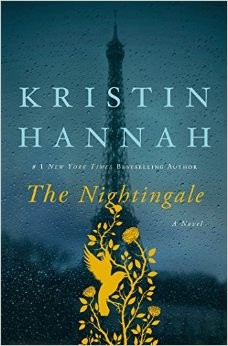
The Nightingale by Kristin Hannah is a 2015 historical fiction book about war and resistance, sisterhood, survival and sacrifice. Vianne's story is as important as Isabelle's, and harder: survival through accommodation has its own moral weight, and the novel takes it seriously.
Summary
France, 1939-1944. Two sisters, Vianne and Isabelle Rossignol, survive the German occupation in entirely different ways. Vianne, practical and maternal, is left behind in the Loire Valley when her husband goes to war and tries to keep her daughter alive and her household intact as German officers are billeted in her home. Isabelle, younger and impetuous, throws herself into the Resistance — becoming, eventually, the Nightingale, the courier who guides shot-down Allied airmen across the Pyrenees to Spain. The novel moves between their stories across five years of occupation, devastation, and impossible choices.
Hannah's subject is specifically about women and war: what women did that official history didn't record, and what surviving required when survival itself was morally complicated. Vianne's trajectory is in many ways the harder story — she isn't brave in the romantic sense Isabelle is; she makes compromises and accommodations that she has to live with afterward. The novel doesn't judge her for them, but it doesn't let her off the hook either. Isabelle's story is more conventional heroism, and Hannah writes it with the open emotional register that is her signature.
The prose is emotional and accessible, not literary in the spare sense. Hannah is a commercial novelist who genuinely cares about historical accuracy, and the wartime France she constructs has the texture of research worn comfortably rather than displayed. She does occasionally hold the camera on the worst of what happened long enough that the novel begins to tip into trauma-as-spectacle, but she generally catches herself.
The Nightingale works best as a corrective to war narratives that center men. It sold fifteen million copies for a reason: Hannah found a massive audience hungry for World War II fiction that acknowledged what women did, endured, and chose. It isn't the deepest novel in its genre — All the Light We Cannot See is more precisely crafted — but it's more emotionally direct, which is what most of its readers were looking for.
Talk to The Nightingale like its author wrote you back.
Get the ideas that fit your life — not generic summaries.
- Chat with the book
- Audiobook-style main ideas
- Adapts to your life and goals
- Helps you take action
Key takeaways
- 1.
Vianne's story is as important as Isabelle's, and harder: survival through accommodation has its own moral weight, and the novel takes it seriously.
- 2.
The framing device — an old woman in 1995 who is one of the sisters — works because it makes the question of memory and acknowledgment part of the novel's argument.
- 3.
Hannah is writing back against a historiography that centered men in World War II; the novel makes the argument with its existence as much as with its content.
- 4.
The Nightingale is based partly on the real history of French resistance workers, including Andrée de Jongh, the Belgian woman who founded the Comet escape line.
- 5.
The cost of resistance in the novel is personal and permanent — it isn't just risk but transformation, and the survivors come back changed in ways the people around them can't fully see.
- 6.
The relationship between the sisters is the novel's core: they are opposite temperaments, opposite survival strategies, and the tension between them is both the book's engine and its moral center.
- 7.
Hannah is particularly good at the specificity of occupation: requisitioned food, curfews, German soldiers made human by proximity, collaboration that begins as pragmatism and becomes something else.
- 8.
The distinction between collaboration and survival is the novel's hardest question — Vianne crosses lines she didn't know she would cross, and the novel charts the slow erosion of those lines with precision.
Discussion questions
Use these on your own, with a book club, or as chat starters in Superbook. Book club version, ready to copy or print →
- 1.
Vianne makes choices that compromise her principles in order to protect her daughter. Isabelle makes choices that put herself and others at mortal risk for the cause. Which is the nobler path — and does the novel think one is?
- 2.
The novel's framing has one of the sisters narrating from 1995 without identifying herself until late. Does that structural choice earn its payoff, or is it a withholding trick?
- 3.
Hannah chose to write about women in World War II in part because she felt their contributions had been underrepresented. Do you think the novel makes that corrective argument successfully?
- 4.
Rachel, Vianne's Jewish neighbor, represents what is happening to French Jews. How does the novel handle Vianne's relationship with Rachel's fate — and does Vianne do enough?
- 5.
Isabelle's courage is partly rooted in recklessness and a desire to prove herself. Does that origin diminish her heroism, or make it more recognizable?
- 6.
The novel includes scenes of explicit wartime atrocity. Were there moments where you felt Hannah was using historical suffering for emotional effect rather than illuminating it?
- 7.
Von Schmidt, the German officer billeted in Vianne's home, is given some humanity. How does the novel's treatment of individual Germans relate to its treatment of the larger evil they represent?
- 8.
Collaboration is one of the most contested topics in French history. How does the novel navigate the question of what ordinary French people did under occupation?
- 9.
The relationship between the sisters is partly about their father's damage. How much does their history before the war explain their different choices during it?
- 10.
The Nightingale sold fifteen million copies. What does the cultural appetite for this particular story say about what readers wanted from World War II fiction in 2015?
- 11.
Compare The Nightingale to All the Light We Cannot See (if you've read it). What does each novel do that the other doesn't, and which approach do you prefer?
- 12.
The novel ends in 1995, not 1945. Why does Hannah need the contemporary frame — what does it add that ending with the liberation wouldn't?
Themes
Frequently asked questions
-
Is The Nightingale based on a true story?
The characters are fictional, but Hannah drew heavily on documented history. The Comet Line escape route that Isabelle's character helps run was real, pioneered by Andrée de Jongh. The wartime details of occupation, collaboration, and resistance are historically grounded.
-
How does The Nightingale compare to All the Light We Cannot See?
Both are World War II novels praised for their emotional power. All the Light We Cannot See is more literary — precise, imagistic, formally ambitious. The Nightingale is more direct emotionally and more explicitly interested in women's history. Which you prefer depends on whether you prioritize craft or emotional directness.
-
Is this book very sad?
Yes, significantly. Hannah doesn't soften the human cost of occupation and war. Several characters you'll care about die badly. The ending offers some resolution but not easy comfort.
-
Is there a film adaptation?
Yes — a film adaptation starring Elle Fanning and Joey King was in production for years and released in 2023, though it had a complicated production history. The book precedes and is independent of the film.
-
Who shouldn't read this?
Readers who find wartime atrocity depicted in close detail disturbing may want to approach carefully. Also readers who prefer understated prose to emotionally open, commercially pitched storytelling — Hannah writes to produce feeling directly, which isn't everyone's preference.