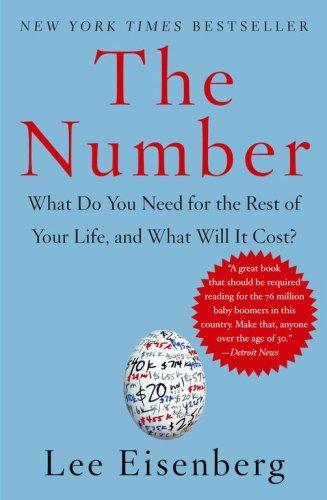
The Number by Lee Eisenberg is a 2006 economics book about retirement planning, personal finance, life stage. The number — the amount of money needed to retire — is not primarily a financial question. It encodes assumptions about identity, purpose, and what daily life should look like that most people have never made explicit.
Summary
The Number is Lee Eisenberg's exploration of the question that haunts many Americans in midlife: how much money do I actually need to retire? Eisenberg, former editor-in-chief of Esquire, came to the subject personally, finding himself in his fifties unsure whether his savings were anywhere near adequate and equally unsure what he was saving for. The result is a book that weaves financial reporting with cultural and psychological inquiry into why the question of the number is so hard to answer honestly.
Eisenberg is direct that the number is not just a financial calculation. It's a proxy for questions about identity, status, purpose, and what a good life looks like. He interviews financial planners, retirees, academics, and therapists, and finds that most people either avoid thinking about the number entirely or fixate on a figure that reflects anxiety rather than analysis. The book documents a culture of retirement planning that is simultaneously over-engineered by the financial services industry and radically underexamined by the people it's supposed to serve.
The financial content covers the basics competently: savings rates, Social Security timing, asset allocation, the gap between what financial advisors recommend and what clients actually do. But Eisenberg's distinctive contribution is forcing the non-financial questions into the same frame. What does a fulfilling day look like when work ends? How much of your self-worth is bound up in your professional identity? What happens to marriages and friendships in retirement? These questions, he argues, determine the number at least as much as spreadsheets do.
The book is more journalism than instruction manual, and readers looking for specific calculations will find it discursive. But for anyone who has avoided confronting retirement planning not because they lack information but because the question feels too large, Eisenberg offers a useful frame: the number is ultimately about what you believe your life is worth living for, and that question has to come first.
Talk to The Number like its author wrote you back.
Get the ideas that fit your life — not generic summaries.
- Chat with the book
- Audiobook-style main ideas
- Adapts to your life and goals
- Helps you take action
Key takeaways
- 1.
The number — the amount of money needed to retire — is not primarily a financial question. It encodes assumptions about identity, purpose, and what daily life should look like that most people have never made explicit.
- 2.
Most Americans either avoid thinking about the number entirely or anchor to a round figure with no real analysis behind it. The financial services industry profits from both behaviors.
- 3.
Retirement planning requires deciding what you're retiring to, not just from. People who enter retirement with a clear daily purpose report dramatically higher satisfaction than those who assume contentment will follow financial security.
- 4.
The sequence and timing of Social Security claiming can add or subtract hundreds of thousands of dollars from lifetime income, yet most people make the decision with minimal analysis.
- 5.
Professional identity is a larger obstacle to retirement than most people expect. For people whose self-worth is tightly coupled to their job title, the transition can be psychologically destabilizing.
- 6.
Financial advisors and clients frequently work from different definitions of the number. Advisors tend to optimize for asset preservation; clients often have unstated goals — travel, legacy, status — that never make it into the financial plan.
- 7.
Couples often disagree sharply about the number and about the retirement life it's supposed to fund, and most avoid the conversation until the decision is almost made.
- 8.
Healthcare and long-term care are the largest sources of financial uncertainty in retirement and the areas where planning is least rigorous for most households.
Discussion questions
Use these on your own, with a book club, or as chat starters in Superbook. Book club version, ready to copy or print →
- 1.
Eisenberg argues the number is really a question about what you believe your life is worth. What does your current number say about what you actually believe?
- 2.
How much of your sense of purpose comes from your professional role? What would replace that if the role ended tomorrow?
- 3.
Have you and your partner (if applicable) had a genuine conversation about what retirement life looks like day to day — not just the finances? What did that reveal?
- 4.
Eisenberg finds that most people anchor to a round-number figure without real analysis. Where did your target number come from?
- 5.
What are you actually afraid of when you think about retirement — running out of money, running out of purpose, or something else?
- 6.
How do you think about the gap between what the financial services industry says you need and what you think you actually need? Who do you trust on this?
- 7.
Eisenberg profiles people who reached financial independence and discovered they'd been solving the wrong problem. Do you know anyone like that? What do you make of their experience?
- 8.
The book documents widespread avoidance of retirement planning. What has made it easy for you to put off this thinking, if you have?
- 9.
What assumptions about your spending in retirement have you never tested empirically?
- 10.
Social Security timing has large long-run consequences that most people don't calculate. Have you modeled different claiming ages for your situation?
- 11.
What does a fulfilling Tuesday in retirement actually look like in concrete detail — not in the abstract?
- 12.
If the number you needed was 30% lower than you assumed, what would you do differently with the time you have now?
Themes
Frequently asked questions
-
Is The Number a practical retirement planning guide?
Not primarily. It covers the basics but is more concerned with the psychological and cultural dimensions of the question than with delivering specific calculations. Readers wanting detailed financial mechanics should pair it with a more technical resource.
-
How long does it take to read The Number?
Around four to five hours at average reading pace. The chapters vary in density — the financial reporting sections move quickly; the cultural analysis requires more engagement.
-
What is the main idea of The Number?
That how much money you need to retire cannot be calculated until you've answered harder questions about what a meaningful life looks like in retirement, and that most people avoid both the financial and the existential calculation.
-
Who should read The Number?
People in their forties and fifties who feel uneasy about retirement planning but can't quite articulate why. It's especially useful for those who have been successful professionally and find the idea of leaving that identity behind unsettling.
-
Is this book still relevant given it was published in 2006?
The financial specifics (Social Security rules, tax law) have changed, but the psychological and cultural argument is entirely intact. The core problem — that people don't know what they're planning for — has not changed.