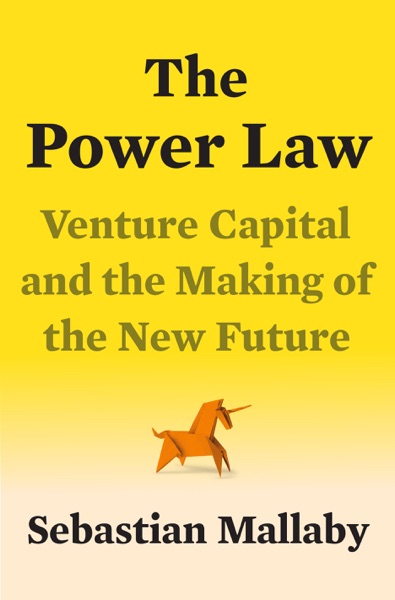
The Power Law by Sebastian Mallaby is a 2022 business book about venture capital, silicon valley, entrepreneurship. Venture returns follow a power law, not a bell curve. The correct strategy isn't diversification for average returns; it's concentration on the handful of investments with extreme upside potential.
Summary
The Power Law is Sebastian Mallaby's history of venture capital, told through the people who built the industry from its roots in postwar military research to its current position as the primary financing mechanism for technology startups worldwide. Mallaby is a seasoned financial journalist and the author of acclaimed books on hedge funds and the Greenspan era; he brings the same research depth to venture capital, conducting hundreds of interviews with figures including John Doerr, Mike Moritz, Peter Thiel, and the founders of Sequoia and Kleiner Perkins.
The title refers to the statistical distribution that defines venture investing: returns are not normally distributed, where most investments cluster around the mean. Instead they follow a power law, where a tiny fraction of investments produce the vast majority of returns. One investment in a portfolio can return more than the entire rest combined. This isn't just a feature of VC economics; Mallaby argues it's the correct framework for understanding the tech industry itself. A small number of companies—Google, Amazon, Facebook—have captured an outsized share of value, and the venture model evolved in response to that reality, not the other way around.
The book traces the evolution of the industry through key moments: Georges Doriot's American Research and Development Corporation pioneering the model in the 1950s, the formation of the first Sand Hill Road firms in the 1970s, the Intel and Apple investments that made Kleiner Perkins and Sequoia, the dot-com bubble and its aftermath, the rise of Benchmark and its radically flat structure, and the emergence of Tiger Global and SoftBank with their growth-at-all-costs approach. Mallaby is willing to be critical—the bubble years and the SoftBank era both receive unflinching treatment—but the overall argument is that venture capital, for all its failures and occasional absurdities, has funded innovations that genuinely changed how people live.
The book is exhaustive and occasionally exhausting. Readers who aren't already interested in startup history may find the middle sections slow. But for anyone trying to understand how technology companies actually get built, funded, and scaled, The Power Law is the most thorough and authoritative account available.
Talk to The Power Law like its author wrote you back.
Get the ideas that fit your life — not generic summaries.
- Chat with the book
- Audiobook-style main ideas
- Adapts to your life and goals
- Helps you take action
Key takeaways
- 1.
Venture returns follow a power law, not a bell curve. The correct strategy isn't diversification for average returns; it's concentration on the handful of investments with extreme upside potential.
- 2.
The best VCs don't just provide capital. They provide networks, operational expertise, and pattern recognition from watching hundreds of companies build and fail.
- 3.
The partnership model that defines most VC firms creates its own pathologies: decisions made by consensus tend toward incrementalism rather than the contrarian bets that produce outlier returns.
- 4.
Benchmark's flat structure—equal partners, equal economics, smaller fund—was a deliberate bet against hierarchy and scale. Its track record (eBay, Uber, Twitter) is the best argument for the model.
- 5.
The SoftBank Vision Fund changed VC norms by injecting massive capital into later-stage companies, inflating valuations and distorting incentives in ways the industry is still unwinding.
- 6.
China's VC ecosystem developed in ways that parallel Silicon Valley but with distinctive features: the government as backstop, Tencent and Alibaba as strategic acquirers, and a willingness to copy faster than American startups typically allow.
- 7.
The dot-com bubble was partly a failure of discipline, but it also funded the infrastructure—fiber networks, e-commerce rails—that the next wave of companies ran on.
- 8.
VC is a relationship business at its core. The reputation of a firm determines which founders choose them over competitors with equal or better terms.
Discussion questions
Use these on your own, with a book club, or as chat starters in Superbook. Book club version, ready to copy or print →
- 1.
The power law means a VC portfolio's returns come almost entirely from a few investments. What does that imply about how VCs should spend their time once a portfolio is assembled?
- 2.
Mallaby argues VC has funded genuinely valuable innovation. How would you weigh that against the criticism that it has also funded extractive, privacy-invading, or anti-competitive businesses?
- 3.
Benchmark's flat, egalitarian model has produced outstanding returns. Why isn't it the industry standard?
- 4.
The SoftBank Vision Fund is treated as an object lesson in what happens when capital outstrips discipline. What was the mechanism by which massive capital led to bad outcomes?
- 5.
Many of the book's protagonists are portrayed as brilliant and deeply flawed simultaneously. Is that combination a cause or consequence of success in venture capital?
- 6.
How does the power-law logic of venture capital compare to other fields where a few outcomes dominate? Publishing? Film? Academic research?
- 7.
Mallaby gives a lot of attention to the interpersonal dynamics of VC partnerships. What does that suggest about how important organizational design is relative to individual talent?
- 8.
The book covers venture capital's role in building Chinese tech companies. Should American VCs have thought harder about the geopolitical implications of those investments?
- 9.
What gets funded and what doesn't is partly a function of who VCs are and what they understand. What kinds of problems or founders does the current system systematically miss?
- 10.
If you were designing a venture capital firm from scratch in 2026, what would you do differently from the models the book describes?
- 11.
The book argues that VC is uniquely well-suited to funding innovation under uncertainty. Are there alternative models—corporate R&D, government funding, crowdfunding—that work better in some domains?
- 12.
Does knowing how VC works change how you think about the technology companies you use every day?
Themes
Frequently asked questions
-
What is The Power Law about?
The history of venture capital, from its postwar origins to the present day, told through the firms and investors who shaped the industry. Mallaby argues that VC's logic—making concentrated bets on extreme upside—reflects a genuine insight about how technology markets work.
-
Do I need to know about finance or startups to read The Power Law?
No. Mallaby writes for a general audience and explains concepts clearly. Some familiarity with the tech industry helps with context, but it's not required. The book reads more like narrative history than financial analysis.
-
Is The Power Law critical of venture capital?
It's measured rather than celebratory. Mallaby covers failures, bubbles, and ethical lapses honestly. The overall verdict is that VC has produced genuine value, but the industry is far from perfect and its worst tendencies — overvaluation, groupthink, founder worship — are documented without flattery.
-
How long is The Power Law?
Around 450 pages. At average reading pace, roughly nine to ten hours. The early chapters on the industry's origins are dense with historical detail; the later chapters on Benchmark and SoftBank move faster.
-
Who should read The Power Law?
Founders seeking funding, people considering a career in venture capital, anyone trying to understand how the tech industry's financing actually works, and readers interested in financial history more broadly.
Similar books
Zero to One: Notes on Startups, or How to Build the Future
Peter Thiel
The Hard Thing About Hard Things
Ben Horowitz
Bad Blood: Secrets and Lies in a Silicon Valley Startup
John Carreyrou
Shoe Dog: A Memoir by the Creator of Nike
Phil Knight
