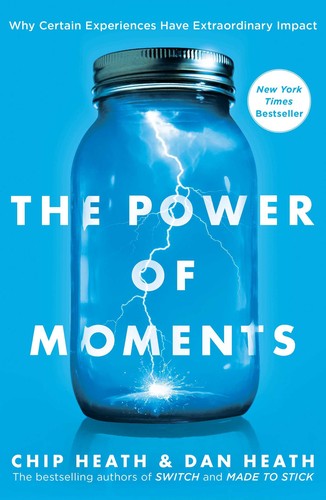
The Power of Moments: Why Certain Experiences Have Extraordinary Impact by Chip Heath and Dan Heath is a 2017 psychology book about memory, experience design, connection. Memorable moments share one or more of four elements: elevation, insight, pride, and connection. Most lasting experiences combine at least two.
Summary
The Power of Moments is Chip and Dan Heath's investigation into why certain brief experiences have an outsized and lasting effect on how we remember events, people, and institutions. Their central claim is that memorable moments don't happen by accident and can be deliberately created — by individuals, organizations, and anyone responsible for the experiences of others.
The Heath brothers identify four elements that define peak experiences: elevation (moments that rise above the ordinary), insight (moments that suddenly reframe understanding), pride (moments of achievement and recognition), and connection (shared moments that deepen social bonds). They argue that most organizations and individuals focus heavily on fixing problems — removing negative experiences — at the expense of creating positive ones. The asymmetry means that a hospital that eliminates every source of frustration still fails to create a memorable patient experience unless it deliberately builds defining moments in.
The book is organized around each of the four elements and illustrated with case studies drawn from healthcare, hospitality, education, and personal life. A hotel that put a popsicle hotline by the pool so guests could request free frozen treats became legendary for exactly that reason, not because of its room quality. A teacher who staged a realistic crime scene for her high school students to examine as amateur detectives created the defining memory of their time in her class. The cases are well-chosen and the pattern-matching across domains is the book's main analytical contribution.
What the Heath brothers do less well is theory. The four elements are descriptively useful but they don't connect to a unified model of what makes moments sticky, and the book doesn't engage seriously with the psychological literature on memory and experience (Kahneman's peak-end rule, for instance, is mentioned but not developed). As practical guidance for people who design experiences — educators, event organizers, product people, managers — it is nevertheless concrete and well-executed. The chapters are short, the examples land, and the checklists at the end of each section are genuinely helpful.
Talk to The Power of Moments: Why Certain Experiences Have Extraordinary Impact like its author wrote you back.
Get the ideas that fit your life — not generic summaries.
- Chat with the book
- Audiobook-style main ideas
- Adapts to your life and goals
- Helps you take action
Key takeaways
- 1.
Memorable moments share one or more of four elements: elevation, insight, pride, and connection. Most lasting experiences combine at least two.
- 2.
Most organizations invest in problem-fixing rather than moment-creating. Removing negatives and adding positives are different projects and rarely happen together.
- 3.
Elevation requires a break from the ordinary — a sensory enhancement, a reversal of usual hierarchies, or a surprise that raises the stakes of an experience.
- 4.
Insight moments reframe a problem or identity in a way that feels sudden and permanent. They can be designed by creating the conditions for revelation rather than delivering information directly.
- 5.
Pride moments are most powerful when they're public and specifically tied to a concrete achievement — not generic praise but recognition of what someone did to get there.
- 6.
Shared struggle creates connection more reliably than shared pleasure. Groups that go through something hard together form stronger bonds than groups that enjoy easy success.
- 7.
The peak-end rule means that memories are disproportionately shaped by the highest point and the final moment of an experience. Deliberately engineering good endings matters more than smoothing the middle.
- 8.
Small acts of responsiveness — noticing someone, acknowledging them specifically, remembering something they said — create moments of connection that persist long after the interaction ends.
Discussion questions
Use these on your own, with a book club, or as chat starters in Superbook. Book club version, ready to copy or print →
- 1.
The Heath brothers argue we spend too much energy fixing problems and not enough creating defining moments. Where in your own life or work does that imbalance show up?
- 2.
Think of a defining moment from your childhood. Which of the four elements — elevation, insight, pride, connection — was driving it?
- 3.
The book distinguishes between moments of pride for completing a task and genuine recognition that names what someone did to get there. How often do you give the more specific kind?
- 4.
Shared struggle creates connection more reliably than shared pleasure. Can you think of a group you belong to where that's been true? What does it suggest about designing team experiences?
- 5.
The popsicle hotline story suggests that small, quirky gestures can become brand-defining moments. What equivalent of a popsicle hotline could you create in your organization or community?
- 6.
The peak-end rule says memories are dominated by the highest point and the ending. Where in an experience you design or lead is the ending weakest?
- 7.
The book argues that insight moments can be engineered by creating conditions for people to discover things themselves. When has that been true in your experience as a learner or a teacher?
- 8.
Connection deepens most during moments of mutual vulnerability. Where in your relationships do you most avoid that kind of vulnerability?
- 9.
The Heath brothers look at the graduation rate at an alternative school that focused on defining moments for at-risk students. What does that data suggest about the relationship between experience and motivation?
- 10.
Elevation requires breaking from the ordinary. What ordinary routine in your work or family life could be elevated with a small, deliberate disruption?
- 11.
Think of an experience that disappointed you because it failed to mark a meaningful transition or achievement. What was missing?
- 12.
The book argues that most people are moment-makers for others accidentally but rarely intentionally. What would it take to be more intentional about this in the next month?
Themes
Frequently asked questions
-
What is The Power of Moments about?
It argues that certain brief experiences have lasting disproportionate impact on how we remember people and places, and that those moments can be deliberately designed. The Heath brothers identify four elements — elevation, insight, pride, connection — that define peak experiences and show how ordinary situations can be transformed into defining ones.
-
Is The Power of Moments worth reading?
Yes, especially for anyone responsible for designing experiences — educators, managers, event organizers, product designers, or healthcare providers. The case studies are specific and the framework is practical. It's lighter on theory than some readers might want, but as a how-to guide for moment creation it's concrete and well-organized.
-
Who should read The Power of Moments?
People whose work involves shaping others' experiences: teachers, managers, healthcare providers, hospitality professionals, and anyone designing onboarding, events, or community rituals. Also useful for individuals who want to be more intentional about creating memorable experiences in personal and family life.
-
What is the most actionable idea in the book?
Deliberately engineer the ending of experiences you control. Because of the peak-end rule, how an experience closes shapes the memory more than the bulk of it. A strong, specific, warm ending to a meeting, class, or customer interaction can transform what people remember about the whole thing.
-
How does The Power of Moments relate to Made to Stick?
Made to Stick examines why some ideas are memorable and others aren't — a question about communication. The Power of Moments examines why some experiences are memorable — a question about design. Both books apply behavioral science research to practical problems, but the domains and tools are different.