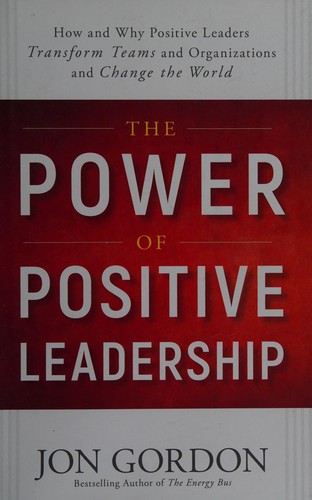
The Power of Positive Leadership by Jon Gordon is a 2017 business book about positive leadership, culture building, resilience. Positive leadership is not naive optimism — it's the deliberate practice of framing challenges, modeling resilience, and building culture in ways that produce energy rather than drain it.
Summary
The Power of Positive Leadership is Jon Gordon's argument that positivity is not a soft trait or a personality quirk — it's a competitive advantage that great leaders deliberately cultivate. Gordon has built a career around speaking to sports teams, corporations, and schools about positive culture and leadership, and this book is a concise summary of the practices he's seen work across those environments.
Gordon is careful to distinguish his version of positive leadership from naive optimism. He's not arguing that leaders should pretend problems don't exist or avoid difficult conversations. His case is that how a leader interprets challenges, frames the team's identity, and maintains energy under adversity has measurable effects on team performance and cohesion. Leaders who lead with fear, cynicism, or complaint produce those qualities in their organizations; leaders who model resilience and purpose produce those instead.
The book covers several related practices: creating a positive culture by articulating a clear purpose, choosing optimism as a leadership discipline rather than a temperament, transforming negativity by addressing it directly rather than ignoring it, leading with love (his phrase for genuine care), pursuing excellence over perfection, and building a connected team. Each section is brief, anecdote-driven, and punctuated by maxims. This is characteristic of Gordon's style, which prioritizes accessibility over nuance.
The trade-off is depth. Gordon's books are short, readable, and easy to apply — but readers who want rigorous evidence or conceptual complexity will find the format frustrating. The book is most effective as a motivational reframe for leaders who've become cynical, negative, or disengaged, and as a fast primer on culture-building principles for new managers. It's less useful for someone already well-read in organizational psychology or leadership research.
Talk to The Power of Positive Leadership like its author wrote you back.
Get the ideas that fit your life — not generic summaries.
- Chat with the book
- Audiobook-style main ideas
- Adapts to your life and goals
- Helps you take action
Key takeaways
- 1.
Positive leadership is not naive optimism — it's the deliberate practice of framing challenges, modeling resilience, and building culture in ways that produce energy rather than drain it.
- 2.
A leader's emotional state is contagious. Fear-based leadership reliably produces fear-based cultures; purpose-driven leadership produces engagement.
- 3.
Culture is built through repeated behaviors and stories, not through annual offsites or value posters. The small daily choices add up faster than the big gestures.
- 4.
Negativity spreads faster than positivity. Leaders must actively address and transform negativity rather than hoping it dissipates on its own.
- 5.
Purpose answers the question of why the work matters beyond compensation. Teams with a clear purpose sustain effort under adversity better than those motivated by fear of failure.
- 6.
Excellence is a process; perfection is a trap. Leaders who model the pursuit of excellence create growth cultures; leaders who demand perfection create avoidance cultures.
- 7.
Love — genuine care for the people you lead — is a leadership practice, not a sentiment. It shows up in honest feedback, investment in development, and consistently putting people before processes.
Discussion questions
Use these on your own, with a book club, or as chat starters in Superbook. Book club version, ready to copy or print →
- 1.
Gordon distinguishes positive leadership from false positivity. Think of a leader in your experience who modeled the former — what did they actually do differently?
- 2.
What is your honest ratio of positive to critical communication with your team in any given week? How does that compare to what you intend?
- 3.
He argues that negativity must be actively transformed, not ignored. Where is negativity currently living in your team or organization, and what would addressing it directly look like?
- 4.
Purpose beyond compensation: do you believe your team understands why their work matters beyond the paycheck? What's the evidence?
- 5.
Gordon's model distinguishes excellence from perfection. Which one does your current environment reward, and what are the consequences of that?
- 6.
Think of a time when your own emotional state set the tone for your team in a negative way. What happened, and what would you do differently?
- 7.
Love as leadership practice: is genuine care for your direct reports visible in your day-to-day behavior, or mostly in your intentions?
- 8.
Gordon's approach is often used in sports contexts. What translates well from sport to your organizational environment? What doesn't?
- 9.
If you left your current organization tomorrow, what culture would you leave behind — and is that the culture you want to be known for building?
- 10.
The book is short and accessible. Is brevity an asset or a liability when dealing with leadership challenges as complex as the ones Gordon describes?
- 11.
Which of Gordon's practices — culture, optimism, transforming negativity, love, excellence, connection — is most underdeveloped in your current leadership?
Themes
Frequently asked questions
-
What is The Power of Positive Leadership about?
Jon Gordon argues that positive leadership is a deliberate practice — not naive optimism — that produces measurable benefits in team performance, culture, and resilience. The book covers culture-building, purpose, handling negativity, and what Gordon calls leading with love.
-
Is this book too inspirational and light on substance?
That's a legitimate concern. Gordon's books are short, anecdote-driven, and written for broad accessibility rather than intellectual depth. Readers who want research-backed models will find it thin. Readers who want a fast, readable reframe of their approach to leadership will find it useful.
-
How long does The Power of Positive Leadership take to read?
About two to three hours. It's around 170 pages and the chapter structure is very accessible. Many people read it in a single sitting.
-
Who is this book best for?
Leaders who've become cynical or negative, new managers looking for a simple framework, coaches and team leaders in sports contexts, and anyone who needs a motivational reset more than a technical one.
-
How does this compare to Gordon's other books?
This is more directly aimed at leaders than The Energy Bus, which uses a parable format. Readers who liked The Energy Bus will find this a useful non-fiction companion. Gordon's core themes are consistent across his books — this is a focused application of them to leadership contexts.