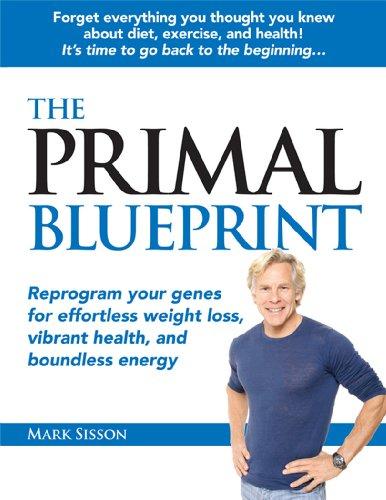
The Primal Blueprint by Mark Sisson is a 2009 health book about ancestral health, nutrition, fitness. The human body is genetically adapted to the behaviors of hunter-gatherers, not to industrialized patterns of eating, movement, and light exposure.
Summary
The Primal Blueprint is Mark Sisson's framework for applying evolutionary logic to every major lifestyle domain: what to eat, how to exercise, how to sleep, how to manage stress, and how to play. Sisson, a former elite distance runner, came to ancestral health after decades of high-mileage training left him injured and sick. His central thesis is that the behaviors and foods that characterized human life for two million years produce health, and that the behaviors introduced by industrialization — chronic cardio, grain-heavy diets, electric light, sedentary work — systematically undermine it.
The nutrition model overlaps with paleo approaches: eliminate grains, legumes, sugar, and industrial seed oils; emphasize meat, fish, eggs, vegetables, fruit, and fat. But Sisson's distinctive contribution is the exercise framework. He argues that the chronic endurance training promoted in mainstream fitness advice is counterproductive, because it keeps the body in a persistent cortisol state. The primal exercise prescription instead combines frequent low-intensity movement (daily walking), brief high-intensity sessions (sprints and heavy lifting), and generous recovery. Sisson calls this pattern "lifting heavy things, moving frequently at a slow pace, and sprinting once in a while."
The book also covers sleep, sunlight, play, and tribal connection as health-critical behaviors. This holistic framing distinguishes it from strict nutrition books. Sisson argues that stress, sleep deprivation, and social disconnection drive metabolic dysfunction as powerfully as diet. The concept of "fat adaptation" — training the body to burn fat as its primary fuel rather than relying on carbohydrate — runs through both the nutrition and exercise sections and is one of the book's signature ideas.
The Primal Blueprint is more accessible and less technical than Robb Wolf's work and more comprehensive than a pure diet book. Sisson writes with the voice of a converted athlete rather than an academic, which makes the argument easier to absorb even if it occasionally sacrifices nuance. The evidence base has some gaps, particularly around chronic cardio harms for most non-elite exercisers, but the lifestyle integration is genuinely useful and the core dietary advice aligns with broadly accepted nutritional science.
Talk to The Primal Blueprint like its author wrote you back.
Get the ideas that fit your life — not generic summaries.
- Chat with the book
- Audiobook-style main ideas
- Adapts to your life and goals
- Helps you take action
Key takeaways
- 1.
The human body is genetically adapted to the behaviors of hunter-gatherers, not to industrialized patterns of eating, movement, and light exposure.
- 2.
Chronic endurance exercise keeps cortisol elevated and suppresses immune function. Brief, intense efforts followed by generous recovery better match our evolutionary design.
- 3.
Fat adaptation — training the metabolism to burn stored fat for energy — improves body composition, reduces hunger, and stabilizes energy levels without relying on constant carbohydrate fueling.
- 4.
The primal exercise formula is simple: move frequently at low intensity, lift heavy things occasionally, and sprint once in a while. Complexity is unnecessary.
- 5.
Grains drive insulin spikes that over time impair fat metabolism and contribute to metabolic syndrome, regardless of whether they contain gluten.
- 6.
Sleep is not optional recovery time. It is the period when growth hormone peaks, tissue repairs, and memory consolidates. Cutting sleep is cutting health.
- 7.
Sunlight, play, and community are as physiologically important as food and exercise. The primal framework treats lifestyle as integrated, not a list of separate habits.
- 8.
The 80/20 principle applies to ancestral eating: getting the big variables right most of the time produces most of the benefit. Perfectionism is unnecessary and unsustainable.
Discussion questions
Use these on your own, with a book club, or as chat starters in Superbook. Book club version, ready to copy or print →
- 1.
Sisson argues chronic cardio is counterproductive for most people. How does that claim sit with you if you run, cycle, or swim as a regular practice?
- 2.
The book traces Sisson's own health problems back to conventional training advice. When have you followed mainstream health advice and later questioned whether it was right?
- 3.
Sisson's exercise prescription is intentionally minimal. Is there something you're doing in your fitness routine that might be more about anxiety than actual benefit?
- 4.
The concept of fat adaptation inverts conventional sports nutrition advice. What would you need to see to be convinced that the standard carbohydrate-loading model is wrong?
- 5.
How much of your current lifestyle was chosen deliberately and how much accumulated by default from cultural norms?
- 6.
Sisson uses 'Grok,' a hypothetical primal ancestor, as a reference point. Is that rhetorical device useful or does it oversimplify what ancestral life was actually like?
- 7.
The book argues sleep, sunlight, and play are as important as diet. Which of those three do you most consistently neglect?
- 8.
Sisson recommends the 80/20 approach rather than strict compliance. Does that framing make lifestyle change more or less likely to stick for you?
- 9.
How would you describe the relationship between your current exercise habits and your stress levels? Does exercise reduce stress or sometimes add to it?
- 10.
The primal framework suggests that modern conveniences — artificial light, processed food, sedentary jobs — create mismatches with our biology. Which conveniences would you be least willing to change?
- 11.
What does 'play' look like in your adult life, and how seriously do you take its role in health?
- 12.
Sisson is candid that his earlier elite performance came at a health cost. How do you think about the trade-off between peak performance and long-term wellbeing?
Themes
Frequently asked questions
-
What is The Primal Blueprint about?
It applies evolutionary logic to all major lifestyle domains — diet, exercise, sleep, stress, sunlight, play — arguing that matching our behavior to our genetic design produces lasting health.
-
How is The Primal Blueprint different from the paleo diet?
The dietary principles largely overlap, but Sisson adds an exercise framework that challenges chronic cardio, a focus on fat adaptation, and coverage of sleep, play, and stress. It is a broader lifestyle system rather than a pure nutrition prescription.
-
Is The Primal Blueprint worth reading?
Yes, particularly for people who want an integrated lifestyle framework rather than isolated diet or exercise advice. The exercise prescription is distinctive and backed by reasoning that many mainstream fitness models ignore.
-
Who should read this book?
Endurance athletes curious whether their training model might be working against their health, anyone who has tried low-fat or high-carb approaches without results, and readers who want a single framework that addresses diet, fitness, and lifestyle together.
-
What is the most actionable idea in The Primal Blueprint?
Replace daily moderate-intensity cardio sessions with frequent slow walks plus two or three intense efforts per week. The shift is counterintuitive but the physiological logic is clear and the time commitment is lower.