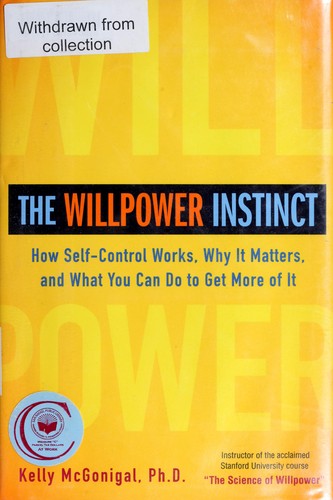
The Willpower Instinct by Kelly McGonigal is a 2011 self-help book about willpower, self-control, neuroscience. Willpower has three components: 'I will,' 'I won't,' and 'I want.' Effective self-control requires all three; most people focus only on resistance while neglecting the motivating vision.
Summary
The Willpower Instinct is based on Kelly McGonigal's popular ten-week science of willpower course at Stanford University's Continuing Studies program. McGonigal is a health psychologist, and the book reflects her interest in translating neuroscience and behavior research into immediately usable tools. Each chapter corresponds to a week of the course, ending with a challenge designed to apply the week's ideas before moving on.
McGonigal frames willpower around three distinct capacities: "I will" (the ability to do what you intend), "I won't" (the ability to resist impulses), and "I want" (the ability to keep your larger goals in mind). All three are mediated by the prefrontal cortex and compete with older, more impulsive systems. Self-control failures are usually failures of this competition — the impulsive system wins before the reflective one has time to engage.
The book's most counterintuitive chapters address the willpower traps that well-intentioned people fall into. Moral licensing — the tendency to reward yourself for good behavior by indulging in bad behavior — explains why people who exercise on Monday often eat worse on Tuesday. The "what the hell" effect explains how a single lapse turns into a full abandonment of a goal. Self-compassion turns out to be more effective than self-criticism for recovering from failures; people who beat themselves up are more, not less, likely to repeat the behavior.
McGonigal consistently returns to mindfulness as the foundational practice for improving self-control: the ability to notice what you're doing and feeling before acting rather than after. Her approach is practical and warm without being soft — she takes seriously that behavior change is hard and that most advice underestimates the difficulty.
Talk to The Willpower Instinct like its author wrote you back.
Get the ideas that fit your life — not generic summaries.
- Chat with the book
- Audiobook-style main ideas
- Adapts to your life and goals
- Helps you take action
Key takeaways
- 1.
Willpower has three components: 'I will,' 'I won't,' and 'I want.' Effective self-control requires all three; most people focus only on resistance while neglecting the motivating vision.
- 2.
Moral licensing sabotages goals: feeling virtuous for one good action creates psychological permission to behave badly immediately after. Tracking virtue is counterproductive.
- 3.
The 'what the hell' effect turns a small lapse into a full abandon. Recognizing this pattern in real time is the most important intervention for breaking it.
- 4.
Self-compassion after failure is more effective than self-criticism. People who treat themselves harshly after a slip are more likely to repeat it, not less.
- 5.
Mindfulness — noticing the urge before acting on it — is the core skill underlying all willpower improvements. You cannot change what you don't observe.
- 6.
Future self-continuity matters. People with a stronger sense of connection to their future self make better long-term decisions; vividly imagining your future self improves present choices.
- 7.
The stress response and the willpower system compete for the same physiological resources. Chronic stress reliably degrades self-control. Anything that reduces stress also improves willpower.
- 8.
Social contagion affects willpower: your self-control is influenced by the self-control norms of people around you. Choosing peer groups wisely has leverage on behavior.
Discussion questions
Use these on your own, with a book club, or as chat starters in Superbook. Book club version, ready to copy or print →
- 1.
McGonigal distinguishes 'I will,' 'I won't,' and 'I want.' Which of the three is weakest for you in the area of behavior change you care most about?
- 2.
Have you noticed moral licensing in your own behavior — using one good action to justify a subsequent bad one? What patterns do you see?
- 3.
The 'what the hell' effect is the moment a small lapse becomes a full abandon. Think of a recent example in your own life. What would have interrupted the cascade?
- 4.
McGonigal says self-compassion is more effective than self-criticism for recovering from failures. Do you believe that for yourself? What makes it hard to practice?
- 5.
Which stress-reduction practice — sleep, exercise, breathing, social connection — most reliably improves your self-control? Which are you currently neglecting?
- 6.
How strong is your sense of continuity with your future self? When you imagine yourself in twenty years, does that person feel like 'you' or like a stranger?
- 7.
What does mindfulness look like in your daily experience — not as a formal practice, but as noticing urges before acting on them?
- 8.
McGonigal discusses how being around others with poor self-control degrades your own. Who in your environment most influences your habits, for better or worse?
- 9.
The book argues that 'trying harder' is rarely the right intervention for willpower failures. What would a smarter intervention look like for your current biggest self-control challenge?
- 10.
She covers the ironic rebound effect — suppressing a thought makes it more intrusive. Where in your life are you fighting yourself in a way that's making things worse?
- 11.
What would it mean to treat your next behavioral lapse as information rather than as failure?
- 12.
If you applied the course structure — one focus per week — to your most important self-control challenge, what would week one look like?
Themes
Frequently asked questions
-
Is The Willpower Instinct worth reading?
Yes, particularly if you want practical exercises alongside the research. The course-based structure — each chapter ending with a weekly challenge — makes it more actionable than most psychology books. McGonigal's writing is warm and direct without being preachy.
-
How long does it take to read The Willpower Instinct?
About four to five hours for the roughly 275-page book. The chapters are self-contained, so it works well read one chapter at a time with space to try the exercises in between.
-
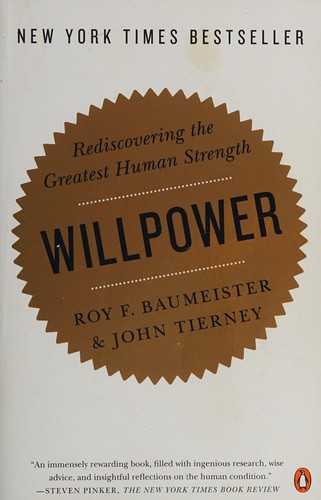
How does The Willpower Instinct differ from Willpower by Baumeister?
Both draw on academic research, but McGonigal's book is more prescriptive and exercise-driven. Baumeister focuses more on the research itself and its structural implications. McGonigal emphasizes mindfulness and self-compassion as foundations, which Baumeister does not. If you want more science, read Baumeister; if you want more exercises, McGonigal.
-
What's the most surprising finding in the book?
That self-compassion after failure outperforms self-criticism. Most people assume being harsh with themselves is motivating. The research consistently shows the opposite: guilt and shame reduce the likelihood of recovery and increase the likelihood of repeating the behavior.
-
Who should read The Willpower Instinct?
Anyone who has tried and failed to change a behavior and wants to understand why the standard approaches didn't work. Also useful for people who are hard on themselves about failures and haven't considered that self-compassion might actually be the more effective tool.