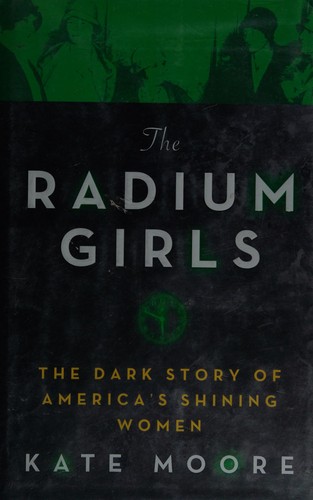
The Radium Girls: The Dark Story of America's Shining Women by Kate Moore is a 2017 history book about labor rights, corporate accountability, women's history. The 'lip, dip, paint' technique was a standard factory instruction, not the workers' own habit. The decision to train workers to ingest radium paint was a deliberate industrial practice.
Summary
The Radium Girls tells the story of the young women who painted luminous watch dials with radium-based paint in factories in New Jersey and Illinois during the 1910s and 1920s. They were instructed to point their brushes with their lips — a technique known as "lip, dip, paint" — and unknowingly ingested lethal quantities of radium. Kate Moore's book follows the women as they sickened, as their employers denied any connection to the paint, and as a small group of them chose to sue rather than accept the company's story and die quietly.
The science of radium poisoning is documented in clinical detail. The women's bones dissolved. Their jaws had to be removed. Their bodies became so radioactive that, decades after their deaths, their graves emitted measurable radiation. Moore does not soften any of this, and the accumulation of specific medical detail serves a purpose: it makes visceral the gap between what the Radium Corporation knew — or should have known — and what it told its employees.
The legal fight took years and nearly destroyed the women who pursued it. They were dying during depositions. Lawyers changed sides. Courts delayed. The Radium Corporation spent heavily to discredit the women's claims, funded alternative medical explanations, and relied on the fact that its workers were young, poor, and female in a legal system that had few tools to protect them. Moore's account of the litigation is one of the book's strongest sections — a detailed picture of how corporate power operates against individual plaintiffs with declining health and limited resources.
The women who sued ultimately won settlements and, more importantly, forced changes in labor law and industrial safety standards that protected generations of workers after them. Moore is clear that the victory was partial — the women were already dying — but she frames the legal battle as an act of courage that had real structural consequences. The book is a straightforward exercise in moral clarity: these women were wronged, the company knew it, and the legal system eventually forced accountability, however late.
Talk to The Radium Girls: The Dark Story of America's Shining Women like its author wrote you back.
Get the ideas that fit your life — not generic summaries.
- Chat with the book
- Audiobook-style main ideas
- Adapts to your life and goals
- Helps you take action
Key takeaways
- 1.
The 'lip, dip, paint' technique was a standard factory instruction, not the workers' own habit. The decision to train workers to ingest radium paint was a deliberate industrial practice.
- 2.
The Radium Corporation's executives handled radium carefully in their own offices while telling workers it was harmless. The knowledge gap was not ignorance — it was institutional dishonesty.
- 3.
Radiation poisoning was poorly understood in the 1910s, but by the early 1920s there was enough evidence linking radium exposure to illness that willful ignorance had become corporate policy.
- 4.
The dial painters' legal case was among the first in which workers successfully sued an employer for occupational illness. The precedent it set helped build the legal framework for workplace safety law.
- 5.
Several of the Radium Girls continued fighting legal battles through depositions while physically unable to walk. The documentary record of their illness and their testimony is among the most powerful in American labor history.
- 6.
The women's bodies remained radioactive after death — a literal legacy in the physical world that parallels the legal legacy they created in labor law.
- 7.
Corporate delay tactics in occupational illness litigation — disputing causation, hiring alternative-explanation experts, prolonging proceedings — were already well developed in the 1920s and remain recognizable today.
- 8.
The social factors that made the dial painters vulnerable — gender, class, youth, dependence on factory wages — were also what made their eventual legal victory remarkable.
Discussion questions
Use these on your own, with a book club, or as chat starters in Superbook. Book club version, ready to copy or print →
- 1.
The factory supervisors handled radium with tongs while workers painted with their lips. At what point does a company's knowledge of harm become a moral rather than merely a legal failure?
- 2.
Several women continued their lawsuits while visibly dying. What drives people to pursue justice through institutional channels when personal cost is that high?
- 3.
Moore's book is written in a clearly sympathetic register toward the workers. How does authorial moral stance affect the kind of history that gets told, and is it always a problem?
- 4.
The Radium Corporation funded alternative medical explanations for the workers' illness. How do you distinguish between legitimate scientific uncertainty and deliberate manufactured doubt?
- 5.
The dial painters were predominantly young women from working-class backgrounds. How much of the company's ability to deny and delay depended on their social vulnerability specifically?
- 6.
The legal victories came too late to save the women who fought. Does that change how you evaluate the success of the lawsuit as an act of resistance?
- 7.
What do you know about the industrial safety standards in your own workplace or field? How would you find out if something similar were happening?
- 8.
The book documents the gap between what science knew and what regulation required. What analogous gaps exist today in industries where we know about harm but have not yet forced accountability?
- 9.
Moore names and individualizes many of the women throughout the book. What does that choice to individualize — rather than aggregate — do for how you read the story?
- 10.
The Radium Girls' case contributed to worker protection law. Can you trace the arc from their specific suffering to general protections that now exist? Does that arc feel like justice?
- 11.
What would have had to be different — socially, legally, scientifically — for these women to have been protected before they were poisoned rather than compensated after?
- 12.
Have you encountered other cases where the victims of industrial harm had to fight institutional denial while already sick? How do those cases compare to what Moore documents?
Themes
Frequently asked questions
-
Is The Radium Girls worth reading?
Yes, particularly for readers interested in labor history, women's history, or the relationship between corporate knowledge and industrial harm. The writing is accessible and the narrative is propulsive, though Moore's sympathetic register is evident throughout.
-
How long does it take to read The Radium Girls?
Around seven to eight hours at average reading pace for the roughly 500-page book. The medical detail in the middle sections is dense, but the legal narrative in the final third reads quickly.
-
What is The Radium Girls about?
The young women who painted luminous watch dials with radium paint in New Jersey and Illinois in the 1910s and 1920s, became fatally ill from the exposure, and successfully sued their employer in landmark cases that helped establish industrial safety law in the United States.
-
Did the Radium Girls actually win their case?
Yes, though not fully and not quickly. Several women won settlements from the Radium Corporation. More importantly, their legal battles set precedents for worker suits against employers for occupational illness and influenced the development of workplace safety regulation.
-
Why did the factory workers lick the paintbrushes?
Because they were instructed to by supervisors as standard procedure, called 'lip, dip, paint.' The technique gave the finest brush tip for precise dial work. Workers were told the paint was harmless. Factory management, meanwhile, handled radium with protective equipment.
-
Who should read this book?
Anyone interested in labor history, corporate accountability, women in early twentieth-century industrial America, or the history of radiation science. It is also a strong choice for readers who want a narrative about systemic injustice with a legal resolution.
Similar books

Killers of the Flower Moon
David Grann

Bad Blood: Secrets and Lies in a Silicon Valley Startup
John Carreyrou

The Warmth of Other Suns
Isabel Wilkerson

Unbroken: A World War II Story of Survival, Resilience, and Redemption
Laura Hillenbrand
