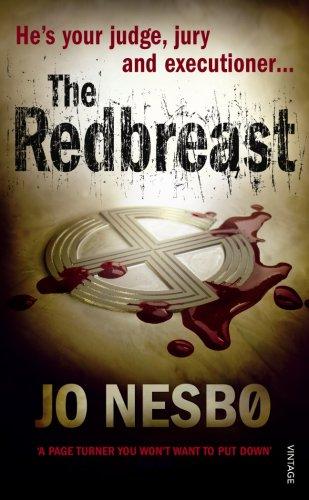
The Redbreast by Jo Nesbø is a 2000 thriller book about wartime betrayal, memory and guilt, norwegian collaboration. Nesbø uses the thriller format to examine a chapter of Norwegian history — the Waffen-SS volunteers — that the country has historically preferred to forget.
Summary
The Redbreast is the third Harry Hole novel and the one that established Nesbø as a major force in Scandinavian crime fiction. Oslo detective Harry Hole investigates a series of seemingly unconnected events — a rare WWII-era Märklin rifle, a dead man in a hospital, whispers about a figure from Norway's shameful past — while the novel cuts back to 1942 and 1944, following Norwegian volunteers on the Eastern Front fighting for the Nazis. The two timelines inch toward each other with the slow patience of a sniper.
What the book is actually about is Norway's relationship with its wartime collaborators. Hundreds of Norwegians volunteered for the Waffen-SS and fought alongside Germany on the Eastern Front. Nesbø doesn't make them cartoonish villains. The men in 1942 are young, confused, and in some cases genuinely brave — which makes the weight of what they represent all the harder. The modern investigation keeps returning to the question of what obligations the present owes to the past, and whether crimes buried by decades can still demand justice.
Structurally, The Redbreast is more ambitious than most genre thrillers. The dual timeline requires patience but pays off, and Nesbø is careful to make the historical sections feel substantive rather than decorative. Harry Hole is one of the better-drawn detectives in the genre — genuinely flawed, alcoholic, loyal in complicated ways — and this is the novel where his character clicks into full focus. The prose in translation (Don Bartlett did this one) is clean and direct without being flat.
Readers who like their crime fiction slow-building and historically grounded will find this rewarding. Those who want tight pacing and frequent plot turns may find the 1940s sections drag. It's long and it takes time to assemble. But the payoff is a thriller that has something real on its mind, not just a puzzle to solve.
Talk to The Redbreast like its author wrote you back.
Get the ideas that fit your life — not generic summaries.
- Chat with the book
- Audiobook-style main ideas
- Adapts to your life and goals
- Helps you take action
Key takeaways
- 1.
Nesbø uses the thriller format to examine a chapter of Norwegian history — the Waffen-SS volunteers — that the country has historically preferred to forget.
- 2.
Harry Hole's alcoholism isn't window dressing. It shapes his judgment, his relationships, and how close he gets to self-destruction, which makes him more interesting than the average competent detective.
- 3.
The dual timeline structure earns its complexity: the 1940s chapters humanize the people whose crimes the present-day investigation is trying to unravel, which makes the moral stakes messier.
- 4.
National guilt and personal guilt run in parallel. Both the country and the individual characters are shown carrying debts they can't quite bring themselves to acknowledge.
- 5.
The novel asks whether loyalty to a cause can coexist with complicity in atrocity. It refuses to give a clean answer.
- 6.
The Märklin rifle is one of the better MacGuffins in modern crime fiction — a real object that anchors an abstract moral history.
- 7.
Nesbø trusts the reader to sit with ambiguity. The historical soldiers are not redeemed, but they're not flattened either.
- 8.
The Norwegian winter and landscape work as character — the cold and darkness aren't atmospheric filler but feel structural to the novel's mood.
Discussion questions
Use these on your own, with a book club, or as chat starters in Superbook. Book club version, ready to copy or print →
- 1.
The Norwegian volunteers in the 1940s sections are portrayed with some empathy. Did you find that effective or uncomfortable? Does the novel earn that choice?
- 2.
Harry Hole is warned multiple times to drop the investigation. What keeps him going? Is it justice, obsession, or something else?
- 3.
The title refers to the European robin — a bird associated with death in some Scandinavian folklore. How does it function in the novel beyond the literal plot?
- 4.
The book suggests Norway has a complicated, underacknowledged relationship with its WWII collaborators. Does this change how you read the crime plot?
- 5.
How does the dual timeline affect your experience of the present-day investigation? Did knowing some of the history ahead of the detective create a different kind of tension?
- 6.
Harry's alcoholism gets him demoted early in the book. The novel treats this as both a personal failing and an institutional injustice. How did you read it?
- 7.
The killer in this book is motivated by something that reads as loyalty rather than pure malice. Does that make them more or less disturbing to you?
- 8.
Compared to other Nordic crime novels you've read — Stieg Larsson, Henning Mankell — where does Nesbø land in terms of what he's using the thriller form to say?
- 9.
The historical soldiers fight bravely in conditions that are genuinely horrific. Does their courage complicate their guilt, or are they entirely separate things?
- 10.
The ending is deliberately ambiguous about certain things. What did you think Nesbø was leaving unresolved on purpose, and why?
- 11.
The investigation is partly hampered by institutional reluctance to look too closely at certain people. What does the novel suggest about how institutions protect their own histories?
- 12.
If you were Harry Hole, would you have pursued this case once the pressure came to stop? What would you have needed to know to make that call?
Themes
Frequently asked questions
-
Do I need to read the first two Harry Hole books before The Redbreast?
No, though Nesbø does reference earlier events. Most readers treat The Redbreast as the effective starting point of the series, since it's where Harry's character and the series' ambitions first fully cohere. The earlier books (The Bat and Cockroaches) are lighter and less essential.
-
Is The Redbreast slow? I've heard Nordic crime can be dense.
The 1940s sections require patience and the book is long. If you want a fast-moving thriller, this isn't it. But if you're willing to sit with dual timelines and historical context, the payoff is substantial. It reads more like literary crime fiction than a pure page-turner.
-
What is The Redbreast actually about, without spoilers?
A present-day Oslo detective investigating a rare WWII rifle and a suspicious death, intercut with the story of Norwegian volunteers who fought for the Nazis on the Eastern Front. The two threads converge around questions of guilt, loyalty, and what Norway chose to forget about its wartime history.
-
Who shouldn't read this book?
Readers who want action-forward thrillers with minimal historical digression, or who find WWII-era moral complexity in fiction off-putting. The book demands you take the historical sections seriously, not just as backstory.
-
Is there a film or TV adaptation of The Redbreast?
The Harry Hole series has been adapted for Norwegian television. The Snowman was adapted as an English-language film in 2017, though it was poorly received. The Redbreast itself has not been a major standalone adaptation.
Similar books
The Spy and the Traitor: The Greatest Espionage Story of the Cold War
Ben Macintyre
Bloodlands: Europe Between Hitler and Stalin
Timothy Snyder
The Rise and Fall of the Third Reich
William L. Shirer
Dead Wake: The Last Crossing of the Lusitania
Erik Larson
