Health · Book club
The Relaxation Response book club questions
Here are 12 book club questions for The Relaxation Response by Herbert Benson, ordered to open easily and end somewhere worth arguing about. Copy them, print them, or bring them up one at a time.
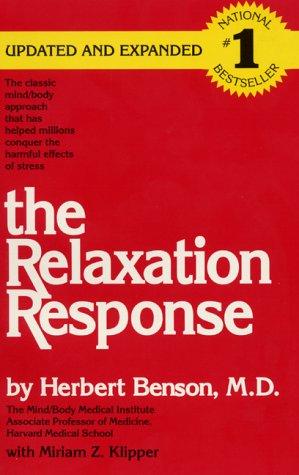
In 1975, Harvard cardiologist Herbert Benson published a compact, research-backed argument that the body carries a built-in counterforce to stress — one that medicine had largely ignored.
Herbert Benson · 1975 · 3h 45m
Full summary and key takeaways →The 12 questions
- 1.
Benson stripped TM down to four secular elements. Did that demystification make the practice more or less appealing to you personally?
- 2.
The book was published in 1975, when stress medicine was still marginal. How has the status of mind-body interventions shifted in your professional or personal experience since then?
- 3.
Benson's technique asks for a passive attitude toward intruding thoughts. What's the difference between passivity and inattention, and why might that distinction matter?
- 4.
The recommended practice is ten to twenty minutes once or twice daily. What actually prevents people from doing something that simple consistently?
- 5.
Benson argues that equivalent techniques appear across Buddhist, Hindu, Christian, and Jewish traditions. What does that convergence suggest about the human stress response?
- 6.
How does chronic, low-grade modern stress differ from the acute stress the fight-or-flight response evolved to handle, and why might that difference matter clinically?
- 7.
Benson presents the relaxation response as a complement to, not a replacement for, conventional medicine. Where do you see that boundary getting crossed in how people actually use meditation today?
- 8.
Which part of Benson's four elements — quiet environment, mental device, passive attitude, comfortable position — would you find hardest to maintain?
- 9.
The book was written for a general audience rather than clinicians. What's gained and lost by that choice?
- 10.
Many people report they can't meditate because their mind won't quiet down. How does Benson's instruction actually address that objection?
- 11.
If the physiological effect is the same regardless of the word used, what does that say about the role of meaning or belief in the technique's effectiveness?
- 12.
Benson's research focused heavily on blood pressure. What other conditions do you think would be most amenable to this kind of intervention?
How to run the discussion
- Pick six to eight, not all of them. An hour of real discussion covers fewer questions than anyone expects, and racing the list is what makes a book club feel like homework.
- Open with what people noticed, not what they concluded. Asking for a verdict first hardens opinions before anyone has heard each other.
- Let the disagreement run. The questions below that split a room are the ones worth the time; the ones everyone answers the same way can be skipped.
- Ask the quiet person a specific question. A direct, narrow question is far easier to answer than an open invitation to contribute.
Themes worth steering toward
If the conversation stalls, these are the threads that usually restart it.
Common questions
What are good book club questions for The Relaxation Response?
Here are 12 book club questions for The Relaxation Response by Herbert Benson, ordered to open easily and end somewhere worth arguing about. The strongest openers ask what each reader noticed rather than what they concluded, and the discussion usually turns on stress reduction, meditation, mind-body medicine.
How long should a book club discussion of The Relaxation Response last?
Most groups run 60 to 90 minutes of actual discussion. That is roughly six to eight questions, not all of them, so pick the ones that suit your group rather than working down the list in order.
What are the main themes in The Relaxation Response?
Stress reduction, Meditation, Mind-body medicine, Relaxation, Chronic disease. Those are the threads most likely to divide a room, which makes them the useful places to steer a discussion that has gone quiet.
Picking the next one? See books like The Relaxation Response or questions for other book club picks.
