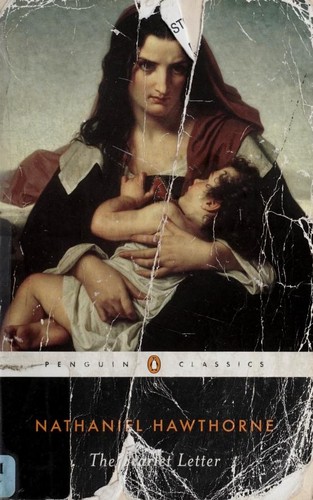
The Scarlet Letter by Nathaniel Hawthorne is a 1850 literary fiction book about guilt and public shame, sin and redemption, identity and symbol. Hester Prynne is more fully realized than many of the female protagonists of later American fiction — she endures public shame without being broken by it, and she forms her own moral code independent of the community that condemned her.
Summary
The Scarlet Letter is set in Puritan Boston in the 1640s and opens with Hester Prynne, a young woman who has given birth to a child while her husband is absent, being released from prison into the public square. She will wear a scarlet letter "A" on her chest for the rest of her life — a mark of adultery, meant to define and shame her. She accepts it, and over time she transforms the letter from a symbol of disgrace into something else entirely.
The novel's central dramatic situation is actually less about Hester than about the other figures caught in the same moral knot: Arthur Dimmesdale, the young minister who is the child's father and who cannot bring himself to confess; and Roger Chillingworth, Hester's long-absent husband, who arrives in Boston and makes it his purpose to expose Dimmesdale through psychological torment. The three of them are locked in a strange closed triangle — shame, guilt, and revenge — and Hawthorne is interested in what each of those positions costs the person who holds it.
The prose is dense and allegorical in ways that require patience. Hawthorne is writing about Puritan New England from the position of a nineteenth-century New Englander with complicated feelings about his own family history (an ancestor was a judge in the Salem witch trials). The result is something that reads less like a conventional novel and more like a sustained moral inquiry written in a symbolic register.
This is required reading in many American high schools, which may be the main reason people don't read it as adults. Returning to it, it is a stranger and richer book than its reputation as a morality tale suggests — particularly in its portrait of Hester, whose quiet defiance and self-sufficiency over fifteen years of ostracism is the novel's most compelling argument about how people survive punishment.
Talk to The Scarlet Letter like its author wrote you back.
Get the ideas that fit your life — not generic summaries.
- Chat with the book
- Audiobook-style main ideas
- Adapts to your life and goals
- Helps you take action
Key takeaways
- 1.
Hester Prynne is more fully realized than many of the female protagonists of later American fiction — she endures public shame without being broken by it, and she forms her own moral code independent of the community that condemned her.
- 2.
Dimmesdale's hidden guilt is shown to be far more destructive than Hester's public shame. Hawthorne suggests that unexpressed guilt corrodes the self in ways that punishment doesn't.
- 3.
Chillingworth's transformation from a cold intellectual to an instrument of revenge is the novel's darkest argument: that vengeance destroys the person who pursues it as thoroughly as the person who receives it.
- 4.
The letter 'A' changes meaning throughout the novel — from 'Adultery' to something like 'Able' as the community gradually reassesses Hester. Hawthorne is interested in how symbols resist the meanings assigned to them.
- 5.
Hawthorne was writing about Puritan New England while working at the Salem Custom House, surrounded by Puritan records. The novel is partly about his own complicated inheritance.
- 6.
Pearl, Hester's daughter, is deliberately uncanny — simultaneously a symbol of the sin and a living child who keeps escaping symbolic interpretation. Hawthorne refuses to resolve the ambiguity.
- 7.
The scaffold appears three times in the novel: beginning, middle, and end. Its reappearances structure the moral argument and give the narrative a quasi-theatrical geometry.
- 8.
The novel's central tension is between public law and private conscience, and Hawthorne doesn't resolve it in favor of either. He shows that both can be corrupted.
Discussion questions
Use these on your own, with a book club, or as chat starters in Superbook. Book club version, ready to copy or print →
- 1.
Hester accepts her punishment and does not flee, even when she could. What do you think keeps her in Boston, and does the novel want us to admire that choice?
- 2.
Dimmesdale's public reputation is at its height while he is privately destroying himself. Is Hawthorne suggesting that public virtue and private integrity are incompatible, or something more specific?
- 3.
Chillingworth begins the novel as a wronged husband with some claim to sympathy. Where does that sympathy run out for you, and why?
- 4.
The letter 'A' eventually becomes ambiguous — the community starts to see it differently. Is that a redemption story, or is Hawthorne showing us something more unsettling about how symbols work?
- 5.
Pearl is described as wild, uncanny, and unresponsive to ordinary social expectations. What function does she serve in the novel's moral argument?
- 6.
Hawthorne sets the novel in the 1640s but was writing in the 1840s. What is he saying about his own time by going two centuries back?
- 7.
The scaffold scenes give the novel a formal structure unusual for nineteenth-century American fiction. Did that structure feel meaningful or schematic to you?
- 8.
Hester contemplates, at one point, whether the moral law governing her community is just, and whether she is bound by it. Does the novel endorse or question her reasoning?
- 9.
The novel ends with Dimmesdale's public confession and death. Is that an ending about redemption, or about the limits of redemption?
- 10.
Roger Chillingworth is sometimes described as the novel's villain, but he has real grievances. How much sympathy does Hawthorne extend to him?
- 11.
Why do you think The Scarlet Letter became a fixture of high school education in America? What is the culture trying to transmit by assigning it?
- 12.
Reading it now, which character do you find most sympathetic, and does that say something about where you are in your own life?
Themes
Frequently asked questions
-
Is The Scarlet Letter worth reading as an adult?
Yes, particularly if you read it under duress in high school. The novel is stranger and more morally nuanced than its reputation as a cautionary tale about sin suggests. Hester Prynne is a more interesting character than she is usually given credit for, and Dimmesdale's psychological deterioration is genuinely disturbing.
-
Is The Scarlet Letter hard to read?
The prose is dense and allegorical, and the pace is slow by contemporary standards. The introductory chapter ('The Custom-House') is notorious for being tedious even to many admirers of the novel — it's acceptable to start at Chapter 1. The symbolic register can feel mechanical, but Hawthorne works hard to give the symbols life.
-
What is the scarlet letter meant to represent?
Initially it marks Hester as an adulteress. But Hawthorne is interested in how symbols escape the meanings assigned to them: over time the letter comes to represent something more like capability or endurance, and its ambiguity is central to the novel's argument about how identity is constructed and resisted.
-
Who is the most sympathetic character in The Scarlet Letter?
Most readers find Hester the most sympathetic — she is the most honest, the most resilient, and the most fully realized character. Dimmesdale is sympathetically drawn but ultimately inadequate. Chillingworth is the novel's closest thing to a villain, though Hawthorne tries to show how he got there.
-
Who shouldn't read The Scarlet Letter?
Readers who find allegorical, symbol-heavy prose tedious will struggle. The novel rarely lets you forget that it is making an argument. If you want naturalistic fiction with psychological depth, Hawthorne's contemporary Melville may serve you better; if you want a clear moral parable, Hawthorne's allegory may feel too ambiguous.