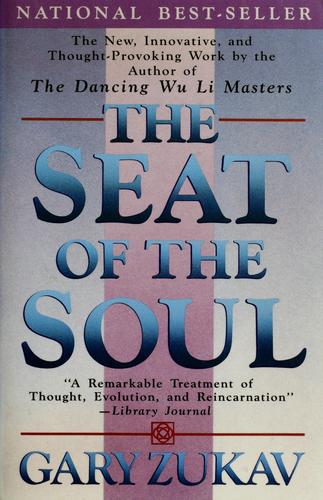
The Seat of the Soul by Gary Zukav is a 1989 philosophy book about soul, intention, spiritual growth. Authentic power comes not from controlling external circumstances but from aligning the personality with the soul's deepest intentions.
Summary
The Seat of the Soul, published in 1989, is Gary Zukav's attempt to construct a framework for human evolution centered not on the five senses but on the soul. Zukav argues that humanity is in the midst of a shift from external power — the ability to manipulate and control the physical world — to authentic power, which comes from aligning the personality with the soul. The soul, in his account, is the eternal part of the self engaged in a long arc of growth across multiple lifetimes.
Much of the book is organized around the idea of intention. Zukav claims that what matters is not the external action but the inner motivation behind it. An act of generosity rooted in fear of rejection is different in kind from the same act rooted in genuine compassion, even if no one outside you can tell the difference. This makes intention the true site of moral and spiritual life. Karma, in Zukav's reading, is not punishment but a mechanism for learning: the consequences you experience are calibrated to bring you face to face with the quality of your intentions.
Zukav also writes extensively about multisensory perception, the idea that humans are evolving beyond reliance on the five physical senses toward an awareness of nonphysical reality — guides, the energy of relationships, the intuitions that precede rational thought. He asks readers to take seriously that which cannot be measured. The chapters on relationships are especially direct: Zukav distinguishes between relationships built on need or fear and relationships of the soul, which he calls spiritual partnerships.
The book reads less like an argument and more like a map. It does not offer the empirical scaffolding that more skeptical readers will want. Its value lies in the vocabulary it gives for examining intention, in the seriousness with which it treats inner life, and in its insistence that the invisible dimensions of experience are not less real for being invisible. Readers open to that register will find it useful. Those who require claims to be falsifiable will find it frustrating.
Talk to The Seat of the Soul like its author wrote you back.
Get the ideas that fit your life — not generic summaries.
- Chat with the book
- Audiobook-style main ideas
- Adapts to your life and goals
- Helps you take action
Key takeaways
- 1.
Authentic power comes not from controlling external circumstances but from aligning the personality with the soul's deepest intentions.
- 2.
Intention is more morally significant than action: the same deed can arise from fear or from love, and that inner difference is what karma tracks.
- 3.
Humanity is shifting from five-sensory perception to multisensory perception, which means becoming aware of non-physical influences on thought and behavior.
- 4.
Karma is a learning mechanism, not a punishment. Every experience is calibrated to teach you what your soul still needs to understand.
- 5.
Spiritual partnerships are relationships chosen not out of need or survival fear but out of a genuine commitment to shared growth.
- 6.
The soul is not the personality. The personality is one expression the soul takes during a single lifetime, and it carries the wounds and gifts of that life.
- 7.
Responsibility for one's own inner state cannot be outsourced. No one else is responsible for your fear, your anger, or your joy.
- 8.
The visible world is not the whole world. Non-physical teachers, guides, and energies are part of the reality a multisensory human learns to navigate.
Discussion questions
Use these on your own, with a book club, or as chat starters in Superbook. Book club version, ready to copy or print →
- 1.
Zukav distinguishes external power from authentic power. Where in your own life are you pursuing one when you want the other?
- 2.
He argues that intention is more important than action. Can you think of a recent moment when your action looked right but your intention was something you're less proud of?
- 3.
What would it mean in practice to make every significant decision by asking 'What is the most loving choice I can make here?'
- 4.
Zukav says karma is educational rather than punitive. Does that reframing change how you think about a painful pattern in your own life?
- 5.
How do you tell the difference between an intuition worth trusting and a projection worth questioning?
- 6.
The book claims spiritual partnerships are different from ordinary relationships of need. Which relationships in your life feel most like genuine spiritual partnerships? What makes them different?
- 7.
Zukav insists that the non-physical is real. What's your honest assessment of that claim — what would you need to take it seriously?
- 8.
He argues the soul is not the personality. If you accepted that distinction, how would it change the way you handle the parts of yourself you dislike?
- 9.
What does 'authentic power' look like in the specific context of your work or career?
- 10.
The book was written in 1989. Which of its ideas feel more relevant now than they would have then, and which feel dated?
- 11.
Zukav says fear-based choices create karma; love-based choices do not. Walk through a fear-based choice you've made. What was the fear, and what learning followed?
- 12.
If you genuinely believed your soul chose this particular life for its growth potential, how would that change how you relate to your current difficulties?
Themes
Frequently asked questions
-
What is The Seat of the Soul about?
It's a spiritual philosophy book arguing that humans are evolving from five-sensory beings focused on external power to multisensory beings capable of authentic power — defined as alignment between personality and soul. Zukav covers intention, karma, relationships, and non-physical reality.
-
Is The Seat of the Soul worth reading?
For readers already drawn to spiritual frameworks, it's a substantive and thoughtfully constructed map of inner life. For readers who want empirical grounding or clear falsifiability, the book will feel like assertion dressed as insight. Know which kind of reader you are before you start.
-
How long does it take to read The Seat of the Soul?
About five to six hours at average pace. The chapters are substantial and conceptually dense in places, so many readers find themselves pausing to reflect, which extends the time considerably.
-
Who should read The Seat of the Soul?
People at a transition point who want a vocabulary for thinking about intention, inner alignment, and the quality of their relationships. It resonates strongly with readers open to spiritual frameworks who find purely psychological self-help books too narrow.
-
What is authentic power according to Gary Zukav?
Zukav defines authentic power as the alignment of the personality with the soul — acting from love rather than fear, and from the deepest sense of what you are here to do. It contrasts with external power, which is the ability to control or influence other people or circumstances.
Similar books
The Untethered Soul
Michael A. Singer
A New Earth: Awakening to Your Life's Purpose
Eckhart Tolle

Man's Search for Meaning
Viktor E. Frankl
Waking Up: A Guide to Spirituality Without Religion
Sam Harris
