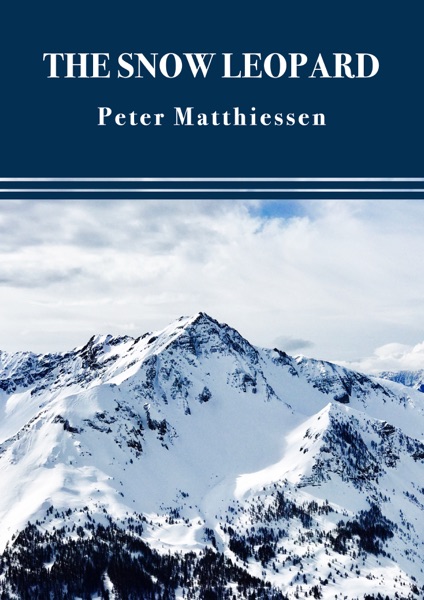
The Snow Leopard by Peter Matthiessen is a 1978 memoir book about grief, spirituality, wilderness. Grief does not resolve on a schedule, and wilderness travel neither heals it nor escapes it — it simply changes the conditions under which you carry it.
Summary
Peter Matthiessen's National Book Award-winning account of a two-month trek into the Dolpo region of Nepal in 1973 is several things at once: a naturalist's field journal, a spiritual autobiography, and a meditation on grief. Matthiessen traveled with the field biologist George Schaller, who was studying the Himalayan blue sheep (bharal) and hoped to observe the rare snow leopard. Matthiessen was a practicing Zen Buddhist whose wife, Deborah Love, had died of cancer the previous year. The journey was also, clearly, an attempt to find a way through loss.
The outer narrative follows the trek itself: the ascent from lowland Nepal into the high Himalayan plateau, the grinding physical difficulty, the encounters with Sherpa guides and Buddhist monks, the wildlife observations, and the arrival at the Crystal Mountain and the monastery of Shey Gompa. Matthiessen's naturalist training is evident throughout — descriptions of birds, mammals, and landscapes are precise and unhurried. But the outer journey is always in conversation with the inner one.
Matthiessen weaves his Zen practice and his grief into the trekking narrative in a way that resists easy resolution. He is often irritable, petty, and resistant to the equanimity his practice aims at. He misses his young son at home. He wants very much to see the snow leopard and is not sure whether wanting is itself the problem. The book's central spiritual question — whether presence and acceptance are achievable or simply idealized — is never answered, and Matthiessen is honest enough not to pretend otherwise.
The snow leopard, famously, may or may not be seen. Matthiessen's account of the possible sighting is characteristically oblique. By the end the ambiguity feels right: the book is less about achieving a goal than about what it means to move through the world with attention, through grief, through altitude, through uncertain faith. The writing is among the finest in American nature writing of the twentieth century, and the combination of natural history and personal reckoning gives it staying power beyond either genre alone.
Talk to The Snow Leopard like its author wrote you back.
Get the ideas that fit your life — not generic summaries.
- Chat with the book
- Audiobook-style main ideas
- Adapts to your life and goals
- Helps you take action
Key takeaways
- 1.
Grief does not resolve on a schedule, and wilderness travel neither heals it nor escapes it — it simply changes the conditions under which you carry it.
- 2.
Zen practice aims at presence and non-attachment, but Matthiessen's honest accounting shows how often the aim and the actuality diverge.
- 3.
Nature writing at its best is both exact observation and personal disclosure. The two are not in tension; each deepens the other.
- 4.
The desire to see the snow leopard becomes a koan. Whether wanting to see it, or not minding if you don't, is the more spiritually honest position is left deliberately unresolved.
- 5.
High altitude physical hardship creates a particular kind of clarity: the simplification of life to a single forward motion strips out the noise of ordinary decision-making.
- 6.
Buddhist impermanence — the teaching that nothing persists — is not a consolation for loss but a framework for understanding what loss always was.
- 7.
Field biology and spiritual practice share a common method: sustained, non-projective attention to what is actually present.
- 8.
The best travel writing is not about arriving somewhere. It's about what close observation, over time, reveals about the observer.
Discussion questions
Use these on your own, with a book club, or as chat starters in Superbook. Book club version, ready to copy or print →
- 1.
Matthiessen makes no clean resolution to his grief by the end of the book. Does that honesty feel like a literary choice or a psychological limitation?
- 2.
He wants to see the snow leopard and simultaneously knows that wanting corrupts attention. Have you experienced this tension between desire and presence in your own life?
- 3.
The physical difficulty of the trek — altitude, cold, exhaustion — seems to clarify rather than distract. What hardships have had that effect for you?
- 4.
Matthiessen is sometimes irritable and petty on the trail, failing to live up to his Zen ideals. Does that self-awareness strengthen or undermine the book's spiritual claims?
- 5.
George Schaller's pragmatic scientific focus and Matthiessen's spiritual searching coexist throughout the journey. What does each man offer the other?
- 6.
The book was written in the mid-1970s, after Matthiessen had been practicing Zen for years. How does that context shape what he chooses to notice and record?
- 7.
Matthiessen describes the Sherpas and Tibetan Buddhist monks with great admiration. Is there a risk of romanticizing a culture you observe only as a passing outsider?
- 8.
The possible snow leopard sighting is described ambiguously. Does that ambiguity feel satisfying or frustrating to you as a reader?
- 9.
Impermanence is a recurring theme. How does the Himalayan landscape — rock and snow and altitude — physically embody that teaching?
- 10.
Matthiessen left his young son at home for two months to go on this journey. How do you weigh that against what the journey produced?
- 11.
What place have you been to, or traveled through, that changed your relationship to something you were carrying at the time?
- 12.
The snow leopard is elusive almost to the point of mythological status. What does it mean to organize a journey around something you may never see?
Themes
Frequently asked questions
-
Is The Snow Leopard fiction or nonfiction?
Nonfiction. It is a first-person journal account of an actual two-month trek through Nepal in 1973, though Matthiessen took some literary liberties with the narrative structure. George Schaller, who traveled with him, is a real figure and confirmed the journey's basic facts.
-
Do you need to know about Zen Buddhism to read this book?
No. Matthiessen explains Zen ideas as they arise and writes for a general reader. Some familiarity helps, but the book works as a naturalist memoir even for readers with no interest in the spiritual material.
-
Is the snow leopard actually seen in the book?
Possibly. Matthiessen describes what may be a sighting near the end, but leaves it deliberately ambiguous. Part of the book's argument is that the ambiguity is not a disappointment — presence and attention were always the point, not the trophy.
-
How does The Snow Leopard compare to other Himalayan books?
Into Thin Air is about ambition and disaster; The Snow Leopard is about attention and grief. They are very different books using the same landscape. Matthiessen's writing is more literary and inward; Krakauer's is more journalistic and propulsive.
-
Who should read The Snow Leopard?
Anyone who has experienced significant loss and is looking for honest rather than consoling treatment of it. Anyone interested in how a serious natural history practice intersects with contemplative spirituality. Readers who like slow, attentive prose.