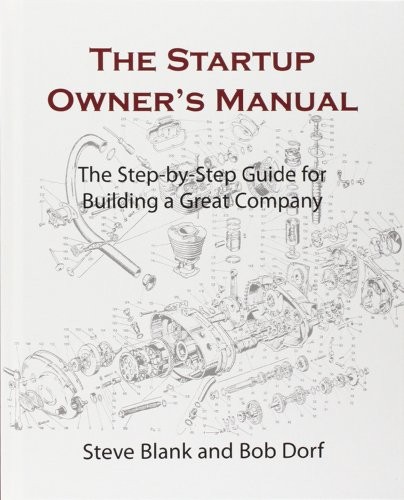
The Startup Owner's Manual by Steve Blank and Bob Dorf is a 2012 business book about customer development, startups, business model. The Business Model Canvas is a tool for capturing hypotheses, not a finished plan. Every box is a guess until customers prove otherwise.
Summary
The Startup Owner's Manual is Steve Blank and Bob Dorf's expanded, updated version of Blank's earlier customer development framework, published seven years after The Four Steps to the Epiphany. Where the earlier book introduced the ideas, this one operationalizes them with step-by-step checklists, templates, and worked examples for both physical and web-based businesses. It is, as the title suggests, a manual — something to work through rather than read cover to cover.
The book's structure follows the four stages of customer development: discovery, validation, creation, and company building. For each stage Blank and Dorf walk through the activities, the deliverables, and the signals that tell you whether you're ready to move on. The Business Model Canvas, developed by Alexander Osterwalder, is woven throughout as the tool for capturing and updating hypotheses as founders learn. This edition adds a separate track for web and mobile businesses, acknowledging that the feedback loops in software products are faster and the pivoting costs lower than in hardware or physical goods.
The core argument is identical to Blank's earlier work: a startup is not a small version of a large company, and applying big-company processes to an organization still searching for a business model will kill it. But the manual format makes the framework accessible to founders who want to actually implement it rather than just understand it conceptually. The checklists are detailed enough to use in a weekly review, not just as a general orientation.
The Startup Owner's Manual is most useful alongside a live founding process, not as a precursor to it. Read in isolation it can feel mechanical. Used as a checklist against real decisions — whether to pivot or persist, when to hire for sales, how to know validation is complete — it becomes a forcing function against the optimism bias that kills most early-stage companies.
Talk to The Startup Owner's Manual like its author wrote you back.
Get the ideas that fit your life — not generic summaries.
- Chat with the book
- Audiobook-style main ideas
- Adapts to your life and goals
- Helps you take action
Key takeaways
- 1.
The Business Model Canvas is a tool for capturing hypotheses, not a finished plan. Every box is a guess until customers prove otherwise.
- 2.
Customer discovery is complete when you can describe your customer's problem in their language and prove that a significant segment will pay to solve it.
- 3.
Customer validation requires a repeatable sales process, not just a few closed deals. If you can't describe the steps someone else could follow, it isn't repeatable yet.
- 4.
Web businesses have different metrics from physical ones: activation, retention, and viral coefficient matter as much as customer acquisition cost and lifetime value.
- 5.
Premature scaling is the number-one cause of startup failure. Scaling a broken sales process just means failing faster and more expensively.
- 6.
The pivot is a structured course correction, not a random direction change. Every pivot should be grounded in what the customer discovery process actually found.
- 7.
Earlyvangelists are not the same as mainstream customers. Selling to them proves a problem exists, not that a mass market is ready.
- 8.
The transition from searching (startup) to executing (company) requires different people, processes, and culture. Founders who don't recognize this transition often become the obstacle to their own company's growth.
Discussion questions
Use these on your own, with a book club, or as chat starters in Superbook. Book club version, ready to copy or print →
- 1.
The book structures everything around hypotheses and tests. What assumption in your current business model has gone the longest without being tested against real customer data?
- 2.
Walk through the Business Model Canvas for your current or most recent project. Which boxes feel solid and which are still guesses?
- 3.
Blank argues that customer validation is not complete until you have a process someone else could follow. How close is your sales process to being that documented?
- 4.
What signal would tell you that your company is ready to move from validation to customer creation — and is that signal the same one your investors or leadership team are using?
- 5.
The web track adds activation, engagement, and virality as metrics. How does your current measurement system compare, and what's missing?
- 6.
Earlyvangelists tend to be atypical customers. In what ways might the customers who bought your first product differ from the customers you're now trying to reach?
- 7.
Where in your organization is there most resistance to treating the business model as a hypothesis rather than a plan? Why?
- 8.
Pick one pivot you've considered but haven't made. What would you need to learn to decide whether to make it or not?
- 9.
How does the book's definition of a pivot differ from how your team actually uses the word?
- 10.
Blank and Dorf say founders often become the obstacle to scaling. What aspects of founder involvement that helped early might now be slowing things down?
- 11.
If you applied one of the customer discovery checklists to something you're working on right now, what item would you fail first?
- 12.
The book is 500+ pages. What does the length tell you about how Blank and Dorf view the nature of the problem they're solving?
Themes
Frequently asked questions
-
How is The Startup Owner's Manual different from The Four Steps to the Epiphany?
It's an updated, expanded operationalization of the same framework. Where Four Steps introduced the ideas, the Manual adds checklists, templates, and a separate web-business track. If you've read Four Steps recently, the Manual has more actionable process detail but less conceptual novelty.
-
Do I need to read The Four Steps to the Epiphany first?
No. The Startup Owner's Manual is self-contained and in many ways supersedes the earlier book. Four Steps is useful as intellectual history; the Manual is more practical for founders actively building a company.
-
Is The Startup Owner's Manual worth reading?
Yes, particularly if you're in the early stages of a startup and want a framework to structure your decisions. It's dense and manual-like rather than narrative, so it works best as a working reference alongside real company-building activity.
-
What is the Business Model Canvas and how does it fit in?
The Business Model Canvas, developed by Alexander Osterwalder, is a one-page tool for capturing the nine elements of a business model as hypotheses. Blank and Dorf use it as the running document founders update throughout customer development — replacing the traditional business plan.
-
Who should read The Startup Owner's Manual?
First-time founders and early-stage entrepreneurs who want a structured process for finding product-market fit. Product managers and operators at growth-stage companies will find the later chapters on company building useful, particularly around the transition from search to execution.
Similar books
Zero to One: Notes on Startups, or How to Build the Future
Peter Thiel
Traction: Get a Grip on Your Business
Gino Wickman

Blitzscaling: The Lightning-Fast Path to Building Massively Valuable Companies
Reid Hoffman and Chris Yeh
The Lean Startup
Eric Ries
