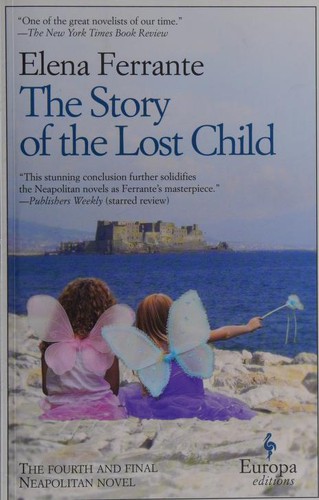
The Story of the Lost Child by Elena Ferrante is a 2015 literary fiction book about female friendship, aging and loss, motherhood. The childhood friendship between Elena and Lila is the load-bearing structure of the series, and this volume shows what it looks like when that structure is tested by old age and catastrophic loss.
Summary
The Story of the Lost Child is the fourth and final volume of Elena Ferrante's Neapolitan quartet, covering roughly thirty years of Elena Greco's life from the late 1970s through the early 2010s. Elena, now a published author and separated from her first husband, returns to Naples and to a proximity with Lila that re-activates everything unresolved between them. The two women are middle-aged, then aging, then old. Their children grow up around them. The neighborhood keeps reasserting its claim. And the novel's title, withheld until late, lands with the weight of everything that has preceded it.
The book is partly about what happens when you have run out of escapes. Elena's career is real but fragile, her personal life in constant reorganization, her relationship to her own intelligence still shadowed by Lila. Lila meanwhile has retreated inward, refusing to participate in the world's expectations of her, and her mind begins to do something frightening at the edges. The friendship — rivalry — mutual possession between these two women finds its final form here, stripped of the projections that accumulated over the first three volumes.
Ferrante's prose in this volume becomes more mournful without becoming sentimental. The digressive, obsessive quality of Elena's narration has always been the series' main formal gesture, and here it acquires a retrospective melancholy: this is a woman looking back over a life and trying to understand what she was doing while she was doing it. The novel asks whether any version of women's lives in the twentieth century could have been different — given the neighborhoods, the men, the economies, the bodies — and doesn't pretend to answer.
This is the conclusion the series earns. Readers who have not read the first three books should not begin here; the ending's force is entirely accumulated. Those who are already in the quartet will find the final hundred pages among the most powerful in contemporary fiction. Not everyone will find Ferrante's vision consoling — it isn't meant to be.
Talk to The Story of the Lost Child like its author wrote you back.
Get the ideas that fit your life — not generic summaries.
- Chat with the book
- Audiobook-style main ideas
- Adapts to your life and goals
- Helps you take action
Key takeaways
- 1.
The childhood friendship between Elena and Lila is the load-bearing structure of the series, and this volume shows what it looks like when that structure is tested by old age and catastrophic loss.
- 2.
Ferrante treats female aging honestly and without sentimentality — the body changes, ambition shifts, and the world's regard diminishes in ways neither character accepts gracefully.
- 3.
The lost child of the title is never one thing; it accumulates meanings across the final third of the book in a way that makes re-reading the earlier volumes different.
- 4.
Elena's narrative unreliability becomes most apparent here: she is writing the story long after the events, and the gap between who she was and who she thinks she was keeps widening.
- 5.
Naples in this volume is neither trap nor home but something more like a permanent condition — a place that keeps happening to its inhabitants no matter how far they've traveled.
- 6.
The novel refuses redemption arcs. Neither Elena nor Lila ends wiser or more at peace; they end as themselves, damaged and irresolvable.
- 7.
Motherhood in this final volume carries the series' heaviest weight — not as theme but as event, in a way that recasts everything that preceded it.
- 8.
Lila's 'dissolving margins' — her sense of self dispersing under pressure — becomes the novel's most haunting motif, and Ferrante never clinically explains it.
Discussion questions
Use these on your own, with a book club, or as chat starters in Superbook. Book club version, ready to copy or print →
- 1.
The novel ends on a gesture from Lila that is ambiguous in intent. How did you read it, and does the ambiguity feel earned or frustrating?
- 2.
Elena's narration is retrospective — she's writing from the future about the past. How much do you trust her account of events by this volume?
- 3.
Ferrante spent four long books building Elena's literary career as a kind of escape. What does the ending suggest about whether that escape worked?
- 4.
Lila's 'dissolving margins' has been read as a metaphor for trauma, for genius, for a kind of visionary perception, and as a literal mental breakdown. What's your reading?
- 5.
The title is withheld until late. When it lands, did it change how you read what had come before?
- 6.
Both women have complicated, often difficult relationships with their children. Is Ferrante making a point about motherhood specifically, or about the impossibility of fully loving anyone?
- 7.
By this volume Naples itself feels like a character. What has Ferrante done across the four books to make a neighborhood carry that much weight?
- 8.
Elena's self-assessments are frequently savage. Does the novel endorse her harshness toward herself, or is she an unreliable narrator in the specific way of someone who undervalues what she's done?
- 9.
Nino — the man both women have been tangled with across the series — is treated with particular severity in this volume. Did you find that earned?
- 10.
The Neapolitan quartet is often called a feminist work. Do you agree? What would it mean for the work to be feminist given how little hope it offers?
- 11.
Compared to other multi-volume literary series you've read, how does Ferrante handle the problem of ending — of resolving or not resolving what four books have accumulated?
- 12.
If you read the series from the beginning, what changed for you between volume one and volume four in how you understood Elena?
Themes
Frequently asked questions
-
Is The Story of the Lost Child the best Neapolitan book?
Many readers consider it the most devastating and the most complete. The first book is the most propulsive; this one is the most earned. It rewards reading the other three first and cannot be meaningfully separated from them.
-
What does the title mean?
The title accrues meaning across the final third of the novel. Answering directly would be a significant spoiler. What can be said: it is not a metaphor for childhood lost to poverty, though that reading is available. The literal meaning lands harder.
-
Is the ending satisfying?
That depends on what you want. The ending is true to the work — it does not offer redemption or resolution. Readers who found the series profound will likely find the ending earned. Readers who wanted something warmer will be disappointed.
-
Who shouldn't read the Neapolitan quartet?
Readers who want defined narrative arcs, clear moral frameworks, or plot-driven momentum. The quartet is a character study driven by accumulation, not event. If literary fiction that refuses to resolve its tensions puts you off, four long books of it will not convert you.
-
Is there a TV adaptation?
Yes. My Brilliant Friend was adapted as an Italian-language HBO series (L'Amica Geniale), which received strong reviews. The series was ongoing through the early 2020s. The adaptation is faithful to the books' tone and setting.