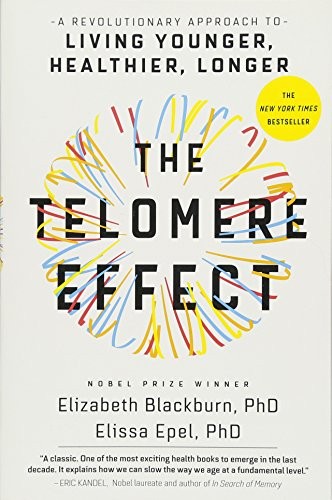
The Telomere Effect by Elizabeth Blackburn is a 2017 science book about aging, telomeres, cellular biology. Telomeres are the protective end-caps on chromosomes. Their length is a marker of cellular age, and their shortening is the cellular mechanism underlying many aspects of biological aging.
Summary
Elizabeth Blackburn shared the 2009 Nobel Prize in Physiology or Medicine for discovering telomerase, the enzyme that maintains and extends telomeres — the protective caps at the ends of chromosomes. The Telomere Effect, co-authored with health psychologist Elissa Epel, translates that research into a practical guide for maintaining cellular health. The central argument is that biological aging happens cell by cell, and that the rate at which your cells age is significantly influenced by lifestyle factors that people can actually change.
Telomeres shorten naturally each time a cell divides. When they become too short, the cell enters a state called senescence — it stops dividing and begins secreting inflammatory compounds that damage surrounding tissue. This senescent cell accumulation drives many of the features of aging and age-related disease. Blackburn and Epel argue that behaviors and psychological states that increase chronic stress accelerate telomere shortening, while protective factors — exercise, sleep, certain dietary patterns, social connection, and stress reduction practices — slow or even partially reverse it through upregulating telomerase.
Much of the book is devoted to the psychological mechanisms. Epel's contribution is particularly valuable here: she and Blackburn have conducted joint research on how perceived stress, rumination, and childhood adversity affect telomere length at the population level. Threat-based thinking — perceiving challenges as threats rather than opportunities — appears to accelerate cellular aging through neuroendocrine pathways involving cortisol and oxidative stress. Conversely, a sense of purpose, social support, and mindfulness practices are associated with longer telomeres, independent of diet and exercise.
The practical sections are specific without being prescriptive. Blackburn and Epel don't propose a single lifestyle protocol but rather a set of factors with varying evidence quality, explained clearly enough that readers can judge for themselves. The science is presented at a level appropriate for a general audience but without dumbing down the mechanism. For readers interested in what cellular aging actually means and what research-backed levers exist, this is an unusually credible source.
Talk to The Telomere Effect like its author wrote you back.
Get the ideas that fit your life — not generic summaries.
- Chat with the book
- Audiobook-style main ideas
- Adapts to your life and goals
- Helps you take action
Key takeaways
- 1.
Telomeres are the protective end-caps on chromosomes. Their length is a marker of cellular age, and their shortening is the cellular mechanism underlying many aspects of biological aging.
- 2.
Telomerase, the enzyme Blackburn discovered, can lengthen telomeres. Its activity is upregulated by exercise, sleep, and stress reduction, and downregulated by chronic stress and certain dietary patterns.
- 3.
Senescent cells — those with critically short telomeres — stop dividing and secrete inflammatory compounds that accelerate aging in surrounding tissue. Clearing senescent cells is an active area of longevity research.
- 4.
Chronic psychological stress, particularly threat-based appraisal and rumination, accelerates telomere shortening through cortisol and oxidative stress pathways that are now well-characterized.
- 5.
Childhood adversity produces measurable telomere shortening that can be observed decades later. The biology of stress is partly written into the genome early in life.
- 6.
Aerobic exercise is the intervention with the strongest evidence for telomerase activation and telomere maintenance across the available research.
- 7.
Mindfulness and stress reduction practices are associated with longer telomeres in controlled studies, independent of other lifestyle factors. The mechanism appears to involve reduced cortisol reactivity.
- 8.
Telomere length varies significantly among individuals of the same chronological age, reflecting accumulated biological wear. This divergence — biological versus chronological aging — is the framework Blackburn and Epel use to understand why people age so differently.
Discussion questions
Use these on your own, with a book club, or as chat starters in Superbook. Book club version, ready to copy or print →
- 1.
Blackburn won the Nobel Prize for the basic science; the book is about translating that science into behavior change. Where do you find the translation most convincing and where does it feel like a stretch?
- 2.
The book suggests that how you appraise challenges — as threats versus opportunities — affects your cellular aging. How much agency do you feel you have over your default appraisal style?
- 3.
Childhood adversity produces telomere shortening that persists into adulthood. How does that finding change how you think about the long-term costs of adverse early environments?
- 4.
Rumination — repetitively processing negative events — is identified as a significant accelerant of telomere shortening. What practices have you found actually interrupt rumination, as opposed to just managing it temporarily?
- 5.
The book is co-written by a biologist and a psychologist. How does that collaboration shape the book's argument, and where do the two disciplines seem to strain against each other?
- 6.
Exercise has the strongest evidence for telomere maintenance. If that's true, why do you think it remains so difficult to maintain for most people despite being free and well-evidenced?
- 7.
The research on social connection and telomere length suggests that isolation accelerates aging at the cellular level. How does that reframe what loneliness costs?
- 8.
Blackburn and Epel are careful about what the research supports versus what it suggests. Where did you find yourself wanting stronger claims than they were willing to make?
- 9.
Purpose and meaning are associated with longer telomeres. How would you measure whether your current life provides enough of either?
- 10.
The book covers telomeres in the context of cancer, where uncontrolled telomerase activation allows tumor cells to become immortal. How does that dual role — telomerase as both protective and potentially dangerous — shape how you think about the research?
- 11.
What's one specific change to your stress response or daily routine that you think would have the largest impact on cellular aging based on what the book describes?
- 12.
The authors note that telomere length is associated with disease risk at the population level but is not a reliable individual diagnostic. What does that limitation say about how to use this science personally?
Themes
Frequently asked questions
-
Is The Telomere Effect accessible without a biology background?
Yes. Blackburn and Epel write for a general audience and explain the cellular biology clearly with analogies. The mechanisms get technical in places but never in a way that requires prior knowledge. Readers with a science background may find some sections slower than necessary; general readers will find them clear.
-
Can you actually lengthen your telomeres?
Telomerase can extend telomeres, and its activity is measurably increased by exercise, sleep, and stress reduction in the research. However, the authors are careful to note that telomere maintenance — slowing shortening and occasionally repairing — is more realistic than dramatic lengthening. The goal is deceleration of biological aging, not reversal.
-
How long does The Telomere Effect take to read?
Around five to five and a half hours. At roughly 380 pages including notes, the main text reads at a steady pace. The later chapters with specific lifestyle protocols are shorter and more reference-like.
-
What are the most actionable recommendations in The Telomere Effect?
Regular aerobic exercise (the strongest evidence), consistent sleep, stress reduction practices like mindfulness or cognitive reframing, strong social connections, and a diet emphasizing whole foods over processed ones. None are novel, but the cellular mechanism the book explains makes them feel more concrete.
-
Who should read The Telomere Effect?
People who want to understand the biology of aging at the cellular level and connect it to lifestyle choices — particularly those who find the 'just exercise and eat well' advice too abstract to act on. Also valuable for healthcare providers explaining aging biology to patients. Readers purely interested in practical protocols may find the book more detailed than necessary.
Similar books
Lifespan: Why We Age—and Why We Don't Have To
David A. Sinclair
Outlive: The Science and Art of Longevity
Peter Attia
The Body Keeps the Score
Bessel van der Kolk
Why We Sleep
Matthew Walker
