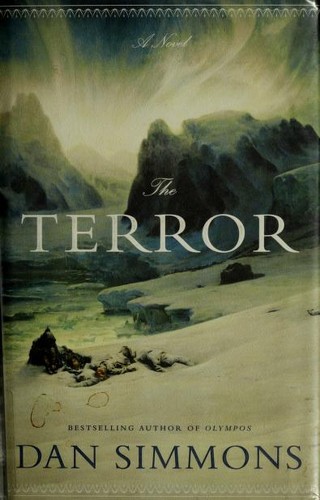
The Terror by Dan Simmons is a 2007 historical fiction book about survival and endurance, command and its failures, the arctic as adversary. The Terror uses historical fiction's license to argue that the Franklin Expedition's failure was not just bad luck but a product of the Victorian certainty that British methods and technology were universally sufficient.
Summary
The Terror is based on the real 1845 Franklin Expedition — two British Royal Navy ships, HMS Erebus and HMS Terror, sent to find the Northwest Passage, which vanished with all 129 men aboard. Simmons takes this historical mystery and turns it into an 850-page novel that combines meticulous historical reconstruction with supernatural horror. His central addition to the historical record is a creature from Inuit mythology stalking the ships and picking off men on the ice. The real cause of the expedition's failure — scurvy, lead poisoning from tinned food, starvation, the cold — is all here too. The monster is an amplification, not a replacement.
The book is fundamentally about the failure of Victorian imperial confidence — the arrogance of sending men into one of the most hostile environments on earth because they believed technology and the certainty of British civilization would be sufficient. Captain Franklin represents this hubris in its pure form; Captain Crozier, his Irish subordinate on Terror, represents something more pragmatic and more tragic. Crozier is the novel's moral center: a man who sees clearly what is happening, who has always been underestimated because of his origins, and who is too late to apply what he knows.
At 270,000 words, The Terror asks for real commitment. Simmons is not in a hurry. The ice, the dark, the progressive deterioration of ships and men are rendered in exhaustive detail that some readers find immersive and others find punishing. The supernatural element is handled with unusual restraint for horror fiction: the creature is present throughout but Simmons delays full revelation and the ambiguity is part of the point. The Inuit storyline — specifically Silence, a Netsilik woman who arrives and becomes central — adds a layer that some readers find profound and others find underdeveloped.
Readers who like their historical fiction long, dark, and serious will find this one of the great examples of the form. Those who want economy, pace, or the familiar pleasures of thriller structure will struggle. This is a book for the patient reader who wants to understand, as far as fiction can provide it, what the ice was like.
Talk to The Terror like its author wrote you back.
Get the ideas that fit your life — not generic summaries.
- Chat with the book
- Audiobook-style main ideas
- Adapts to your life and goals
- Helps you take action
Key takeaways
- 1.
The Terror uses historical fiction's license to argue that the Franklin Expedition's failure was not just bad luck but a product of the Victorian certainty that British methods and technology were universally sufficient.
- 2.
Crozier is the novel's moral intelligence: experienced, marginalized by his Irish origins, more competent than Franklin, and ultimately more honest about what they are facing.
- 3.
The supernatural creature is drawn from Inuit mythology and functions as the Arctic's response to colonial intrusion — the land fighting back in a form the expedition cannot comprehend.
- 4.
Simmons's detail is extensive and purposeful. The reader understands, viscerally, what hypothermia, scurvy, and lead poisoning do to the human body over months and years.
- 5.
The command structure of the Royal Navy is shown as catastrophically inflexible when flexible thinking is the only thing that can save lives.
- 6.
Silence's arc — an Inuit woman who holds knowledge the expedition needs but cannot communicate and does not fully offer — is the novel's most enigmatic element.
- 7.
The cold is a character. Simmons makes the Arctic feel like an active force with its own agenda, not merely a backdrop.
- 8.
The novel is an implicit argument about the price of certainty: Franklin's men die partly because they refuse to learn from people who have survived the Arctic for generations.
Discussion questions
Use these on your own, with a book club, or as chat starters in Superbook. Book club version, ready to copy or print →
- 1.
Franklin is portrayed as well-meaning but fatally overconfident. Crozier is more capable but unable to change the course of events. What does the novel say about the relationship between competence and authority?
- 2.
The supernatural element: did it add to the horror for you, or would a purely historical account have been more disturbing?
- 3.
Silence is one of the most discussed aspects of the novel. Did you find her storyline satisfying, underdeveloped, or something else? What do you think Simmons intended?
- 4.
The Inuit are the only people who know how to survive in this environment, and the expedition consistently fails to learn from them. What does Simmons want us to make of that?
- 5.
The book is very long and deliberately paced. At what point, if any, did you feel the length was working against the novel rather than for it?
- 6.
Crozier is Irish, which in the 1840s Royal Navy carried a specific class and cultural weight. How does Simmons use that aspect of his identity?
- 7.
The creature is never fully explained and its nature is left deliberately ambiguous. Does that restraint work for you?
- 8.
Several characters — Blanky, Goodsir, Bridgens — are given considerable space before they die. What effect does spending time with people you know will not survive have on you as a reader?
- 9.
The novel argues that the expedition's failure was a product of specific cultural assumptions. Does that feel like a retrospective judgment imposed on the Victorians, or does the evidence of the historical record support it?
- 10.
Goodsir, the expedition's naturalist, keeps detailed journals. What function does his observational voice serve in the novel?
- 11.
How does The Terror compare to other survival narratives you've read — Endurance, In the Kingdom of Ice? What does the fictional form add that non-fiction cannot?
- 12.
The ending Simmons imagines for Crozier is deliberately strange and ambiguous. Did it satisfy you?
Themes
Frequently asked questions
-
Is The Terror really that long? Is it worth it?
Yes, it is around 850 pages. Whether it's worth it depends on your tolerance for immersive, deliberate historical fiction. If you can commit to living inside the Arctic for the duration, it is one of the most fully realized historical novels of the last two decades. If you want pace and efficiency, it will frustrate you.
-
Is the TV show based on The Terror good?
The AMC series (2018) is excellent — thoughtful, terrifying, and very faithful in spirit to the novel. It compresses the narrative efficiently and has strong performances. Highly recommended as a companion to or substitute for the book, depending on your reading appetite.
-
What is The Terror about, briefly?
The doomed 1845 British expedition to find the Northwest Passage — the real historical mystery of 129 men who vanished in the Arctic — told as both rigorous historical fiction and supernatural horror, with a creature from Inuit mythology stalking the stranded ships.
-
Who shouldn't read this book?
Readers who want plot efficiency, regular forward momentum, or a relatively short commitment. The Terror is a slow, long, cold book. It also contains extended descriptions of physical suffering — starvation, frostbite, disease — that some readers will find difficult.
-
Is the supernatural element serious horror or more of a literary device?
Both. Simmons writes the creature scenes as genuine horror, and some of them are extremely effective. But the creature also functions as a metaphor — for the Arctic's hostility to European intrusion, for the unknown that the expedition's certainty refuses to acknowledge. You can read it at either level.
Similar books
Endurance: Shackleton's Incredible Voyage
Alfred Lansing
In the Kingdom of Ice: The Grand and Terrible Polar Voyage of the USS Jeannette
Hampton Sides
Dead Wake: The Last Crossing of the Lusitania
Erik Larson
All Quiet on the Western Front
Erich Maria Remarque
