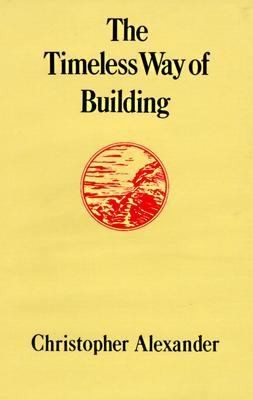
The Timeless Way of Building by Christopher Alexander is a 1979 philosophy book about design, architecture, pattern language. The quality without a name — the aliveness found in certain buildings and places — is real, objective, and can be cultivated by following patterns that arise from genuine human need.
Summary
Christopher Alexander's The Timeless Way of Building is a strange and ambitious book. It is the theoretical companion to A Pattern Language, the more practically famous work Alexander published two years earlier, and it attempts to do something that most design books never try: explain why some buildings, streets, and places feel alive and others feel dead, and provide a general theory of what makes the difference.
Alexander's central concept is what he calls "the quality without a name" — an attribute of buildings, towns, and outdoor spaces that makes them feel deeply right, that makes people genuinely comfortable and alive within them. He argues this quality is not subjective or cultural but is an objective feature of the world, grounded in the relationship between a structure and the needs of the human beings who inhabit it. A building that has it feels complete; one that lacks it feels hollow or forced. The claim is deliberately provocative, and Alexander defends it carefully through dozens of examples.
The mechanism by which this quality is produced, Alexander argues, is pattern language: a shared vocabulary of recurring spatial configurations — a window seat that catches afternoon light, a street narrow enough for people to make eye contact across, a garden path that forms naturally where feet have worn it — each of which expresses a proven solution to a recurring human need. The Timeless Way explains the theory; A Pattern Language gives 253 specific patterns. The two books are meant to be read together, but The Timeless Way is the harder and more philosophically complete of the two.
The book's influence has extended well beyond architecture. Software engineers in the 1990s adapted Alexander's pattern language concept into design patterns for code — the Gang of Four book, Extreme Programming, and much of what became Agile thinking all draw directly on Alexander. Urban planners, landscape architects, and interior designers have drawn on it in different ways. The prose is sometimes repetitive and occasionally mystical in a way that can frustrate pragmatically minded readers, but the core insight — that good design emerges from patterns that meet real human needs, rather than from the formal cleverness of designers — remains genuinely radical.
Talk to The Timeless Way of Building like its author wrote you back.
Get the ideas that fit your life — not generic summaries.
- Chat with the book
- Audiobook-style main ideas
- Adapts to your life and goals
- Helps you take action
Key takeaways
- 1.
The quality without a name — the aliveness found in certain buildings and places — is real, objective, and can be cultivated by following patterns that arise from genuine human need.
- 2.
Good design does not come from formal invention or aesthetic novelty. It comes from patterns discovered over generations that solve recurring human problems.
- 3.
A pattern language is a shared vocabulary for design: each pattern captures a solution to a problem in a specific context and connects to related patterns at larger and smaller scales.
- 4.
Buildings and towns feel alive when they are adapted to human needs at every scale, from the city down to the doorknob. Wholeness requires coherence at all levels simultaneously.
- 5.
The process of design is as important as its product. A building designed by its future users, iteratively and with real feedback, will feel more alive than one designed by experts imposing a vision.
- 6.
Modernist design failed, in Alexander's analysis, because it prioritized formal novelty over felt human experience. The resulting buildings made people feel worse without the designers noticing.
- 7.
Living structure emerges, it is not made. The role of a designer is to provide the conditions under which the right form can emerge, not to impose a predetermined solution.
- 8.
Software design patterns descend directly from Alexander's work — the pattern concept migrated from architecture to code precisely because it addressed the same problem: reusable solutions to recurring design forces.
Discussion questions
Use these on your own, with a book club, or as chat starters in Superbook. Book club version, ready to copy or print →
- 1.
Alexander argues that certain buildings feel alive and others dead. Can you name a specific building or place in your experience that exemplifies each, and what accounts for the difference?
- 2.
The claim that the quality without a name is objective, not subjective, is provocative. Do you find it convincing? What would count as evidence either way?
- 3.
Pattern languages assume that recurring problems have recurring solutions. When might this assumption fail — when might genuinely novel situations require genuinely novel answers?
- 4.
Alexander argues that modern architecture made buildings worse by prioritizing formal novelty. Where do you see an equivalent dynamic in another field?
- 5.
Software engineers adopted pattern language in the 1990s. Does the concept transfer cleanly to code, or is something lost in that translation?
- 6.
Alexander says living structure must emerge rather than be imposed. What does that mean for the role of the designer — is there still a designer if the process is emergent?
- 7.
The book was written in 1979. Which of Alexander's specific concerns about modern buildings feel more or less urgent from the perspective of urban design today?
- 8.
Alexander argues that users should be involved in designing the spaces they will inhabit. How much of your own built environment was shaped by its future users, and does it show?
- 9.
The prose is deliberately repetitive and incantatory in places. What is Alexander trying to achieve stylistically, and does it work for you?
- 10.
The quality without a name resists naming by design. Is there a conceptual domain in your own work where the most important thing also resists explicit formulation?
- 11.
Alexander's later work (The Nature of Order) extended these ideas into a general theory of wholeness and living structure. Does The Timeless Way feel like a complete argument or the beginning of one?
Themes
Frequently asked questions
-
Do I need to read A Pattern Language first?
No. The Timeless Way of Building is theoretically self-contained and was actually intended as the introduction to Alexander's project. Most readers come to it after A Pattern Language, which is more immediately practical, but either order works.
-
Why is this book relevant to software engineers?
Alexander's pattern concept — a named, recurring solution to a problem in a specific context — was directly adopted by software engineers in the 1990s, leading to the Gang of Four's Design Patterns and the broader patterns movement. Reading Alexander in the original gives context that most programming discussions lack.
-
Is the book too mystical to take seriously?
Depends on the reader. Alexander writes about life, aliveness, and wholeness in ways that some find profound and others find vague. The book works best if you treat the mystical language as pointing at something real that resists ordinary description, rather than as literal metaphysics.
-
What is pattern language in plain terms?
A vocabulary of proven spatial solutions to recurring design problems. Each pattern (e.g., 'window place,' 'activity pockets') describes a problem, explains why it matters, and gives a structural solution that has worked repeatedly across cultures and time.
-
Who should read The Timeless Way of Building?
Architects, urban designers, software engineers interested in the origins of design patterns, and anyone who has strong intuitions about why some environments feel right and others wrong but has never had a vocabulary to analyze the difference.