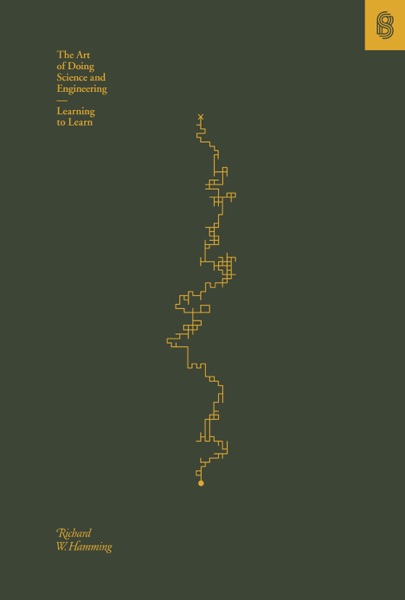
The Art of Doing Science and Engineering by Richard Hamming is a 1997 science book about learning, problem-solving, creativity. Work on important problems. Hamming's defining question: 'What are the most important problems in your field, and why aren't you working on them?'
Summary
Richard Hamming's book is based on a course he taught at the Naval Postgraduate School in the late 1980s, after a long career at Bell Labs where he made foundational contributions to information theory and computer science — the Hamming distance, Hamming codes, and various contributions to numerical methods all bear his name. The book is not a textbook. It is an attempt to teach something harder: how to have a successful scientific career, how to do work that matters, and how to think about problems so that you work on the right ones.
Hamming's central question is why some scientists do great work and others, equally intelligent and trained, do ordinary work. His answer involves several factors: the courage to work on important problems rather than safe ones, the willingness to tolerate ambiguity while pursuing a clear long-term vision, and what he calls "the open door" policy — knowing enough about adjacent fields that luck, when it arrives, finds you prepared. He famously asked colleagues at Bell Labs, "What are the most important problems in your field, and why aren't you working on them?" Many found the question annoying. Hamming thought annoyance was the point.
The technical chapters cover digital filtering, information theory, coding theory, computer simulations, and artificial intelligence as it was understood in 1990. These sections age variably. The AI chapters are more historical document than current guide, though Hamming's methodological skepticism about what machines can actually do is worth reading alongside contemporary claims. The information theory and error-correcting code chapters hold up better, both because Hamming knew the material intimately and because the ideas are foundational.
What gives the book unusual staying power is the recurring thread about the character of good thinking. Hamming returns repeatedly to the same themes: study your failures as carefully as your successes, convert fuzzy problems into well-defined ones before trying to solve them, and recognize that style — how you present ideas — is not separate from the ideas themselves. The book is uneven in structure and sometimes repetitive, reflecting its origins as a lecture series, but no other book covers this particular territory in quite this way. It is a manual for thinking well written by someone who spent forty years doing it.
Talk to The Art of Doing Science and Engineering like its author wrote you back.
Get the ideas that fit your life — not generic summaries.
- Chat with the book
- Audiobook-style main ideas
- Adapts to your life and goals
- Helps you take action
Key takeaways
- 1.
Work on important problems. Hamming's defining question: 'What are the most important problems in your field, and why aren't you working on them?'
- 2.
Luck favors prepared minds. Serendipitous discoveries require enough knowledge of neighboring fields to recognize what you've stumbled upon.
- 3.
Convert vague problems into well-defined ones before attempting solutions. Most wasted effort goes into solving the wrong version of a problem.
- 4.
Study your failures as carefully as your successes. The pattern of errors is often more instructive than the pattern of wins.
- 5.
Style matters in science. A discovery that cannot be communicated clearly is partly wasted. Writing, presentation, and clarity are core professional skills.
- 6.
The bandwidth of human attention is limited. Spending it on easily publishable safe problems is a kind of career failure, even if it looks like productivity.
- 7.
Long-term thinking requires working backward from where you want to be in ten years, not forward from what's currently tractable.
- 8.
Tolerance for ambiguity is a professional skill. Important problems often stay fuzzy for years before yielding to the right framing.
Discussion questions
Use these on your own, with a book club, or as chat starters in Superbook. Book club version, ready to copy or print →
- 1.
Hamming asked colleagues why they weren't working on the most important problems in their field. What would your honest answer be to that question in your own work?
- 2.
He argues that working on safe, publishable problems is a kind of failure. Where do you draw the line between ambition and recklessness in choosing what to work on?
- 3.
Hamming claims that luck is preparation meeting opportunity. Think of a lucky break in your own career — how much was it preparation, and how much was chance?
- 4.
The book insists style is not separate from substance in science. Has a poorly presented idea ever failed to get traction it deserved, in your experience?
- 5.
Hamming was known for asking uncomfortable questions. What uncomfortable question about your work would you most want someone to ask, and most dread hearing?
- 6.
The book is based on lectures from the 1990s and shows its age in places. How do you read a text that mixes durable insight with dated material?
- 7.
Hamming emphasizes converting fuzzy problems into well-defined ones. What is a problem in your professional life that is still too vague to solve?
- 8.
He describes how some people leave their office door open and others closed. What do you do that is equivalent — inviting or blocking unexpected intellectual collisions?
- 9.
Hamming argues that most people shy away from great work because it requires risking failure on harder problems. How much of your current work is genuinely at risk of failure?
- 10.
What does 'doing great work' mean in a field that isn't science or engineering? Does Hamming's framework translate?
- 11.
The book is self-evidently written by someone who accomplished important things. Does that authority make you more or less critical of his prescriptions?
- 12.
Hamming spent his career at Bell Labs, an environment that was unusually permissive about pure research. How much of his advice is transferable to normal institutions?
Themes
Frequently asked questions
-
Is this book worth reading if I'm not a scientist or engineer?
Yes, though you'll skim some technical chapters. The meta-level argument about how to have a productive intellectual career, how to choose important problems, and how to think clearly translates well beyond science and engineering.
-
What is the most famous idea in the book?
The question Hamming asked colleagues: 'What are the most important problems in your field, and why aren't you working on them?' It sounds simple but most people find it difficult to answer honestly, which was Hamming's point.
-
How technical is the book?
Moderately. The chapters on digital filtering, information theory, and coding require some mathematical background. The chapters on research philosophy, learning, and career are accessible to any reader. Many people read selectively.
-
How does this compare to Surely You're Joking, Mr. Feynman?
Feynman is more entertaining and anecdotal; Hamming is more prescriptive and methodological. Feynman shows what great scientific thinking looks like; Hamming tries to explain how to cultivate it. Both are valuable.
-
Why isn't this book more widely known?
It has a technical audience in its title and some dense chapters that scare off casual readers. It has been steadily rediscovered online — particularly in software engineering communities — but never reached mainstream audiences the way simpler advice books do.
Similar books
Surely You're Joking, Mr. Feynman!
Richard P. Feynman

Mastery
Robert Greene
Range: Why Generalists Triumph in a Specialized World
David Epstein
Peak: Secrets from the New Science of Expertise
Anders Ericsson and Robert Pool
