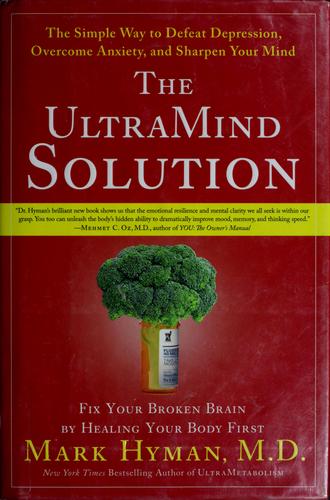
The UltraMind Solution by Mark Hyman is a 2008 health book about brain health, nutrition, functional medicine. Most common mental health problems are symptoms of underlying physical imbalances — nutritional, hormonal, inflammatory, or toxic — not purely psychiatric disorders.
Summary
The UltraMind Solution is Mark Hyman's argument that most mental and cognitive problems — depression, anxiety, ADHD, brain fog, memory decline — are not primarily psychiatric disorders but symptoms of underlying physical imbalances. Hyman, a functional medicine physician, contends that the conventional approach of matching psychiatric symptoms to drugs ignores the root causes: nutritional deficiencies, toxins, infections, blood sugar dysregulation, hormonal imbalances, and chronic inflammation. Fix the body, he argues, and the brain follows.
The book is organized around seven core systems that Hyman believes govern brain function: nutrition, hormones, inflammation, digestion, detoxification, energy metabolism, and the mind-body connection. He walks through each in detail, explaining how imbalances in any one system can produce recognizable cognitive or emotional symptoms, and providing self-assessment quizzes to help readers identify their personal weak points. The central protocol is a six-week plan involving dietary changes, targeted supplementation, stress reduction, and sleep optimization.
Hyman is particularly emphatic about sugar and processed food. He argues that the modern diet drives insulin resistance, systemic inflammation, and gut dysbiosis, all of which impair brain chemistry in measurable ways. He also gives significant attention to nutrient deficiencies — omega-3 fatty acids, B vitamins, magnesium, zinc — that are common in the general population and have documented effects on mood and cognition. On toxins, he covers heavy metals and environmental chemicals that accumulate in tissue and disrupt neurological function.
The book's weakness is its scope. Hyman covers so much ground that some sections read as catalogues of tests to order rather than coherent arguments. The self-assessment quizzes are useful entry points, but the underlying research ranges from well-established to speculative. Readers who engage critically will find genuinely useful frameworks for thinking about the brain-body connection; those looking for a simple protocol may find the breadth overwhelming. As a corrective to the idea that depression is simply a chemical imbalance requiring a pill, it makes its case effectively.
Talk to The UltraMind Solution like its author wrote you back.
Get the ideas that fit your life — not generic summaries.
- Chat with the book
- Audiobook-style main ideas
- Adapts to your life and goals
- Helps you take action
Key takeaways
- 1.
Most common mental health problems are symptoms of underlying physical imbalances — nutritional, hormonal, inflammatory, or toxic — not purely psychiatric disorders.
- 2.
The gut-brain connection is real and bidirectional. Dysbiosis and intestinal permeability can produce depression and anxiety as reliably as any psychological trigger.
- 3.
Nutrient deficiencies — particularly omega-3s, B vitamins, vitamin D, zinc, and magnesium — are widespread and directly impair mood, memory, and focus.
- 4.
Chronic low-grade inflammation, driven largely by diet and stress, damages neurons and disrupts the neurotransmitter systems targeted by psychiatric drugs.
- 5.
Blood sugar instability is a common and underappreciated cause of mood swings, brain fog, and difficulty concentrating.
- 6.
Heavy metals and environmental toxins accumulate in the nervous system and can mimic or worsen psychiatric conditions, but are rarely tested for in conventional care.
- 7.
Sleep, exercise, and stress reduction are not lifestyle extras — they are essential inputs to the brain chemistry that governs mood and cognition.
- 8.
A six-week elimination protocol targeting the seven core systems can produce measurable cognitive and emotional improvements before any drug intervention.
Discussion questions
Use these on your own, with a book club, or as chat starters in Superbook. Book club version, ready to copy or print →
- 1.
Hyman argues that conventional psychiatry treats symptoms rather than root causes. Has your own experience with mental health care focused on symptoms or underlying biology?
- 2.
Which of Hyman's seven core systems — nutrition, hormones, inflammation, digestion, detoxification, energy, mind-body — seems most relevant to your own health patterns?
- 3.
The book makes a strong case against processed sugar and refined carbohydrates. What would it realistically take for you to change your relationship with those foods?
- 4.
Hyman argues that most people have nutrient deficiencies affecting brain function. How would you even know if this were true for you, and what would you do about it?
- 5.
How much trust do you place in functional medicine versus conventional psychiatry? Where does the evidence feel solid to you, and where does it feel speculative?
- 6.
The gut-brain axis is central to Hyman's framework. Does the idea that your digestion affects your mood match anything you've noticed in your own life?
- 7.
Hyman gives significant attention to environmental toxins. How much does that concern feel actionable versus anxiety-inducing given how many exposures are unavoidable?
- 8.
The self-assessment quizzes in the book are designed to help readers self-diagnose. What are the risks of self-diagnosis in a book like this, and how would you navigate them?
- 9.
Hyman recommends a long list of supplements. How do you think about the difference between targeted supplementation and general pill-taking?
- 10.
How does the framing of depression as a physical illness rather than a psychological one affect how you think about stigma and treatment?
- 11.
If you ran Hyman's six-week protocol, which three changes would be easiest to make and which would be hardest?
- 12.
Hyman's approach requires significant personal investment — tests, dietary overhaul, supplements, lifestyle change. Who has realistic access to this kind of health care?
Themes
Frequently asked questions
-
What is The UltraMind Solution about?
The book argues that depression, anxiety, ADHD, and brain fog are frequently symptoms of physical imbalances — nutritional deficiencies, inflammation, hormonal disruption, gut problems, or toxins — rather than purely psychiatric disorders. Hyman provides a six-week protocol to identify and address these root causes.
-
Is The UltraMind Solution evidence-based?
It draws on real research in nutrition, inflammation, and functional medicine, but the quality of evidence varies. Some recommendations are well-supported; others reflect Hyman's clinical experience more than rigorous trials. Critical readers should check primary sources before acting on the most aggressive recommendations.
-
Who should read The UltraMind Solution?
People who have struggled with mood, focus, or cognitive issues and found conventional treatment unsatisfying will get the most from it. It is also useful for anyone interested in the connections between diet, gut health, and mental function. It requires willingness to engage with a detailed self-assessment and protocol.
-
How long does it take to read The UltraMind Solution?
Around six to seven hours at average reading pace. The book is dense with self-assessment quizzes and detailed supplement protocols, so many readers spend additional time with those sections. Reading it in parallel with starting some of the dietary changes works well.
-
What is the most actionable idea in The UltraMind Solution?
Probably the dietary cleanup: eliminating sugar, processed food, and gluten for six weeks while adding omega-3 fatty acids and the most commonly deficient nutrients. This is both the most accessible intervention and the one with the strongest supporting evidence for mood and cognitive effects.