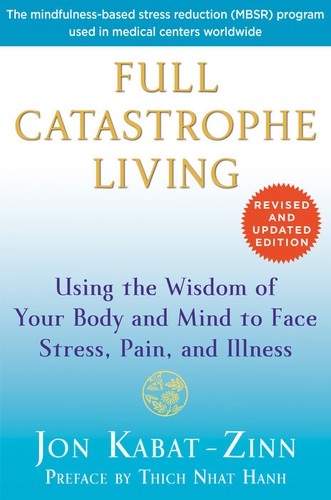
Full Catastrophe Living by Jon Kabat-Zinn is a 1990 health book about mindfulness, stress reduction, chronic pain. Mindfulness — paying deliberate, nonjudgmental attention to present-moment experience — is both a practice and a mode of being that can be cultivated and that has measurable effects on health and wellbeing.
Summary
Full Catastrophe Living is Jon Kabat-Zinn's foundational text on Mindfulness-Based Stress Reduction (MBSR), the eight-week clinical program he developed at the University of Massachusetts Medical School in 1979. The book is both a complete manual for the program and a philosophical argument for why mindfulness — paying deliberate, nonjudgmental attention to present-moment experience — is a foundational health intervention. Now in a revised and updated edition, it remains the most comprehensive and clinically grounded treatment of secular mindfulness practice available.
Kabat-Zinn developed MBSR to help patients with chronic pain, anxiety, and stress-related illness for whom medicine had little more to offer. The program synthesizes Buddhist meditation practices, yoga, and psychological skills training into a secular, evidence-testable format. The title comes from Zorba the Greek, who speaks of accepting "the full catastrophe" of life — the suffering, impermanence, and complexity — not as defeat but as the total human experience that mindfulness practice allows you to meet with greater wisdom and equanimity.
The first half of the book introduces the core practices: mindful breathing, the body scan, mindful yoga, sitting meditation, and walking meditation. Kabat-Zinn's instructions are unusually detailed and careful, and the practices are introduced gradually over the eight-week curriculum. He is specific about common obstacles — the wandering mind, physical discomfort during meditation, frustration with progress — and addresses them with the patience of a teacher who has worked with thousands of patients.
The second half covers applications: chronic pain, anxiety, heart disease, cancer, and general stress. In each area, Kabat-Zinn reviews the clinical evidence for MBSR's effectiveness (which has grown enormously since the first edition) and explains the theoretical mechanisms — how changing one's relationship to sensations, thoughts, and emotions alters physiological responses. The book makes a sustained argument that the mind and body are inseparable, and that a medicine that treats them as such will be more effective than one that treats them separately. This was a more radical claim in 1990 than it is now; the clinical evidence since then has substantially supported it.
Talk to Full Catastrophe Living like its author wrote you back.
Get the ideas that fit your life — not generic summaries.
- Chat with the book
- Audiobook-style main ideas
- Adapts to your life and goals
- Helps you take action
Key takeaways
- 1.
Mindfulness — paying deliberate, nonjudgmental attention to present-moment experience — is both a practice and a mode of being that can be cultivated and that has measurable effects on health and wellbeing.
- 2.
The body scan is a foundational practice that develops the ability to attend to physical sensations without reacting automatically — a skill that transfers to pain, stress, and emotional reactivity in daily life.
- 3.
Chronic pain is often amplified by the catastrophizing, anticipation, and resistance that surround the painful sensation; mindfulness practice can reduce suffering without reducing the underlying sensation.
- 4.
The eight-week MBSR curriculum provides a structured path for developing a regular meditation practice; the structure, frequency, and duration of practice are as important as the technique.
- 5.
Automatic pilot — moving through life on habitual patterns without awareness — is the baseline human condition; mindfulness practice interrupts autopilot and creates the possibility of responding rather than reacting.
- 6.
Thoughts are not facts: one of the key insights developed in MBSR is observing thoughts as mental events rather than identifying with them, which reduces rumination, anxiety, and depression.
- 7.
Mindfulness is not relaxation, though relaxation often follows it; the practice involves attending to whatever is present, including difficult states, rather than seeking pleasant ones.
- 8.
The MBSR program has accumulated substantial clinical evidence since 1979: randomized trials show effects on anxiety, depression, chronic pain, immune function, and quality of life in diverse clinical populations.
Discussion questions
Use these on your own, with a book club, or as chat starters in Superbook. Book club version, ready to copy or print →
- 1.
Kabat-Zinn describes mindfulness as paying attention in a particular way — on purpose, in the present moment, nonjudgmentally. How much of your daily experience qualifies as mindful by that definition?
- 2.
He argues that chronic pain is often amplified by the mental relationship we have with pain rather than by the pain signal itself. Does that distinction — between pain and suffering — resonate with your experience?
- 3.
MBSR was designed for people with serious health conditions. How does the clinical origin of the practice compare to the wellness context in which mindfulness is now typically promoted?
- 4.
The body scan is the first formal practice he introduces. Have you tried a body scan? What was the experience, and how did it compare to his description?
- 5.
Kabat-Zinn is careful to distinguish mindfulness from religion while acknowledging its Buddhist origins. How do you navigate a practice that was developed in a religious context and presented in a secular one?
- 6.
Automatic pilot is his term for our habitual, unreflective mode of functioning. What are your most significant automatic pilot behaviors, and what would interrupting them look like?
- 7.
He argues that thoughts are not facts — observing them as mental events rather than truths. Have you experienced that shift in relationship to a thought that was causing you suffering? How did it happen?
- 8.
The book is long and detailed. Is it better suited to someone who wants to practice MBSR seriously or to someone exploring mindfulness conceptually? What kind of reader were you when you approached it?
- 9.
Kabat-Zinn covers the evidence for MBSR's clinical effectiveness. Does scientific validation change how you approach a contemplative practice, or does it feel irrelevant to whether you benefit?
- 10.
He argues the mind and body are inseparable. How does that claim challenge or confirm what you've experienced in your own health?
- 11.
The book was first published in 1990. Mindfulness is now ubiquitous in popular culture. Has its mainstreaming diluted what Kabat-Zinn describes here?
- 12.
If you were to commit to the eight-week MBSR program, what would be the practical challenges? What would need to change in your daily schedule?
Themes
Frequently asked questions
-
Do I need a teacher to use Full Catastrophe Living?
The book is designed to be usable independently, and many people have used it to self-guide through the MBSR curriculum. That said, the eight-week program benefits from group support and a trained teacher's guidance, particularly for working through difficulties in practice. Kabat-Zinn acknowledges this throughout and recommends formal MBSR programs when available.
-
Is mindfulness as described here religious?
Kabat-Zinn explicitly presents MBSR in secular terms, and the book contains no religious requirement or instruction. The practices derive from Buddhist meditation, and Kabat-Zinn acknowledges this origin, but the program is designed to be accessible to people of any or no religious tradition.
-
What is the evidence that MBSR works?
Extensive, particularly in the decades since the first edition. Randomized controlled trials have demonstrated MBSR's effectiveness for anxiety, depression, chronic pain, stress, immune function, and quality of life across diverse clinical populations. It is now recommended by the UK's National Institute for Health and Care Excellence for recurrent depression.
-
How long is the full MBSR program?
Eight weeks, with daily home practice of forty-five to sixty minutes. The program includes eight weekly group sessions, a full-day retreat, and a range of formal and informal practices. The book provides everything needed to self-guide through the curriculum, though the group setting of a formal program adds important elements.
-
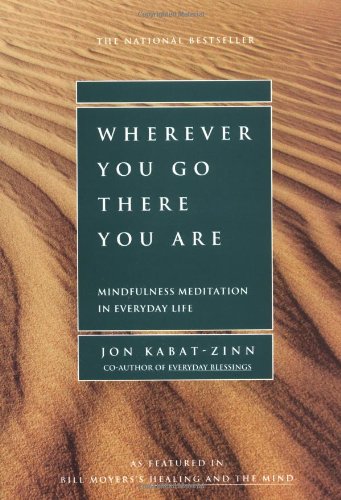
How does Full Catastrophe Living compare to Wherever You Go, There You Are by the same author?
Full Catastrophe Living is a comprehensive clinical and practical manual for MBSR. Wherever You Go, There You Are is a more accessible introduction to mindfulness as a way of life, organized around short reflections rather than a structured program. Most readers benefit from Wherever You Go first and Full Catastrophe Living when they want to practice more seriously.