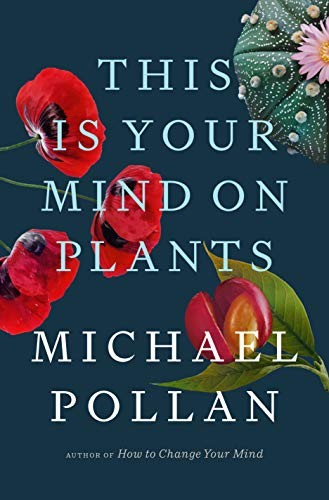
This Is Your Mind on Plants by Michael Pollan is a 2021 science book about consciousness, psychoactive plants, drug policy. Every culture uses psychoactive plants, but which ones are permitted versus prohibited reflects political and commercial interests as much as pharmacology.
Summary
Michael Pollan's third exploration of the human relationship with plants focuses on three psychoactive substances: opium, caffeine, and mescaline. The book is part cultural history, part pharmacology, and part personal experiment — Pollan grows poppies in his garden, quits caffeine for three months, and travels to the Southwest to participate in a Native American peyote ceremony. The result is an argument that what a culture decides to classify as a drug versus an acceptable plant extract tells you something important about that culture's values and anxieties.
The opium chapter is the oldest of the three, originally written for Harper's Magazine in 1997 then spiked under legal pressure. Its publication here, finally complete, tracks Pollan's nervous year of growing opium poppies — technically legal to grow ornamentally, illegal to process — and the Drug Enforcement Administration's contradictory enforcement. Pollan uses it to examine how a plant central to global agriculture, medicine, and trade became America's most feared substance. The chapter doubles as a meditation on how government power shapes which pleasures are permissible.
The caffeine chapter is the most universal. Pollan argues that the global adoption of coffee and tea in the seventeenth century functionally transformed Western civilization: the shift from alcohol as the daily beverage to caffeine cleared minds, lengthened working days, and may have catalyzed the Enlightenment. On quitting for three months, Pollan experiences the full depth of dependency most people never notice because they never stop. Sleep quality improves dramatically. The cognitive cost of absence, and the horror of returning withdrawal, reframes caffeine as perhaps the most widely accepted addiction in human history.
The mescaline chapter is the most personal and the most culturally sensitive. Pollan attends a Native American Church ceremony with permission but acknowledges he cannot fully enter what is for its practitioners a religious sacrament. He situates mescaline's history in the colonial suppression of indigenous spirituality and the twentieth-century drug war's particular targeting of peyote. The book lands on a clear thesis: the story of psychoactive plants is a story of power — who gets to alter consciousness, under what conditions, and why.
Talk to This Is Your Mind on Plants like its author wrote you back.
Get the ideas that fit your life — not generic summaries.
- Chat with the book
- Audiobook-style main ideas
- Adapts to your life and goals
- Helps you take action
Key takeaways
- 1.
Every culture uses psychoactive plants, but which ones are permitted versus prohibited reflects political and commercial interests as much as pharmacology.
- 2.
Caffeine is the world's most widely consumed psychoactive drug, and most users are dependent in a clinical sense without ever realizing it.
- 3.
Quitting caffeine for even a few weeks dramatically improves sleep architecture, revealing how much the stimulant suppresses natural rhythms.
- 4.
The global spread of coffee and tea in the 17th century likely helped catalyze intellectual and commercial revolutions by replacing alcohol with a stimulant.
- 5.
Opium poppy cultivation sits in a legal gray zone that reveals the arbitrary and politically motivated nature of drug scheduling.
- 6.
Mescaline from peyote has been a central sacrament in Native American spiritual practice for millennia, and its suppression was tied directly to colonialism.
- 7.
Pollan argues that the desire to alter consciousness is a basic human drive, one that no amount of legal prohibition has ever eliminated.
- 8.
Plant-human relationships are co-evolutionary: plants that provide desirable psychoactive effects get grown, spread, and protected by the humans they affect.
Discussion questions
Use these on your own, with a book club, or as chat starters in Superbook. Book club version, ready to copy or print →
- 1.
Pollan distinguishes between a drug and an acceptable psychoactive substance. Where do you draw that line personally, and how much of that reflects cultural conditioning?
- 2.
How did the caffeine chapter change how you think about your own morning routine? Are you dependent in the sense Pollan describes?
- 3.
The opium chapter was spiked by a magazine under legal pressure. What does that say about the relationship between drug law and free speech?
- 4.
Pollan argues caffeine helped produce the Enlightenment by changing how Europeans thought and worked. Does that causal claim seem plausible to you?
- 5.
What is lost when a substance used for centuries in sacred contexts gets reclassified as a controlled drug by an outside government?
- 6.
If you tried quitting caffeine for a month, what do you think you would find? Have you ever done it?
- 7.
The book suggests the desire to alter consciousness is universal and irrepressible. Does that change how you think about drug policy?
- 8.
Pollan attends a peyote ceremony as a sympathetic outsider. Where is the line between respectful documentation and appropriation?
- 9.
Which of the three plants — opium, caffeine, mescaline — do you think gets the most distorted treatment in American culture, and why?
- 10.
Do you think the legal status of a substance changes your subjective sense of how harmful or beneficial it is?
- 11.
Pollan writes about his discomfort growing poppies while knowing the legal risk. Has there ever been a law you found yourself in quiet, deliberate conflict with?
- 12.
The book frames plant relationships as co-evolutionary. Does thinking of your morning coffee as something the coffee plant evolved to deliver to you change how it feels?
Themes
Frequently asked questions
-
Is This Is Your Mind on Plants worth reading?
Yes, particularly if you enjoyed Pollan's previous work or have an interest in drug policy, consciousness, or cultural history. The caffeine chapter alone is a genuine revelation for most readers. The mescaline chapter is more personal and more cautious, which some readers find honest and others find incomplete.
-
Do you need to have read Pollan's other books first?
No. Each chapter stands alone, and Pollan provides enough context that readers new to his work won't be lost. Familiarity with The Omnivore's Dilemma or How to Change Your Mind adds texture but isn't required.
-
How long is This Is Your Mind on Plants?
Around 256 pages, which puts it at roughly four to five hours of reading time. It's one of Pollan's shorter books. The three-chapter structure makes it easy to read in discrete sessions.
-
What's the most surprising idea in the book?
For most readers, the caffeine chapter. The claim that global caffeine adoption in the 17th century may have contributed to the Enlightenment — because it sobered up a Europe that drank alcohol all day — is provocative and reasonably well-supported.
-
Who should read this book?
Anyone interested in how drug laws are made, in the pharmacology of everyday stimulants, or in the cultural politics of consciousness. It also works well for readers coming off Pollan's food books who want something adjacent but distinct.