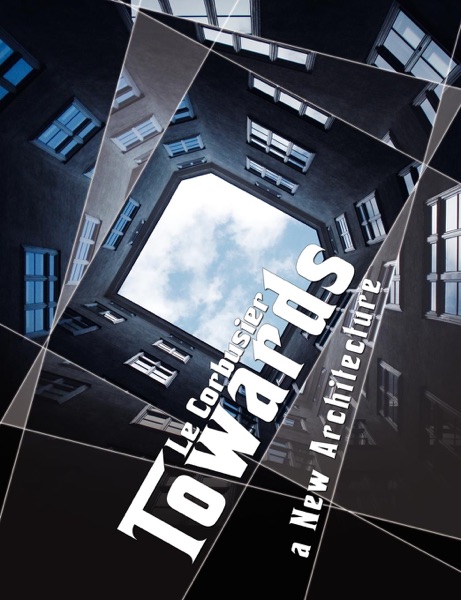
Towards a New Architecture by Le Corbusier is a 1923 philosophy book about modernism, architecture and society, form and function. A house is a machine for living in — meant not as a cold reduction but as a call for architecture to apply the clarity and economy that engineering had achieved in ships, cars, and aircraft.
Summary
Published in French in 1923 as Vers une architecture, this is one of the most influential and most contested manifestos in the history of design. Le Corbusier — born Charles-Édouard Jeanneret — was not yet forty when he assembled these essays from his journal L'Esprit Nouveau, and the book reads with the impatience of someone who believes an entire civilization is making avoidable errors. His target is the architecture profession as it existed: backward-looking, ornamental, disconnected from the industrial revolution that had already transformed everything else.
The argument comes in several movements. Engineers, Corbusier insists, are the real architects of the twentieth century. Grain silos, steamships, automobiles, and aircraft are beautiful precisely because their forms are governed entirely by function and made with industrial methods — no ornament, no historical pastiche. Architects, by contrast, are still designing like it is 1870. The book contains some of his most memorable phrases: a house is a machine for living in; the architect's task is to establish emotional relationships by means of raw materials. He does not mean these as cold propositions but as liberating ones.
The second movement is a primer on the primary forms — spheres, cones, cylinders, cubes — which Corbusier calls the great primary forms that light reveals well. He traces them through Greek temples, Roman engineering, and contemporary factories. The argument is that these forms carry universal emotional weight independent of culture and style. This is also where the book is most dated: the universalism was contested in his own time and has been demolished more thoroughly since.
Reading the book in the 2020s means holding two things simultaneously: the undeniable power of the ideas as they circulated in the 1920s and the scale of the social damage caused by their application — specifically by the urban housing projects that followed from the machine-for-living logic. The ideas are important enough to engage with seriously, and flawed enough to require that same seriousness.
Talk to Towards a New Architecture like its author wrote you back.
Get the ideas that fit your life — not generic summaries.
- Chat with the book
- Audiobook-style main ideas
- Adapts to your life and goals
- Helps you take action
Key takeaways
- 1.
A house is a machine for living in — meant not as a cold reduction but as a call for architecture to apply the clarity and economy that engineering had achieved in ships, cars, and aircraft.
- 2.
Corbusier believed the engineer was outpacing the architect: industrial forms created purely through functional logic had achieved a beauty that tradition-bound architecture no longer could.
- 3.
The primary forms — sphere, cone, cylinder, cube, pyramid — were for Corbusier universally beautiful because they are unambiguous and light reveals their geometry clearly.
- 4.
Ornament was not merely unnecessary but actively dishonest: it concealed structure and covered over the functional logic that should have generated the form.
- 5.
The Parthenon stood as his model of perfection not for its cultural content but for its dimensional refinement — he returned to it obsessively as evidence that formal precision produces emotional power.
- 6.
Mass production was an opportunity, not a threat: standardized housing produced by industrial methods could solve the crisis of urban overcrowding while creating genuinely modern forms.
- 7.
His famous Five Points of Architecture — pilotis, roof gardens, free plan, horizontal windows, free facades — were meant to be the direct formal consequences of concrete construction's structural freedom.
- 8.
The book ends with an explicit warning: architecture or revolution. Without rational urbanism, Corbusier believed social upheaval was inevitable. This was the politics embedded in the formalism.
Discussion questions
Use these on your own, with a book club, or as chat starters in Superbook. Book club version, ready to copy or print →
- 1.
Corbusier's equation of beauty with functional logic has been influential and contested. Do you find it persuasive? Can you think of designed objects that are beautiful for reasons that have nothing to do with function?
- 2.
The book was written partly as an attack on the architecture profession. Is there a field you know well where a similar attack — on tradition versus function — would be valid today?
- 3.
He treats ships, cars, and aircraft as models for architecture. What are the limits of that analogy? Is a house actually like a machine?
- 4.
The 'machine for living in' became a slogan used to justify housing projects that caused enormous social harm. Does the failure of those applications invalidate the original idea?
- 5.
Corbusier's universalism — the claim that primary forms have cross-cultural emotional weight — has been challenged on historical and anthropological grounds. How seriously should we take it?
- 6.
His critique of ornament echoes Adolf Loos's 'Ornament and Crime' from 1913. Is that critique still valid in contemporary design? Has ornament been rehabilitated?
- 7.
The Parthenon recurs throughout the book as a model of dimensional precision. What does it mean to use a Greek temple as the ideal for a theory of industrial modernity?
- 8.
The book was a manifesto as much as an argument. What are the risks of thinking about architecture — or any discipline — through the frame of the manifesto?
- 9.
Corbusier's urbanism led, in the hands of his followers, to demolishing historic neighborhoods to build towers. Who bears responsibility: the theorist or the practitioners who applied the theory?
- 10.
Looking at architecture built under his influence — from Chandigarh to social housing blocks across Europe — how do you evaluate the balance of aesthetic success and human failure?
- 11.
What would a contemporary equivalent of this book look like? Which design field most needs the kind of confrontation with industry and function that Corbusier was proposing?
- 12.
He believed architecture could prevent revolution. Do you think formal and spatial design has real social and political power — or is that a kind of architectural overreach?
Themes
Frequently asked questions
-
Is Towards a New Architecture still relevant?
Yes, as intellectual history — it is one of the founding documents of architectural modernism, and understanding it helps explain both the built environment of the twentieth century and many of its failures. As a practical guide it must be read critically, given what its ideas enabled when applied at urban scale.
-
How difficult is Towards a New Architecture to read?
Moderately difficult. The prose is combative and declarative rather than analytical, and the argument moves by assertion and visual example rather than by sustained reasoning. The original photographs of grain silos, steamships, and houses are essential to the book's logic and are included in standard editions.
-
What does 'a house is a machine for living in' mean?
It is a call for architecture to achieve the economy and formal clarity that engineers had achieved in designing ships and aircraft — forms determined entirely by function. Corbusier meant it as liberation from historical pastiche, not as a reduction of home life to mechanism.
-
Who should read this book?
Architecture and design students, urban planners, and anyone trying to understand the intellectual roots of twentieth-century built form. It is also useful for readers interested in how ideas become doctrine and how doctrine produces unintended consequences at scale.
-
What are the book's main weaknesses?
Its universalism — the claim that primary geometric forms produce the same emotional response across cultures — has not held up. Its politics, embedded in the argument for rational urbanism, contributed to urban renewal policies that destroyed communities. And its dismissal of ornament and historical continuity has been persuasively critiqued by architects from Venturi to Koolhaas.
Similar books
The Design of Everyday Things
Donald Norman
The Timeless Way of Building
Christopher Alexander
Zen and the Art of Motorcycle Maintenance
Robert Pirsig
The Art of Doing Science and Engineering
Richard Hamming
